




Backed by Data Point Capital and Uncorrelated Ventures : FloCareer raised US$5.7M in Series A funding.

See how Developers Think, Not Just What They Submit

Get a complete view of a developer’s problem-solving skills through a fully interactive, AI-driven coding interview. Candidates think aloud, ask questions, break down problems, and write code — while your AI interviewer probes, evaluates, and scores with human-level depth.

What’s Assessed

Most Coding Interviews only grade output. Our AI evaluates how candidates think, communicate, and problem-solve in a live technical conversation — revealing strengths and gaps that static challenges can’t detect.

1. Problem-Solving Approach

We evaluate the candidate’s ability to break down the problem, choose an approach, and adapt when challenged.
  • Whether they default to brute force or consider optimizations
  • How proactively they explore edge cases
  • Whether advanced approaches (e.g., two-pointer, hashing, recursion) arise naturally or only when prompted
  • How much guidance they require to reach a solution

Signal Example: Candidates who need direct help to discover basic optimizations or implementation steps are flagged accordingly.

2. Technical Skills & Core Fundamentals

We assess language-specific fluency and real engineering competence — not just whether code eventually runs.
  • Gaps in foundational concepts (e.g., Python slicing, method chaining, list manipulation)
  • Over-reliance on hints or copy-pasting provided code
  • Whether they can write idiomatic, clean, correct code independently
  • Comfort switching between topics, patterns, or difficulty levels

Signal Example: Struggling with basic syntax or leaning on provided snippets triggers a low technical proficiency rating.

3. Communication & Soft Skills

Because real coding interviews are conversational, the AI evaluates how candidates think out loud.
  • Clarity when explaining reasoning and choices
  • Willingness to ask clarifying questions
  • Ability to communicate trade-offs and assumptions
  • Transparency about confusion or mistakes

Signal Example: Candidates who give minimal commentary or silently copy solutions without acknowledgment produce low communication and integrity signals.

4. Adaptability & Interactive Reasoning

Unlike static tests, the AI actively engages with the candidate.
  • How well they respond to follow-up questions
  • Whether they can adjust their approach when nudged
  • Depth of understanding when concepts are explored further
  • Ability to handle difficulty increases or topic switches (e.g., from arrays → strings → time complexity)

Signal Example: If they can only describe optimizations after being explicitly asked, the system notes it as reactive rather than proactive reasoning.

5. Debugging & Testing Behavior

We observe real debugging, not after-the-fact autograder fixes.
  • How candidates investigate failing cases
  • Whether they think in terms of inputs, outputs, and invariants
  • Their ability to self-correct without being spoon-fed
  • How they validate correctness through tests or reasoning

Signal Example: Heavy reliance on interviewer hints or failure to understand error messages reduces the debugging competency score.
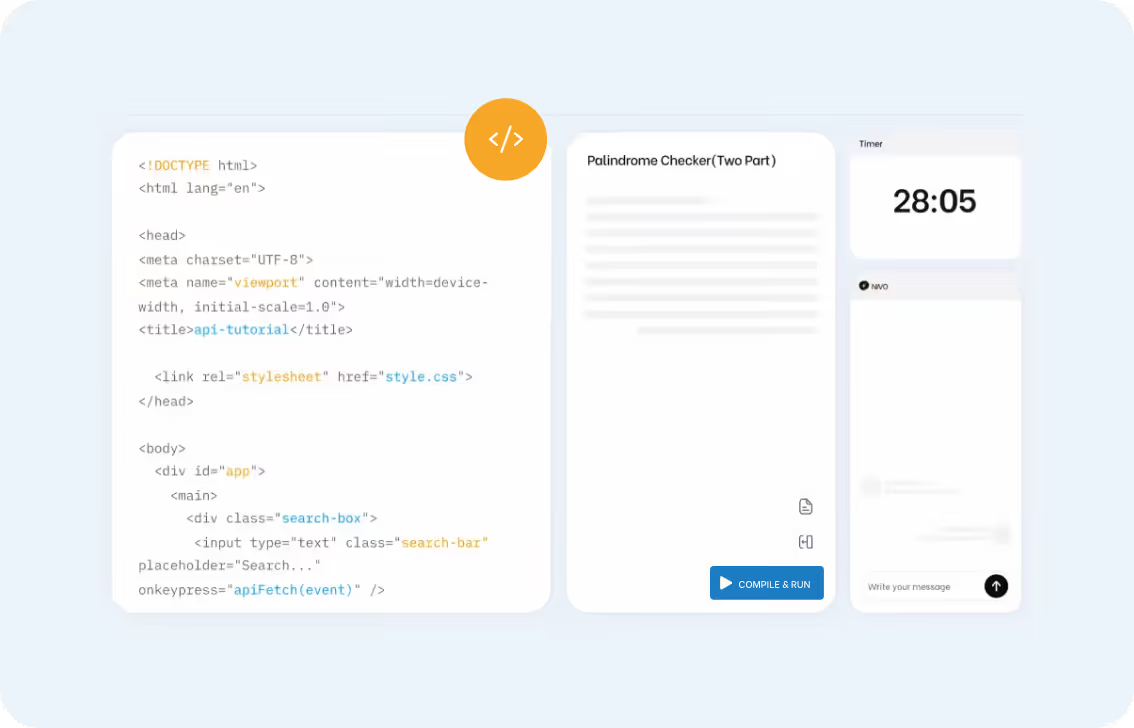
A Real Coding Environment

No Downloads Need, Built-in Browser Based Code Editor

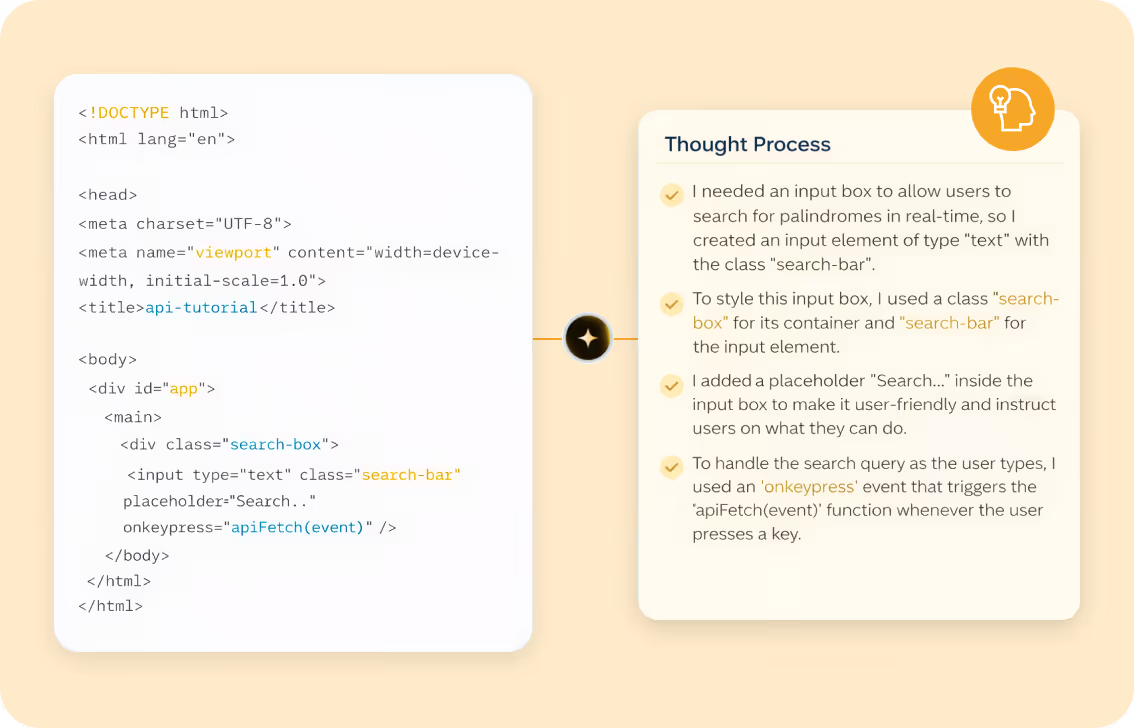
See Every Thought Process

Not Just the Final Code

Interview Integrity That Goes Beyond Browser Proctoring

Because our interviews happen through real conversation, not silent coding tests, the AI can spot behaviors that most proctoring tools completely miss.

Our AI flags patterns that indicate the candidate may not be producing the work themselves, such as:

  • Copy-pasting code provided by the interviewer
  • Relying on direct help to write basic syntax or logic
  • Abrupt jumps in code quality (a common giveaway of external assistance)
  • Silence during major changes with no explanation of thought process
  • Inability to explain code they "wrote"

See how Teams Use AI Coding Interviews