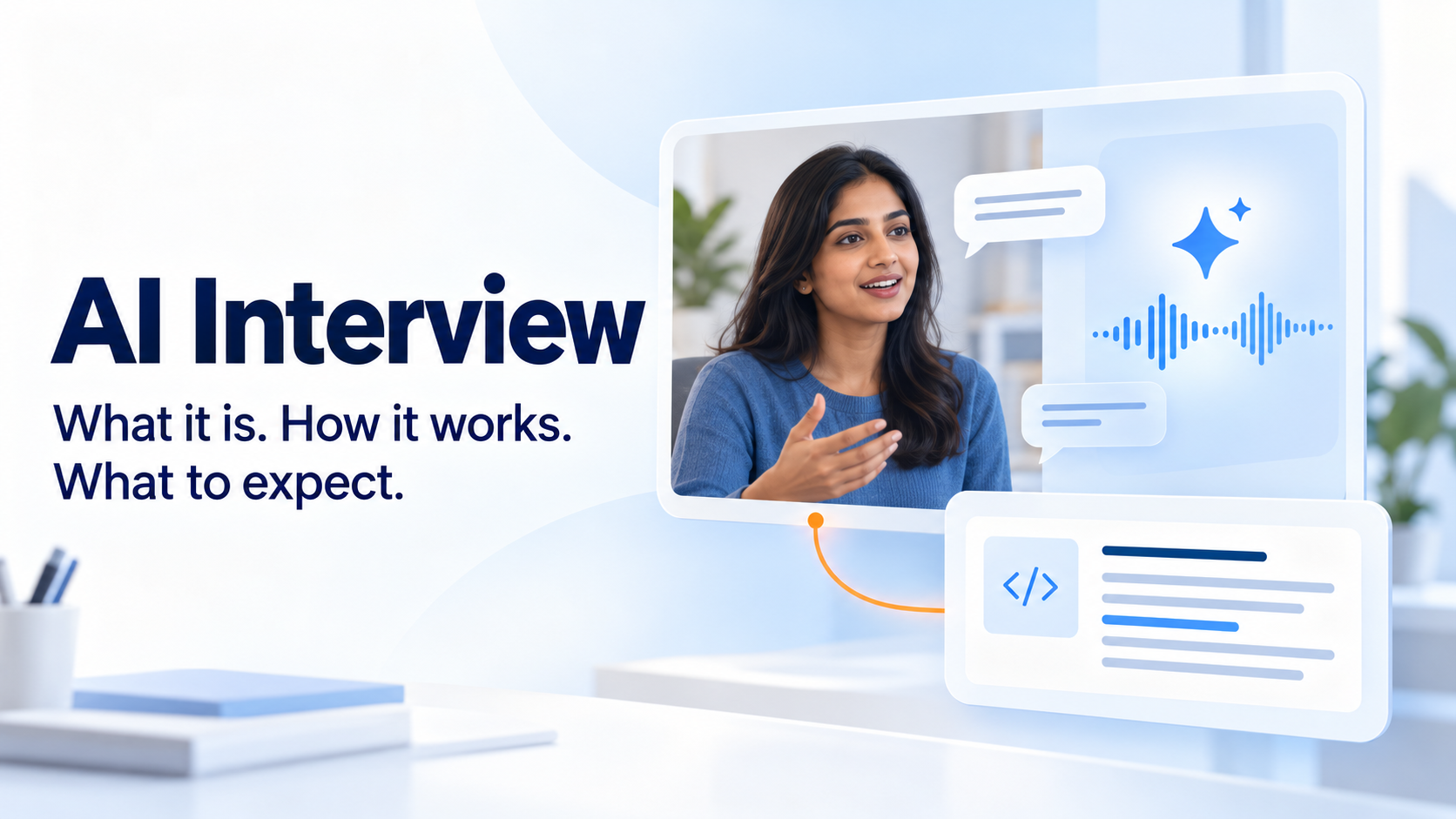
An AI interview is a hiring interview in which artificial intelligence helps conduct the interaction, analyse candidate responses, or support a human interviewer. Depending on the platform, AI may ask questions, generate transcripts or summaries, or assess responses. Interviews can take place through video, voice, or text, and may be pre-recorded or conducted in real time.
An AI interviewer is the software that conducts or facilitates the interview interaction. An AI interview platform is the broader system used to configure, deliver, manage, and analyse interviews and their outputs. AI involvement does not necessarily mean that the system makes hiring decisions autonomously; employers may use AI alongside human review and decision-making.
When exploring how AI interviews work, keep four things in mind:
Depending on what the AI is doing, what the employer wants to assess and how the candidate interacts with it, AI Interviews can take several forms. Some interviews are designed for pre-screening, while others are built to stimulate a real conversation or assess how a candidate handles a specific job scenario.
Here are some of the most common types of AI interviews.
Chatbot interviews are typically used for initial prescreening. Instead of a recruiter speaking with every applicant, a chatbot asks candidates a short series of questions and collects their responses.
These interviews are usually brief and focus on basic information that helps employers decide whether a candidate meets the initial requirements for the role. Questions might cover:
The goal isn't usually to conduct a deep assessment. It's to filter a large candidate pool and identify people who should move to the next stage.
In an asynchronous one-way video interview, candidates are given a set of questions and asked to record their answers using video or audio. They don't speak to an interviewer in real time.
Candidates typically receive a time limit for each response and may also have a deadline by which they need to complete the entire interview.
Once submitted, the responses can be reviewed by a recruiter or assessed using AI, depending on how the employer has designed the process.
These interviews are commonly used for early-stage screening, particularly when an employer wants to evaluate a large number of candidates without scheduling individual live interviews.
Conversational AI interviews are designed to create a two-way interaction between a candidate and an AI interviewer. Instead of simply presenting a fixed list of questions, the AI can listen to or process the candidate’s response, continue the conversation, and ask relevant follow-up questions or request clarification.
Conversational AI interviews can be delivered through different channels:
The interview itself can be scheduled for a specific time or made available within a defined completion window. For example, a candidate might receive a voice or avatar interview link and be given one week to complete it.
Conversational AI interviews can be used for screening, skills assessment, technical knowledge, and role-specific questions.
An AI Screening Interview is a voice or chat-based automated interview conducted by an AI interviewer to assess candidates in the early stages of hiring. . It simulates a real-time conversation, asks job-relevant questions, and evaluates candidate responses using Natural Language Processing (NLP), speech recognition, and machine learning models—all without human intervention.
An AI Coding Interview is an automated technical interview where an AI interviewer assesses a candidate's coding skills in real time. It goes beyond simply checking if the final code is correct—it simulates a real-world problem-solving environment to evaluate logic, code quality, and the candidate's overall approach, all without human intervention
AI doesn't always conduct the interview. Sometimes it assists a human interviewer.
In an AI-assisted interview, a recruiter or hiring manager still leads the conversation, while AI supports them with tasks such as:
Here, the interview is still human-led. AI is being used to make the interview process more efficient or structured rather than replacing the interviewer.
AI skills simulations and role play interviews
Some AI interviews are designed to simulate situations that a candidate could encounter in the actual job.
In these interviews, the AI takes on a role. It might act as a customer, patient, client, manager, colleague, or another stakeholder, while the candidate responds as they would in the workplace.
These interviews can assess things that aren't easy to measure through traditional questions, such as:
These categories aren't mutually exclusive. The same interview can have several of these characteristics at once.
For example, an employer might send a candidate a link to complete an asynchronous conversational AI interview. The candidate can choose when to start it within a 48-hour window. Once they begin, they have a real-time voice conversation with an AI interviewer, which asks screening questions and follows up based on their answers.
Different hiring assessments may look similar because they all ask candidates questions or give them tasks. But they don't all produce the same kind of evidence.
Different hiring assessments may look similar because they all ask candidates questions or give them tasks. But they don't all produce the same kind of evidence.
The difference is easier to see with an example
Suppose an employer wants to assess a candidate's SQL capability.
A knowledge assessment might ask: What is the difference between an INNER JOIN and a LEFT JOIN?
This shows whether the candidate understands the concept.
A skills assessment might ask the candidate to write a query that combines customer and transaction data and identifies customers with more than five purchases.
This provides evidence that the candidate can perform the task.
A one-way interview might ask: Tell us about a situation where you used SQL to investigate a data problem.
The employer can hear how the candidate explains their experience, but there is usually no opportunity to challenge or explore the answer during the interview.
A conversational AI interview could start by asking: How would you investigate a SQL query that has suddenly become slow?
If the candidate says they would check the execution plan and indexes, the AI could ask: What would you look for in the execution plan?
It could then continue with another question, such as: When could adding another index actually make performance worse?
This gives the employer evidence not only of whether the candidate knows the terminology, but also of how deeply they understand it and whether they can apply that knowledge when the situation changes.
A human interviewer can do the same while bringing additional context and judgment, particularly when the discussion involves ambiguous situations, senior-level trade-offs, or knowledge of the organisation's specific environment.
An AI interview uses software to conduct or support an interview, collect candidate responses, and produce structured outputs for the hiring team. The exact process varies by platform, but it generally follows six steps.
1. Define what the interview should assess
The employer starts by defining the role, seniority, essential skills, competencies, and the evidence they want to collect. This may include technical knowledge, problem-solving, communication, or role-specific scenarios.
The employer can then set the questions, evaluation criteria, and scoring rubric the system should use.
2. Prepare the interview
The interview is configured around the skills and competencies being assessed. Questions may be fixed for all candidates, while some systems can personalize questions or use follow-ups based on a candidate's responses.
If questions adapt during the interview, the underlying competencies, coverage, and level of difficulty still need to be controlled so candidates are assessed against the same requirements.
3. Prepare the candidate
The candidate receives instructions on how to complete the interview. Depending on the setup, this may include the interview format, expected duration, technology requirements, and when the interview needs to be completed.
For example, a candidate may receive a link and have a defined window, such as one week, to complete the interview. They can choose when to start within that window.
4. Conduct the interview
The candidate then completes the interview through the format provided by the system, such as text, voice, video, or an AI avatar.
The system asks questions and records the candidate's responses. In a conversational AI interview, it can also respond to those answers and ask relevant follow-up questions. Other AI interviews may simply present predefined questions or include a separate task, such as a coding exercise.
5. Produce the outputs
After or during the interview, the system can organize the information collected into outputs such as transcripts, summaries, evidence against specific competencies, ratings, or reports, depending on what the platform supports.
The aim is to give the hiring team structured information they can use when reviewing candidates.
6. Review the evidence and decide what happens next
The hiring team reviews the available evidence, including candidate responses, assessment results, gaps, and any relevant technical issues. They then decide whether the candidate should move to the next stage.
The division of responsibility is important: the employer defines what matters, the system performs the configured tasks, and the hiring team decides how the outputs are used.
Here's what usually happens when the candidate will take an AI interview.
From a candidate's perspective, an AI interview usually feels like a structured interview conducted through software. The exact experience depends on the employer and platform, but the process may look something like this.
1. Receive the interview invitation
You will typically receive an invitation with a link to the interview and instructions about when it needs to be completed.
Many AI interviews are asynchronous, meaning you can complete them within a specified time window rather than arranging a live meeting with an interviewer. Others may be conducted as part of a scheduled assessment.
2. Review the instructions
Before starting, you may be shown information about the interview format, expected duration, recording or AI use, evaluation process, and any technical requirements.
If the assessment includes features such as recording or proctoring, the employer should provide the relevant information before you begin. The exact disclosures and consent process vary between platforms.
3. Check your setup
Depending on the interview format, you may need to check your:
• Camera
• Microphone
• Internet connection
• Browser or device
• Coding or assessment environment, if applicable
Some platforms also provide a practice or familiarisation question before the actual assessment begins. If one is available, use it to understand how the interface works rather than treating it as part of the interview itself.
4. Answer the interview questions
The interview then begins. You might receive questions through text, audio, or video and respond by typing, speaking, or recording a video response.
The questions can cover different areas depending on the role. For example:
• Experience: “Tell me about a project where you used Python.”
• Behavioural: “Tell me about a disagreement with a teammate and how you handled it.”
• Technical: “What is the difference between an INNER JOIN and a LEFT JOIN?”
• Scenario-based: “A production API has suddenly become slow. What would you investigate first?”
• Problem-solving: “Walk me through how you would approach this problem.”
So there isn't one standard type of question that defines an AI interview.
5. Respond to follow-up questions where supported
This is where a conversational AI interview can differ from a simple one-way recorded interview.
A fixed interview might ask a question, record your answer, and move to the next question. A conversational system may instead use your response to decide whether a follow-up is useful.
For example:
AI: “Tell me about your experience building REST APIs.”
Candidate: “I built REST APIs using Spring Boot.”
AI: “How did you handle authentication?”
The system may continue probing until it has gathered enough evidence about the competency being assessed.
This doesn't happen in every AI interview. Some platforms use a predetermined sequence, while others support more adaptive conversations.
6. Complete any additional tasks
Some interviews may include a practical component, particularly for technical or specialised roles.
A coding interview, for example, might ask you to write and run a function and then explain your approach. A follow-up could ask about the time complexity of your solution or how you would adapt it for a larger dataset.
Other roles might include a work sample, scenario, simulation, or another task relevant to the position.
7. Finish and submit the assessment
Once you've answered the required questions and completed any required tasks, you submit or finish the interview.
What happens immediately afterward varies. You may receive a simple completion confirmation, information about the next stage, or no immediate feedback at all.
The employer may then review the resulting assessment evidence before deciding what happens next.
Learn more: What does an AI interview look like in practice?
AI interviews can help hiring teams handle more first-round assessments, reduce scheduling and interviewer availability constraints, and make candidate responses available in a more structured format. Depending on the setup, candidates may complete interviews within a defined time window rather than coordinating a specific time with a recruiter. The system can also produce outputs such as transcripts, summaries, competency evidence, and scores, which can reduce the time spent collecting and organizing interview feedback.
These benefits are not automatic. More interviews can also mean more reports for recruiters to review, and automated scoring still requires appropriate rubrics, calibration, human oversight, and review of uncertain or incomplete results. Technical problems, candidate support, repeat assessments, and setup costs can also affect the overall efficiency. The useful question is therefore not simply whether AI can automate part of the interview, but whether the complete process helps the hiring team assess candidates with the required evidence, in less time and with less operational effort, while maintaining assessment quality and fairness.
Know more: What can an AI interview evaluate and what can a report show?
AI interviews can help streamline early-stage screening and evaluate candidates consistently, while human involvement remains essential for nuanced judgment, relationship-building, and final hiring decisions. The key is knowing where AI adds value and where the human touch matters most.
Explore our guide on using AI interviews across the hiring funnel to learn how to balance automation with human involvement at each stage of recruitment.
AI interviews do not have one universal accuracy score. Their reliability and fairness depend on factors such as the role being assessed, the competencies being measured, the interview format, the scoring method, and the candidates taking part.
A system may produce consistent scores but still assess the wrong things. Similarly, a polished AI-generated report may sound convincing while misrepresenting a candidate's response. Employers should therefore evaluate not just how consistently an AI interview scores candidates, but also whether its conclusions are supported by evidence and relevant to the job.
Several checks can help establish whether an AI interview is producing reliable and fair assessments.
Ultimately, AI interview quality cannot be established by a single accuracy figure or a professional-looking report. Employers need to examine the evidence behind assessments, investigate disagreements and technical limitations, and review outcomes to understand whether the system supports sound hiring decisions.
For a deeper look at specific aspects of assessment quality, explore our guides to AI interview scoring, AI interview evaluation and decisioning, human-in-the-loop AI interviews, and candidate experience in AI interviews.
Introducing AI interviews requires more than choosing a tool. Employers need to define where it fits into the hiring process, establish clear assessment criteria, and verify that it produces useful evidence without creating unnecessary friction for candidates.
A practical starting point is to introduce AI interviews through a controlled pilot before expanding their use.
The goal is not simply to automate more interviews, but to establish whether AI improves the hiring process in a specific context. Employers should validate the results, address identified gaps, and expand gradually when the evidence supports doing so.
FloCareer's NIVO is an AI interviewer designed to help hiring teams conduct structured screening and coding interviews at scale. It brings together job description parsing, customizable skill assessments, conversational interviewing, and structured reports in a single workflow.
Here's how it supports the interview process.
Hiring teams can upload a job description as a PDF or Word document, or enter the content directly. NIVO extracts the key skills and suggests the competencies to assess, giving recruiters a starting point for building a role-specific interview.
Teams can review and customize the skill set, adjust the importance of individual competencies, and define the expected proficiency level before generating questions.
Not every role requires the same type of assessment. NIVO allows hiring teams to tailor interview questions to the skills and expectations of a particular position.
Recruiters can configure question types, such as theoretical or scenario-based questions, set proficiency expectations, distinguish must-have skills from good-to-have skills, and adjust the question pool and the number of questions asked per candidate.
This helps align the interview with the role rather than relying entirely on a generic question set.
NIVO conducts voice-led interviews that go beyond static questionnaires. It asks role-relevant questions and can use follow-up questions to explore a candidate's responses more deeply.
For screening interviews, this helps employers assess foundational knowledge and role-specific competencies. For technical positions, AI coding interviews provide a way to explore coding skills and problem-solving through a dedicated interview format.
Candidates can complete interviews remotely, with availability designed to reduce dependence on interviewer schedules.
Hiring teams can configure interview policies to suit their process, including interview duration and the time window in which candidates can complete an interview.
Depending on the configuration, available integrity controls can include full-screen requirements, restrictions on mobile devices or keyboard shortcuts, and candidate activity monitoring.
These controls provide additional context about the interview session. Any flagged activity should still be interpreted carefully and reviewed in context rather than treated as automatic proof of misconduct.
After an interview, NIVO generates a report to help recruiters and hiring managers review candidate performance. Depending on the interview type, reports can include skill-level ratings, a summary of responses, transcripts, video recordings, and relevant integrity findings.
These outputs help hiring teams examine how candidates performed against the intended criteria and identify areas that may need further investigation.
The reports are designed to support hiring decisions, not eliminate the need for judgment. Recruiters and hiring managers should review the underlying evidence, particularly when results are unclear or additional context is needed.
NIVO connects several steps that would otherwise require separate preparation and coordination: configuring the job, defining assessment criteria, generating questions, conducting interviews, and reviewing results.
For employers, the practical value lies in making structured interviews easier to run across larger candidate pools while retaining the ability to customize assessments for different roles.
To explore the platform's capabilities in more detail, visit FloCareer's AI Interview Platform or learn more about NIVO's AI Screening Interview.
No. A video interview describes how an interview is conducted, while an AI interview describes the role AI plays in the process. A live video call with a recruiter or a recorded interview reviewed entirely by a human does not necessarily involve AI. An AI interview, on the other hand, may use AI to ask questions, evaluate responses, or generate structured assessments—and it can take place through video, voice, or text. In short, video describes the format; AI describes the technology involved.
Yes. An AI interview can be conversational without a recruiter or human interviewer being present. Candidates can complete the interview independently while the AI asks questions, interprets responses, and generates relevant follow-up questions where supported. Unlike a traditional one-way video interview with predefined questions, a conversational AI interview can adapt to a candidate's answers, allowing the discussion to explore job-relevant skills in greater depth. FloCareer's NIVO supports voice-led AI interviews, allowing candidates to complete interviews within a defined time window without coordinating schedules with a recruiter. Hiring teams can review the resulting assessment and interview evidence afterward.
No. Some AI interviews follow a fixed sequence of predefined questions, while others use conversational AI to ask follow-up questions based on a candidate's responses. For example, if a candidate explains how they troubleshoot a slow API, an adaptive AI interviewer might ask how they would determine whether the database is causing the slowdown. This helps explore the candidate's reasoning and gather additional evidence of their skills. Whether follow-ups are used depends on the platform, interview configuration, and assessment design. An AI interview isn't necessarily a conversational or adaptive interview.
Yes. Some AI hiring systems can automatically reject candidates based on predefined eligibility rules, assessment scores, or configured decision criteria. Others provide scores and recommendations for recruiters to review. The important distinction is between an assessment result, an automated recommendation, and the employer's hiring decision. A low AI interview score does not necessarily mean a candidate lacks the required skills, particularly when evidence is incomplete or technical issues affect the assessment. Employers should establish clear decision criteria, validate assessments, and define when human review is required. Borderline results, incomplete interviews, accessibility issues, and integrity concerns may warrant further investigation before a decision is made. AI can automate parts of candidate screening, but employers remain responsible for ensuring that hiring decisions are appropriate, fair, and accountable.
No. AI interviews are not inherently unbiased. While structured assessments can help reduce inconsistencies by evaluating candidates against shared, job-relevant criteria, AI systems can also reproduce or introduce bias through their design, scoring methods, or implementation. Fairness depends on whether the assessment measures relevant skills, has been appropriately validated, accommodates candidates with different needs, and is monitored for potential disparities. Employers should also ensure that assessment results are reviewable and that uncertain or conflicting evidence can be examined by a human. Consistent scoring does not automatically mean fair scoring. AI interviews should be evaluated for fairness rather than assumed to be unbiased.
AI interviews can flag potential integrity concerns, such as unusual browser activity, copying and pasting, or activity that may violate interview rules. However, these signals do not prove that a candidate has cheated or lied. Similarly, behaviours such as eye movements, facial expressions, pauses, or nervousness are not reliable stand-alone indicators of deception. Inconsistent answers may warrant clarification, but they do not automatically establish dishonesty. Employers should treat integrity signals as prompts for contextual review, not as definitive evidence of misconduct. AI can help identify activity that warrants investigation, but a flagged signal should not automatically result in rejection.
Candidates should prepare for an AI interview much like they would for a traditional interview: understand the role, review relevant skills, and prepare genuine examples that demonstrate their experience. Review the job description. Identify the key skills, responsibilities, and competencies the employer is looking for. Prepare real examples. Think of specific situations from your work, projects, or studies that demonstrate your abilities. Explain what you did, why you did it, and what the outcome was. Explain your reasoning. For technical or scenario-based questions, walk through your approach rather than giving only the final answer. Test your equipment. Check your internet connection, microphone, camera if required, and browser compatibility before starting. Choose a suitable environment. Find a quiet space with minimal interruptions and follow any instructions about notes, external resources, or other tools. Ask for support if needed. Contact the recruiter or use the designated support channel if you encounter technical difficulties or require an accommodation. Most importantly, focus on demonstrating your actual skills and experience rather than memorising scripted answers or trying to predict how the AI will evaluate you.
Sometimes, but it depends on the employer's instructions and the purpose of the assessment. Some interviews prohibit external tools to assess independent problem-solving, while others allow resources such as ChatGPT, GitHub Copilot, or technical documentation to evaluate how candidates use them. If AI assistance is permitted, candidates should still understand the output, explain their approach, and verify that the solution works. If the rules are unclear, ask the recruiter before starting. Using AI is not automatically cheating, but it is not automatically permitted either. Always follow the rules for the specific assessment.
Technical issues can occur during an AI interview, including internet disconnections, microphone or camera failures, browser problems, or interruptions in the coding environment. If something goes wrong: Follow the troubleshooting instructions provided by the interview platform, if available. Document the issue. Note when it occurred and save any error messages or screenshots where possible. Contact support or the recruiter using the contact details provided in your interview invitation. Explain how the issue affected your interview, particularly if your answers were not recorded properly or you could not complete the assessment. Whether you can resume, retry, receive a new interview link, or complete an alternative assessment depends on the employer's process and the platform's configuration. Technical failures should also be distinguished from candidate performance. If an issue prevented the system from capturing usable assessment evidence, the hiring team may need to review the situation before interpreting the results. The best approach is to report the problem promptly rather than assume you must restart or that a retry will be available.