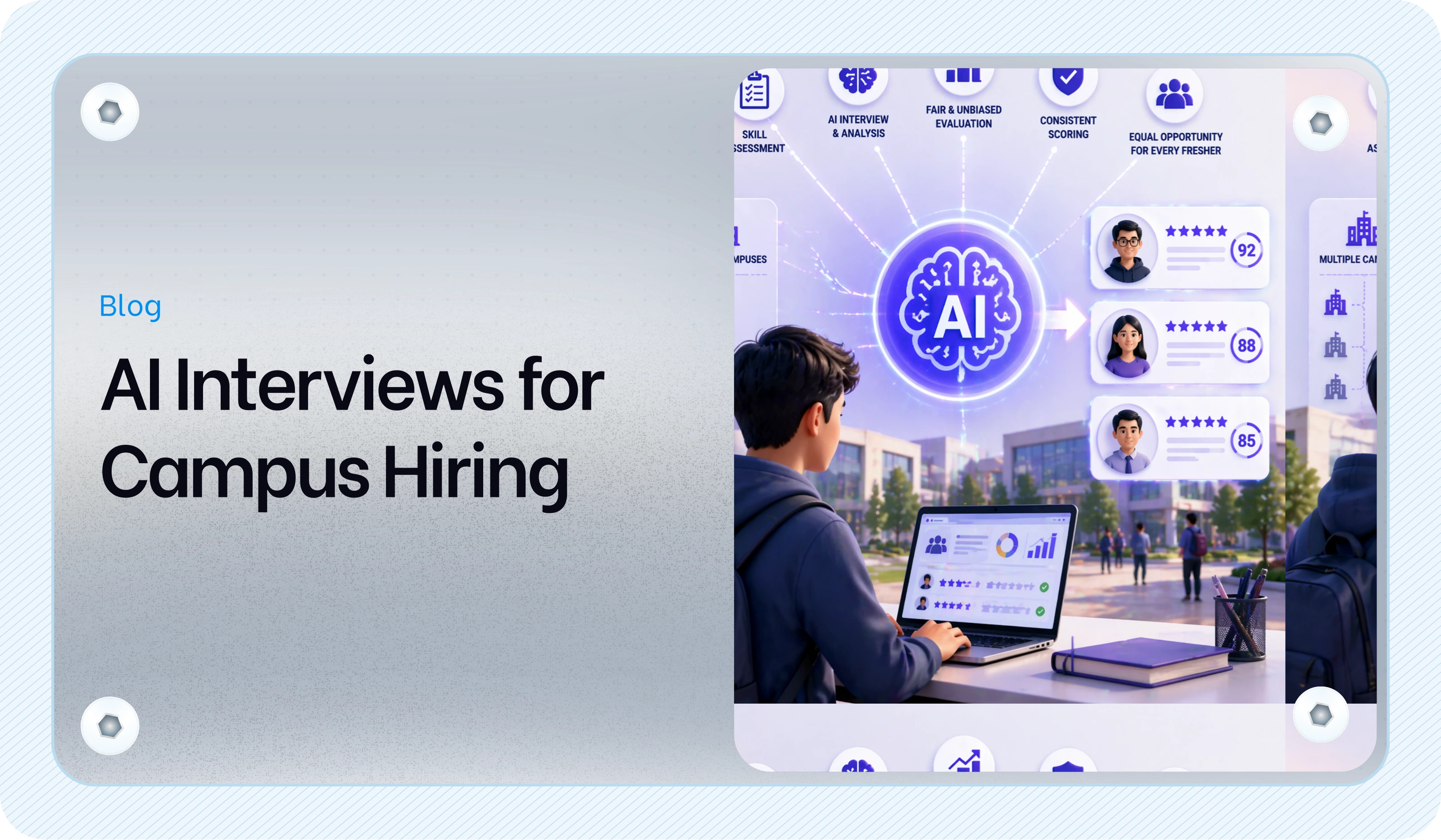
Campus hiring creates a unique challenge for enterprises: thousands of freshers apply within days, but teams have limited capacity to evaluate them fairly and consistently.
Resumes reveal very little about early talent, interview panels vary across colleges, and recruiters are forced to make high-volume decisions under tight timelines. The result is often inconsistent evaluation, interviewer overload, and a candidate experience that suffers at scale.
AI interviews are emerging not to replace recruiters, but to act as a standardized first-round evaluation layer — helping teams assess every candidate by the same criteria, reduce resume bias, and manage campus hiring volume without compromising fairness.
Campus hiring looks predictable on paper: visit colleges, invite applications, conduct interviews, roll out offers. In reality, it unfolds in short, intense bursts where thousands of students enter the pipeline within days. What breaks down is not candidate availability — it is the ability to evaluate every fresher consistently across campuses under time pressure.
Campus drives and early talent programs create sudden waves of applications, assessments, and interviews. Recruiters who comfortably manage steady pipelines during the year suddenly face thousands of profiles that must be processed within strict placement timelines.
At the same time, employers compete in the same hiring windows for the same early-career talent. According to insights from Yello’s 2025 campus recruiting report, 71% of employers reported intense competition for early-career candidates. Speed becomes important — but speed without structure quickly turns into chaos.
Today’s Gen Z candidates expect transparent communication, quick updates, and smooth digital workflows. When processes slow down due to recruiter overload, candidate drop-offs increase and employer brand perception suffers across campuses.
Most traditional hiring funnels are designed for sequential filtering — review resumes, shortlist, schedule interviews, evaluate. That approach breaks when thousands of candidates must be evaluated in parallel within days.
In fresher hiring, resumes offer very little real differentiation. Most candidates have similar academic backgrounds, similar project exposure, and limited work experience. Yet, under time pressure, recruiters fall back on resume filtering as the primary screening tool.
This creates two serious problems:
Resumes become weak predictors of performance, but teams rely on them because they lack a better standardized evaluation mechanism at scale.
Different campuses operate with different placement rules, timelines, and expectations. Meanwhile, multiple interview panels assess candidates across colleges within a short span.
Without structured evaluation criteria and standardized scorecards, interview quality varies:
When hiring 50, 100, or 500 freshers, this inconsistency becomes a serious risk. Comparisons between candidates become subjective, and decisions become difficult to justify internally.
In campus hiring, consistency matters more than speed — but most teams struggle to achieve both.
On the surface, campus hiring appears to be a sequence of familiar steps: visit colleges, collect resumes, conduct interviews, release offers. But when organizations attempt to run this across multiple campuses and hundreds of freshers, they discover that success depends on something deeper.
Campus hiring is not a sourcing problem — it is a structured evaluation problem at scale.
To execute it fairly and consistently, enterprises need an operating framework that goes far beyond campus visits and resume collection.
Freshers often come from similar academic backgrounds. This makes it essential to define:
Without standardization, comparisons across campuses become subjective, and fairness breaks down.
Because resumes offer limited differentiation in fresher hiring, organizations must rely on:
Evaluation must be anchored to capability and potential, not college pedigree or resume formatting.
Campus hiring does not happen in a steady flow. Thousands of candidates enter the pipeline at the same time. This requires:
When multiple interviewers assess candidates across campuses, consistency depends on:
This ensures that two candidates from two different colleges are judged by the same standards.
AI interviews change the shape of campus hiring by turning the most chaotic part of the process — first-round evaluation — into a standardized, parallel, and fair assessment layer.
They do not replace recruiters. They remove the inconsistency and interviewer dependency that make fresher evaluation difficult across campuses.
One of the biggest challenges in campus hiring is that different interviewers ask different questions to different students across colleges. This makes comparisons subjective.
AI interviews solve this by:
This creates a uniform interview experience, regardless of which campus the candidate is from or when they take the interview.
For freshers, resumes reveal very little about actual capability. AI interviews shift the focus from:
college name and formatting → to demonstrated skills and thinking ability
Candidates are evaluated based on how they respond to structured, job-relevant questions, practical scenarios, and assessments rather than how their resume looks.
This significantly reduces resume bias and enables fairer evaluation across large applicant pools.
Traditional interviews depend on interviewer availability. During campus season, this becomes the biggest bottleneck.
AI interviews allow thousands of candidates to complete their interviews simultaneously without waiting for panel slots. Recruiters no longer have to process candidates sequentially.
This is what makes consistency and scale possible at the same time.
Students can complete interviews at a time convenient to them within the given window. There is no dependency on scheduling coordination across campuses, panels, and time zones.
This improves completion rates and reduces candidate drop-offs during peak hiring windows.
AI interviews are most effective when used as a structured first-round evaluation layer.
This hybrid model ensures that fairness, transparency, and human judgment remain central to the hiring decision.
AI interviews enable enterprises to evaluate large fresher cohorts consistently without increasing interviewer dependency.
This is where AI interviews become practical in campus hiring — not as a standalone tool, but as a structured evaluation layer inside the existing campus process.
AI does not change what campus hiring teams do. It changes how consistently and how fairly they can evaluate thousands of freshers across colleges.
AI interviews don’t replace campus hiring — they bring consistency and scalability to it.
Here is how a well-designed AI-enabled campus hiring flow works in practice.
Applications come in through campus drives, placement cells, career portals, and events across multiple colleges within a short window.
Instead of immediately starting manual resume screening, all candidates enter a centralized system connected to an ATS and the AI evaluation layer.
Before any human review, candidates go through an AI-powered screening stage aligned to job requirements.
This may include:
Every candidate is evaluated on the same parameters, removing early resume bias and ensuring only role-relevant signals are used for filtering.
Shortlisted candidates are invited to complete a structured AI interview.
Candidates complete the interview within the given window at their convenience, while the system captures structured responses for evaluation.
This is where consistency becomes visible.
The platform generates standardized scorecards by combining:
Recruiters now see candidates ranked on evidence-based evaluation, not resume quality or college name.
Two candidates from two different campuses can be compared fairly on the same scale.
Only the top-ranked candidates move to human interviews.
Hiring managers and recruiters enter these conversations with:
Human effort is now focused where judgment matters most — final decision-making, cultural fit, and role alignment.
Enterprises do not feel the impact of AI across the entire campus funnel equally. The biggest gains appear in the stages where fair evaluation, coordination, and consistency are hardest to maintain across campuses.
This is where AI interviews and structured screening create visible operational and quality improvements.
The first and most important impact is the ability to evaluate students from different colleges using the same standards.
When AI interviews and assessments are used as the first evaluation layer:
This removes dependency on which recruiter or interviewer happened to assess a student and brings fairness into large fresher cohorts.
During campus season, assembling enough trained interviewers becomes difficult. AI interviews reduce the need for large panels for first-round evaluation.
Recruiters and hiring managers now spend time only on the top shortlisted candidates instead of conducting hundreds of repetitive screening interviews.
Because candidates can be screened and interviewed in parallel:
Importantly, this speed does not come from cutting corners. It comes from removing manual bottlenecks while keeping evaluation structured.
Enterprises notice that shortlists improve when resume filtering is replaced with skill-based AI evaluation.
Candidates are shortlisted based on:
This leads to fewer rejections in later rounds and better alignment with hiring manager expectations.
When students experience:
Completion rates improve and drop-offs reduce. This has a direct impact on employer brand perception across campuses.
The largest enterprise benefit is this:
Campus hiring shifts from an activity-driven process (collect resumes, conduct drives) to an outcome-driven process (fair evaluation, quality shortlists, faster decisions).
AI does not automatically make campus hiring fair or effective. In many cases, enterprises introduce AI into the funnel without redesigning the process around standardization, transparency, and candidate experience.
The result? Technology moves faster, but inconsistency remains.
Scaling campus hiring without structured evaluation only scales inconsistency.
One of the most common mistakes is using AI to screen resumes faster instead of reducing dependence on resumes altogether.
In fresher hiring, resumes are weak signals. When AI is configured to rank candidates based on keywords, formats, or college names, it simply automates the same bias that already exists in manual screening.
The fix is to move from resume-first filtering to evidence-first evaluation using assessments and structured interviews as the primary filter.
Some teams deploy AI interviews but allow:
This defeats the purpose of AI-led consistency.
AI interviews work only when:
Without this discipline, AI becomes another tool in an inconsistent process.
A frequent failure point is poor communication around the AI process.
When candidates do not understand:
The process feels robotic and impersonal. This directly impacts employer brand across campuses.
Clear instructions, timelines, and visible human involvement are essential to maintaining candidate trust.
AI should reduce repetitive effort, not remove human judgment.
When teams rely entirely on automated shortlisting without human review, they risk missing high-potential candidates and creating distrust in the process.
The most effective models keep recruiters involved in shortlist validation and final decisions.
Because AI makes screening easier, some enterprises start adding more campuses without a clear strategy.
This increases application volume but reduces evaluation quality. Campus hiring still requires disciplined campus selection and relationship management.
Teams often measure:
But ignore:
Without these metrics, it is impossible to know whether AI is actually improving hiring outcomes.
For freshers, campus hiring is often their first interaction with a corporate hiring process. Their perception of fairness, clarity, and professionalism is shaped here.
AI can significantly improve this experience — but only when it is implemented with transparency and visible human involvement.
Freshers value fairness and clarity more than personalization — especially in large hiring processes.
In traditional campus hiring, students must wait for assigned slots, panel availability, and coordination between placement cells and recruiters.
With AI interviews:
This flexibility reduces anxiety and improves completion rates during peak placement season.
A well-designed AI-led process clearly communicates:
When students understand the structure, the process feels organized rather than robotic.
Many freshers worry that their college name, resume format, or background may influence outcomes.
AI interviews help address this concern because:
This creates a strong perception of merit-based evaluation across campuses.
Candidate experience suffers when:
In such cases, students feel like they are “performing for a machine,” which harms employer brand.
The best AI-led campus hiring experience feels structured but human.
This balance ensures that technology improves the journey without removing empathy from the process.
AI interviews are not meant to replace human judgment. They are most effective when used to solve a first-round scale and consistency problem that is common in campus hiring.
They make the most sense when the goal is to standardize early evaluation across a large number of freshers before human interviewers step in.
Campus hiring compresses thousands of applications into a few weeks.
In such cases, recruiters spend more time on:
AI interviews absorb this surge by:
This is where the biggest time and cost savings happen.
Freshers usually have limited work history. That means early evaluation depends heavily on how consistently candidates are assessed.
AI interviews help when you need:
This replaces an inconsistent early round with a structured, comparable assessment layer.
AI interviews are ideal when the pain point is operational:
They work best for evaluating:
They are not meant for nuanced final-round decisions.
This is the most important condition.
AI interviews make sense only when:
Candidates are far more comfortable when AI supports decisions rather than making them.
Campus candidates are often experiencing formal hiring for the first time. If AI is part of the process, employers must be able to explain:
Without this clarity, the process feels opaque and impersonal.
AI interviews are appropriate only when:
This ensures that AI improves fairness instead of unintentionally creating barriers.
AI interviews make sense in campus hiring when they are used as a structured, scalable first-round evaluation layer for high-volume roles — with transparent communication, visible human review, and strong fairness controls.
Measuring success in AI-enabled campus hiring requires a shift from tracking activity (resumes collected, events attended) to tracking outcomes (quality, conversion, fairness, and ROI).
Speed and cost matter—but on their own, they are incomplete. A strong measurement approach combines funnel efficiency, hiring outcomes, candidate experience, and fairness/compliance.
Guidance from the National Association of Colleges and Employers (NACE) recommends that early-talent programs consistently track:
These metrics form the operational baseline. Before adding AI, you need to know how your funnel performs without it.
An AI-enabled campus process is not successful because it processed more candidates. It is successful if a higher proportion of the right candidates move forward.
Watch for improvements in:
These indicate better decision quality, not just faster screening.
AI’s earliest and most visible impact is operational. Recruiters spend less time:
The Society for Human Resource Management (SHRM) notes that organizations most often evaluate AI in HR through productivity gains, cost savings, and improved decision-making.
Cost reduction should be measured, but not in isolation. Track:
A lower cost per hire is meaningful only if quality, acceptance, and retention remain strong or improve.
Campus hiring is highly sensitive to employer brand and perception. AI can improve speed but harm trust if not designed carefully.
Track:
A process that is fast but opaque can reduce acceptance rates even if it improves efficiency.
AI should improve the quality of shortlists and hiring decisions.
Look for signals such as:
These indicate that AI is helping teams choose better, not just faster.
This is not optional in AI hiring.
The Equal Employment Opportunity Commission (EEOC) makes clear that automated hiring tools must be assessed for disparate impact using standards such as the four-fifths rule.
This means tracking pass rates across demographic groups at each stage of the process and auditing regularly for bias.
An efficient system that is not accessible is not a success.
Monitor:
The most reliable way to measure success is before-and-after comparison:
Many teams adopt AI but never formally verify whether outcomes actually improved.
Campus AI hiring is working when:
In campus hiring, your employer brand is not what you say about yourself. It is what students tell each other after going through your process.
For many freshers, this is their first real hiring experience. They don’t yet know how to judge companies by culture, leadership, or long-term growth. They judge you by how you hire.
The National Association of Colleges and Employers (NACE) describes this as Employment Brand Strength being shaped by execution and authenticity across the candidate journey.
Every touchpoint becomes a signal:
Students extrapolate from the recruiting experience to imagine what it must be like to work at your company.
If the process feels chaotic, opaque, or careless, that becomes your brand on campus.
Students consistently trust people over marketing:
They trust these far more than:
This is why campus hiring is uniquely sensitive to how impersonal AI can feel if used incorrectly.
AI changes how students experience your hiring process, and therefore changes how they perceive your brand.
Recent student sentiment reported by National Association of Colleges and Employers (NACE) shows:
This does not mean students reject AI. It means they are highly sensitive to how it is used.
When AI feels transparent, structured, and fair, it strengthens brand trust.
When AI feels opaque, robotic, and unexplained, it signals detachment.
Before students apply, they notice:
Research from Handshake and guidance from Society for Human Resource Management (SHRM) both highlight that early, credible presence on campus increases consideration and reduces hiring costs later.
Students actively discuss:
These conversations spread quickly through batches, WhatsApp groups, and seniors advising juniors.
A slow or impersonal process damages brand far more than any marketing can repair.
Students respond better to:
They are skeptical of generic “best place to work” messaging if their hiring experience does not match it.
A great pre-placement talk followed by:
…breaks trust.
NACE repeatedly emphasizes that employer brand is not a campaign layered onto recruiting. It is the result of how consistently the organization delivers during the candidate journey.
In campus hiring, the hiring process itself is your most powerful brand statement.
You already have more applicants than you can handle. The real challenge is evaluating them fairly and consistently across campuses within tight timelines.
When teams rely on resume filtering — manually or with AI — they automate bias instead of improving evaluation. Skill-based assessment and structured interviews must replace resume-first screening.
AI interviews work because they remove the need for large panels to conduct repetitive first-round interviews, allowing candidates to be evaluated in parallel.
They should not make final decisions. They should create structured, comparable inputs for recruiters and hiring managers to use in final rounds.
Different questions, different panels, and different scoring standards create unfair comparisons. AI interviews solve this by applying the same structure to everyone.
Students are not against AI. They are against opaque, robotic processes. Transparency, communication, and visible human involvement are essential.
Without standardized questions, scoring rubrics, and evaluation criteria, AI only accelerates inconsistency.
They are ideal for assessing communication, thinking clarity, and role readiness at scale — not for nuanced final decisions.
Time saved and interviews completed are not enough. Focus on:
Students judge your company by how you hire. A fair, structured, and transparent AI-enabled process strengthens trust across campuses.
.avif)
.avif)

.svg)

.svg)


%201.svg)
.svg)

.webp)