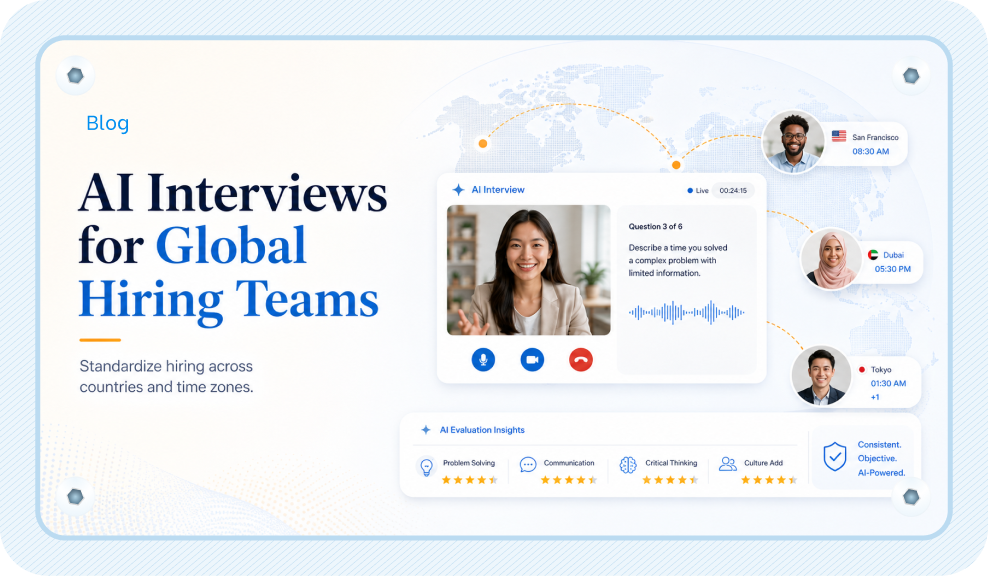
Companies are hiring across borders more than ever. Talent teams may be based in one region, hiring managers in another, interviewers in a third, and candidates spread across several countries. This gives enterprises access to wider talent pools, but it also creates a harder question: how do you maintain the same hiring standard everywhere?
Global hiring becomes challenging when organizations need to maintain consistent evaluation across countries, teams, and time zones. A candidate in Singapore may go through a structured interview, while a candidate for the same role in Germany may face a more conversational assessment. Over time, these differences create uneven hiring quality.
That is why global hiring is not only about access to talent. It is about building a hiring system that can evaluate candidates fairly and consistently, even when the people involved are not in the same country or working day.
As companies expand globally, hiring systems must evolve to ensure consistency without slowing down decision-making. AI interviews help by creating a standardized evaluation layer across geographies, while still allowing regional teams to make final hiring decisions with local context
Global hiring looks simple from the outside: open roles in different countries, attract candidates, and build teams across regions. But for global talent acquisition leaders, the real complexity begins after the role goes live.
The challenge is not just finding candidates in multiple countries. The larger challenge is ensuring that every candidate is evaluated through a consistent, fair, and comparable process. Once hiring expands across regions, interview processes can quickly fragment. Different teams may use different interview formats, ask different questions, apply different scorecards, or define candidate quality in different ways.
Global hiring is not just about access to talent. It is about maintaining consistency across regions.
When an enterprise hires across countries, the same role can move through very different hiring journeys. A product manager role in India, Germany, and the United States may have the same job description, but the actual evaluation process may differ across regions.
For leadership, this raises difficult questions. Are candidates being assessed against the same role expectations? Are strong candidates being missed in some regions? Are hiring decisions based on common standards or local interviewer preferences?
Every region develops its own hiring habits. These differences are natural, but they can also create evaluation drift. A candidate’s outcome may depend less on capability and more on where they interviewed, who interviewed them, and how that local team defines a strong response.
For global roles, the interview experience can be adapted to local expectations, but the evaluation standard should remain common.
Time zones add another layer of complexity. Coordinating even one live interview can require multiple calendar checks, delayed responses, and uncomfortable meeting times.
This does not only slow hiring down. It also affects consistency. When interviewers are rushed, tired, or joining outside normal working hours, evaluation quality can become uneven. For global hiring teams, the issue is not just speed. It is coordination and consistency.
Many companies treat global hiring as an extension of their existing domestic hiring process. They assume that if the process works in one country, it can be repeated across other regions with minor adjustments.
But global hiring does not work that way.
Domestic hiring often operates within one market, one time zone, one hiring culture, and one shared understanding of evaluation standards. Global hiring removes those assumptions. Global hiring is not just scaling hiring. It is aligning evaluation across countries and teams.
Cross-border hiring requires centralized standards with localized execution. The same role should have the same competency expectations. The same hiring stage should assess the same capabilities. The same scorecard should help teams compare candidates across countries.
At the same time, regional teams still need room to interpret market context. Too much central control makes hiring rigid. Too much regional flexibility creates inconsistency. Global hiring requires a model where standards are defined centrally, but decisions can be made locally with shared evidence.
That foundation becomes even more important when time zones begin affecting day-to-day hiring operations.
Time-zone differences introduce friction in hiring workflows, impacting both speed and consistency.
In local hiring, coordination is usually simple. Recruiters, interviewers, hiring managers, and candidates work within similar business hours. Interviews can be scheduled quickly. Feedback can be collected the same day. Decisions can move without long gaps.
Global hiring changes this rhythm completely. When stakeholders are spread across regions, even simple hiring tasks can stretch across days. A first-round interview may be delayed because the candidate and recruiter have limited overlap. These delays affect candidate experience, but they also affect evaluation quality.
When interviewers are overloaded across time zones, assessments become less consistent. When recruiters spend most of their time chasing schedules, less time is available for strategic candidate engagement. The biggest bottleneck is often dependency on synchronous interviews. If every candidate must wait for a live interviewer in another time zone, the process becomes difficult to scale. It also makes hiring quality dependent on calendar availability.
That is why global teams need workflows that reduce dependency on everyone being online at the same time. They need structured interviews, shared documentation, asynchronous evaluation, and clear decision ownership. This creates the bridge to AI interviews.
Once companies hire across countries and time zones, they need more than strong recruiters in each region. They need a shared hiring system.
Successful global hiring depends on consistency and coordination, not just access to talent. Global teams need a clear answer to one question: what does a strong candidate look like for this role, regardless of country? Without that clarity, each region may create its own definition of quality. Candidates for similar roles should move through comparable stages. Screening should assess baseline fit and role readiness. Functional interviews should assess job-specific capability. Final discussions should evaluate team context and business alignment.
Global hiring becomes difficult when every region evaluates candidates in isolation. A shared benchmark helps teams ask, “Does this candidate meet the organization’s standard for this role?” rather than only, “Does this candidate look strong in this market?”
Recruiters, interviewers, hiring managers, and regional leaders need a shared process for moving candidates forward. Feedback, documentation, and decisions cannot depend entirely on real-time availability. Once role competencies, interview structures, benchmarks, and workflows are defined, AI interviews can help apply them consistently across geographies.
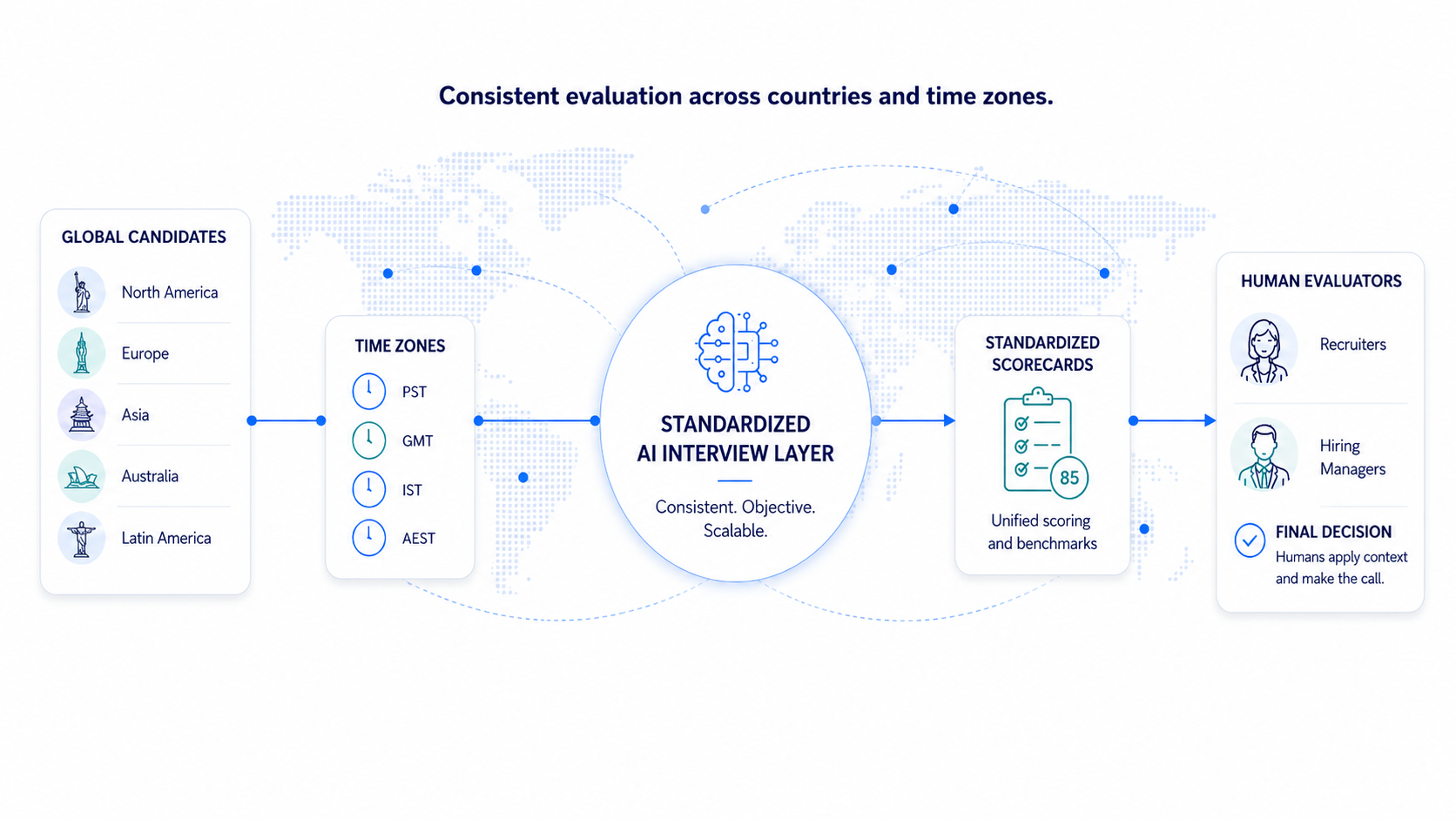
AI interviews are useful in global hiring because they solve one of the hardest problems in distributed recruitment: consistent evaluation across countries and time zones.
In traditional global hiring, interview quality often depends on who is available, where they are located, how they conduct interviews, and how much time they have. A recruiter in one region may ask detailed competency-based questions, while another may rely on a conversational screening call. A technical interviewer in one country may score strictly, while another may be more flexible.
These differences are not always intentional, but they affect outcomes.
AI interviews provide a consistent first-round evaluation layer across geographies, reducing dependency on local interview practices and interviewer availability.
The most important benefit is standardization. Candidates applying for the same role can receive the same core questions, mapped to the same competencies, and evaluated against the same scoring framework.
Local teams can still interpret results in context, but the first-round assessment remains comparable.
AI interviews also reduce scheduling friction. Candidates can complete a structured interview in their own time zone. A recruiter in London can review the output later. A hiring manager in New York can compare shortlisted candidates without waiting for every screening call to happen live.
This does not remove human interaction. It reserves human interviews for the stages where they add the most value.
AI interviews become stronger when connected to centralized evaluation frameworks. Instead of scattered notes and inconsistent feedback, candidate responses can be organized around defined competencies, role expectations, and scorecards.
This gives global talent leaders better visibility into how candidates perform across regions. It also helps regional teams make decisions with more structured evidence.
Platforms like FloCareer can support this layer by helping enterprises standardize first-round interviews across countries, roles, and time zones without removing human judgment from the final decision.
AI interviews work best when they are used as a structured screening and first-round evaluation layer. This is especially useful in global hiring because early-stage interviews are often where coordination problems begin.
Recruiters across regions may ask different qualifying questions, apply different standards, or struggle to schedule screening calls across time zones. AI interviews help standardize this stage by giving every candidate a comparable first-round assessment based on the same role requirements.
This creates a cleaner hiring funnel. Candidates can be evaluated consistently before they reach hiring managers or technical interviewers, while human teams can focus their time on deeper assessment, context, and final decision-making.
AI interviews should not replace hiring teams. They should support them.
Global hiring still requires human judgment because candidates are more than interview responses. Regional teams understand local market context, communication norms, team needs, and business priorities.
AI interviews standardize evaluation globally while allowing local teams to make final hiring decisions.
The strongest model is simple: AI handles structure, humans handle context. AI supports consistency, while regional teams remain accountable for decisions.
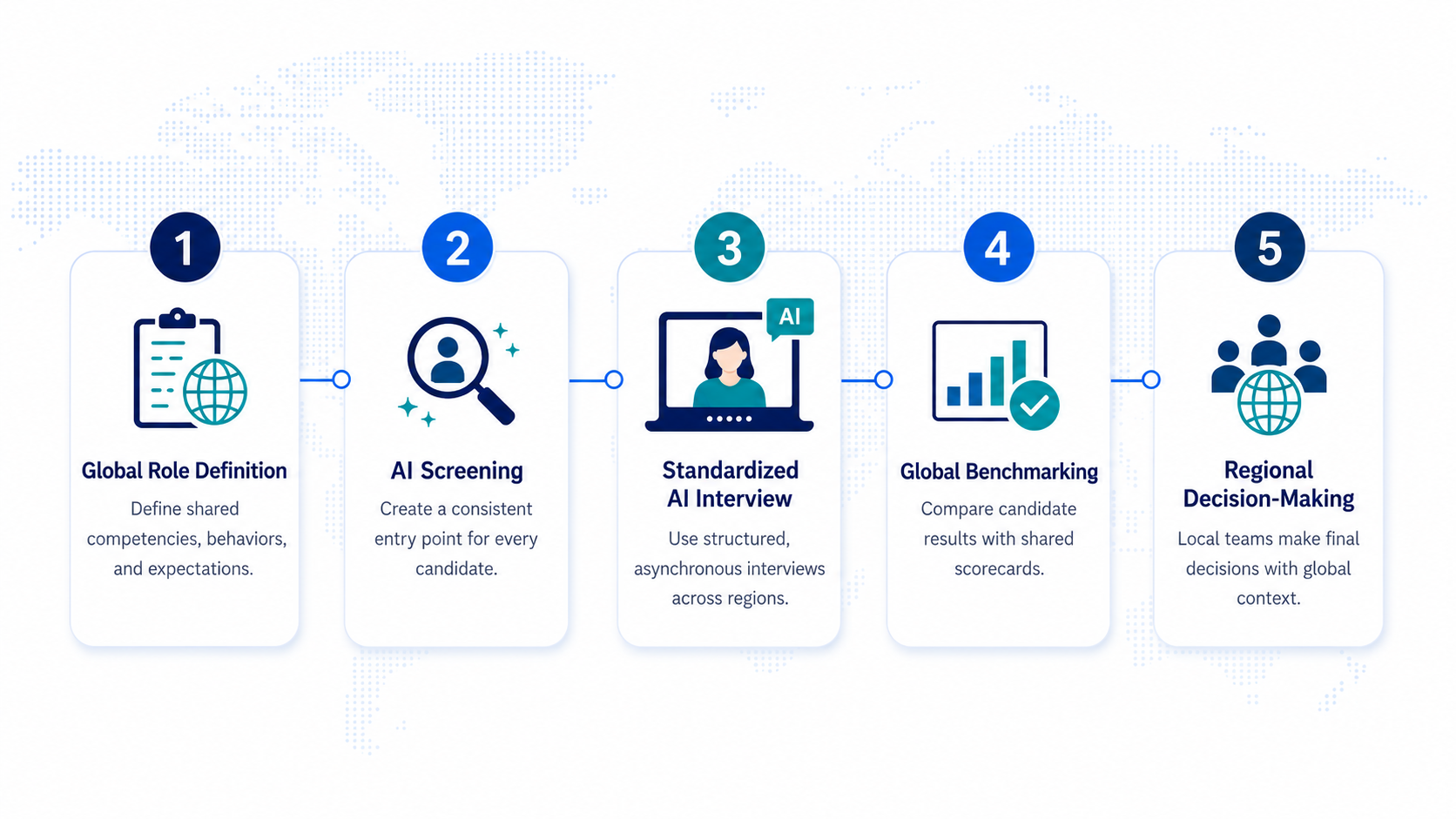
An AI-enabled global hiring system is not just an interview tool. It is a structured operating model that helps enterprises evaluate candidates consistently across countries while allowing local teams to execute hiring decisions.
AI interviews unify global hiring processes while enabling localized execution.
The process begins with a global role definition. Before interviews begin, teams must define the competencies, behaviors, and performance expectations that should remain consistent across regions.
This definition clarifies what should be evaluated globally and what can be interpreted locally.
The next step is AI-supported screening. In global hiring, the screening stage often becomes inconsistent because recruiters across regions may ask different qualifying questions or apply different standards.
AI screening creates a more consistent entry point. Candidates can be assessed against predefined role requirements before moving into deeper evaluation. This creates a cleaner funnel and reduces repetitive screening work for recruiters.
The standardized AI interview is the core layer of the system. Candidates complete a structured interview based on the same competencies, questions, and evaluation criteria. Because the interview can be asynchronous, candidates do not need to wait for an interviewer in another time zone.
This makes the process both more coordinated and more comparable. Candidates across regions are assessed through a shared structure, making it easier for hiring teams to compare responses fairly.
Once candidates complete standardized interviews, global teams need a way to compare results. AI-enabled systems can organize evaluation data around shared benchmarks, helping leaders understand whether candidates across regions are being assessed consistently.
The final step is regional decision-making. AI interviews and global benchmarks should not remove local judgment. They should improve the quality of information available to local teams.
In this model, the central framework creates consistency, while regional teams apply context. The result is a hiring process where candidates are evaluated consistently across countries, but final decisions are still made by humans who understand the local business environment.
The biggest impact of AI interviews in global hiring does not come from replacing recruiters. It comes from reducing the operational friction that prevents teams from hiring consistently across countries.
The first impact is consistent hiring quality across regions. When candidates are assessed using the same competencies, questions, and scorecard structure, global leaders can compare talent more confidently.
The second impact is reduced coordination overhead. Candidates can complete early interviews asynchronously, recruiters can review structured outputs later, and hiring managers can focus on deeper evaluation instead of basic screening.
The third impact is faster hiring cycles. In global hiring, delays often happen between stages because teams are not online at the same time. AI interviews help reduce those gaps without forcing recruiters or interviewers to work outside normal hours.
The fourth impact is improved governance. Structured interviews create better documentation, clearer scorecards, and more visibility into how decisions are being made across regions.
For global enterprises, this creates a stronger hiring operating model: consistent standards, smoother coordination, faster movement, and better visibility.
Even with strong teams, global hiring can become difficult when processes are not standardized.
The first challenge is inconsistent evaluation across regions. One team may use structured interviews, while another relies on informal discussions. One hiring manager may use a detailed rubric, while another makes decisions based on overall impression. Without standardization, global hiring leads to inconsistent outcomes across regions.
A single candidate journey may involve a recruiter in one region, an interviewer in another, a hiring manager in a third, and an approval process elsewhere. Scheduling takes longer, feedback loops stretch, and candidates wait for updates.
Regional teams often make local changes to solve immediate problems. One country changes the interview flow. Another modifies the scorecard. Another adds a screening step. Individually, these changes may make sense. Collectively, they weaken global consistency.
The solution is to standardize what should be consistent and localize what should remain flexible. Evaluation criteria, role competencies, first-round interview structure, and scorecards should be consistent globally. Final decision-making, market interpretation, and team context can remain regional.
This is where AI interviews fit naturally: they standardize the parts of hiring that need consistency while leaving room for human judgment where context matters most.
AI interviews make the most sense when global hiring teams need to evaluate candidates consistently across countries, time zones, and distributed teams.
AI interviews also make sense when consistency matters more than interviewer improvisation. If regions are using different questions, scorecards, or definitions of quality, AI interviews can create a shared evaluation foundation.
They are also valuable when hiring teams are distributed across time zones. Candidates can complete interviews when convenient, and hiring teams can review structured responses later. This helps avoid a common global hiring problem: making hiring quality depend on calendar availability.
However, AI interviews are not ideal for every situation. Teams should be careful with highly contextual roles, senior leadership hiring, strategic client-facing roles, or positions where relationship-building and nuanced judgment are central from the beginning.
In those cases, AI may support structure, but human conversations should remain central. The best model is hybrid: AI for structured screening and first-round consistency, humans for context, relationships, and final decisions.
Global hiring success cannot be measured only by how many candidates enter the pipeline or how quickly roles are filled. The better question is whether the organization can hire across countries while maintaining consistent evaluation standards, strong hiring quality, and smooth coordination.
Are candidates for similar roles assessed against the same competencies? Are scorecards used consistently? Are some regions adding or skipping stages without a clear reason?
Global teams should track new-hire performance, manager satisfaction, role readiness, ramp-up time, and retention by region. If one region consistently performs differently, the issue may be process calibration rather than talent availability.
Global teams should also measure time from application to first response, screening to interview, interview to feedback, and final interview to decision. These metrics reveal where time-zone friction is slowing the process.
Useful coordination signals include scheduling touchpoints per interview, time taken to collect feedback, delayed interview stages, candidate drop-off, and recruiter time spent on coordination.
For enterprises using AI interviews, the key question is not only whether automation reduced workload. The better question is: did AI interviews help create a more consistent, coordinated, and reliable global hiring process?
Global hiring does not only affect recruitment operations. It also affects employer brand.
When companies hire across countries, candidates experience the organization from different regions and time zones. Some candidates may receive fast communication, structured interviews, and clear next steps. Others may face delays, confusing scheduling, or inconsistent evaluation.
To the company, these may feel like operational issues. To candidates, they become brand signals.
Global employer brands are shaped by consistent hiring experiences across regions.
A strong global employer brand depends on a process that feels professional, fair, and organized. Candidates should understand the hiring stages, what they are being evaluated on, when they can expect updates, whether AI is part of the process, and how human review is involved.
This is especially important in cross-border hiring because candidates may already be evaluating whether the company can manage global teams effectively. If the hiring process feels fragmented, candidates may question whether the work environment will feel the same.
AI interviews can strengthen employer brand when implemented transparently. They can create a structured first-round experience, reduce scheduling delays, and make evaluation more consistent. But candidates should know when AI is being used, what it is evaluating, and how humans remain involved.
The strongest global employer brands balance consistency with local relevance. The evaluation framework stays consistent, while communication style, scheduling preferences, and local context can be adapted by regional teams.
In global hiring, the employer brand is not only what the company says. It is how consistently the company hires.
.avif)
.avif)


.svg)

.svg)


%201.svg)
.svg)

.webp)