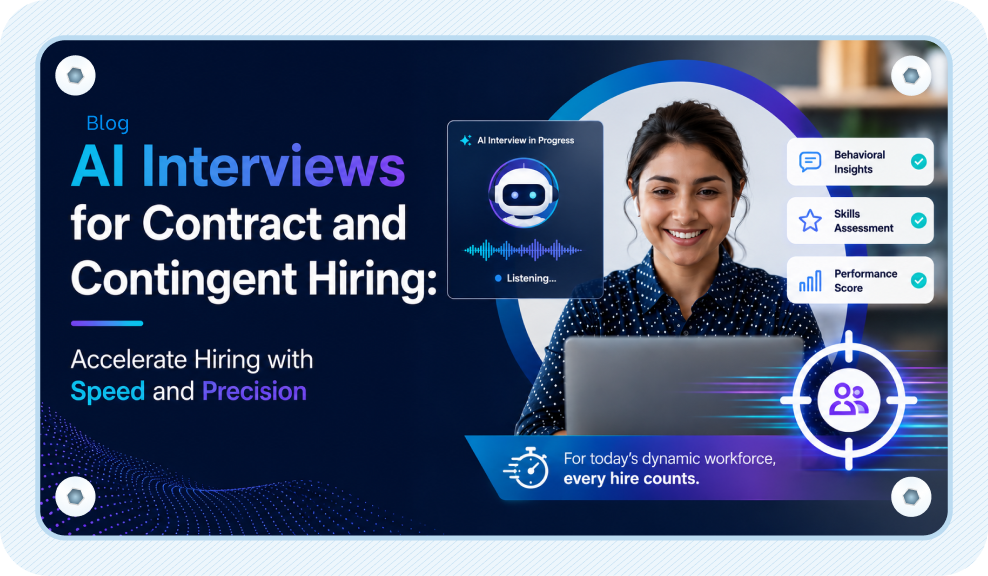
Contract hiring works very differently from traditional permanent hiring.
When companies hire for full-time roles, they usually have the flexibility to spend more time evaluating candidates. The focus is often on long-term fit, future growth potential, team alignment, and deeper validation. A longer interview process may be inconvenient, but it is often accepted as part of the decision-making process.
Contract hiring does not offer that luxury.
In most cases, businesses are trying to solve an immediate need. A project needs to be staffed quickly. A client delivery timeline has moved up. A specialist is required for a short-term engagement. A temporary gap has appeared in a critical team.
The urgency is operational, not theoretical.
A contract developer hired three weeks late may miss the most important phase of a product launch. A cloud engineer brought in too late can delay a migration timeline. A support specialist hired after the peak demand period may no longer solve the original problem.
This is why contract hiring often does not fail because of a lack of candidates. It fails because hiring teams cannot evaluate and convert available candidates quickly enough.
At the same time, speed cannot come at the cost of hiring quality.
Hiring quickly only helps if the selected candidate can actually deliver. A poor contract hire creates a different set of problems including missed deadlines, poor execution, rework, and another urgent hiring cycle.
This creates a very practical challenge for enterprise hiring teams.
How do you evaluate candidates fast enough to meet business urgency without turning hiring into a rushed guessing exercise?
This is where AI interviews are becoming increasingly valuable.
By creating an immediate and structured evaluation layer, AI interviews help organizations reduce delays in the hiring process while maintaining consistency in candidate assessment.
Speed matters in every hiring process, but in contract hiring, it matters much more.
Contract professionals typically operate in shorter decision windows than permanent candidates. Many are actively evaluating multiple opportunities at the same time, especially in high-demand skill areas such as cloud, infrastructure, implementation, engineering, and enterprise technology support.
The candidate who looks available today may not be available by the end of the week.
That is because contract candidates are often optimizing for speed to engagement. They are looking for clear opportunities, fast movement, and predictable start timelines. If another employer moves faster with a credible opportunity, they are unlikely to wait for a slower process to catch up.
This becomes even more challenging because contract hiring is rarely planned far in advance.
A business may suddenly need technical support for an implementation. A delivery team may require short-term bandwidth expansion. A GCC may need contingent specialists to meet a project deadline. A consulting engagement may require immediate deployment.
These are not situations where hiring can comfortably stretch across multiple weeks.
The business need exists now.
And the longer hiring takes, the less useful the eventual hire becomes.
If a contractor is hired halfway through the period when they were originally needed, the business has already absorbed part of the impact.
That makes speed a business requirement, not just a hiring preference.
One of the biggest challenges in contract hiring is candidate drop-off.
Contract candidates behave differently from full-time job seekers because their priorities are often more immediate. They care about opportunity quality, but they also care about momentum.
A long and uncertain hiring process creates friction.
Imagine a cloud engineer exploring short-term migration opportunities. Within a few days, they may receive outreach from several companies. If one employer requires multiple rounds of scheduling, recruiter coordination, and delayed feedback, while another offers a fast and structured evaluation process, the faster employer has a clear advantage.
This is not always about compensation.
It is often about confidence.
When hiring teams move quickly, candidates feel the opportunity is real and active. When the process slows down, uncertainty increases. Candidates begin assuming delays, internal confusion, or weak intent.
That uncertainty leads to drop-off.
Even strong candidates lose interest when the process feels slow or unpredictable.
The traditional interview model was not designed for speed-sensitive hiring.
It depends heavily on human coordination.
A recruiter needs to be available for screening. Hiring managers need open calendars. Technical interviewers must be aligned. Feedback needs to be collected. Additional rounds often need to be scheduled.
Even when every stakeholder intends to move quickly, the process creates natural delays.
Scheduling alone can add several days.
A missed slot can push interviews further out.
A delayed feedback cycle can hold decisions for another few days.
By the time evaluation is complete, strong candidates may already be gone.
The issue is not that interviews are unnecessary.
The issue is that traditional interview structures create friction at exactly the stage where speed matters most.
In contract hiring, the question is not whether candidates should be evaluated.
The real question is whether that evaluation can happen faster and in a more efficient way.
Many organizations assume fast hiring simply means asking recruiters to move faster.
That is rarely the real solution.
Speed problems in hiring are usually structural.
The biggest bottleneck is often not sourcing, approvals, or recruiter effort. It is candidate evaluation.
Most delays happen because evaluation depends on people being available at the same time.
That makes fast hiring difficult to scale consistently.
What actually makes fast hiring work is a better process design.
First, candidates need to be evaluated early.
If someone applies today but waits several days just to reach the first screening conversation, the process has already lost momentum. Early engagement matters because candidate intent is highest at the start.
Second, evaluation needs consistency.
If different recruiters ask different questions and assess candidates using different standards, hiring teams spend more time trying to interpret inconsistent feedback. Structured evaluation creates faster decision-making because the data is easier to compare.
Third, fast hiring requires fewer scheduling dependencies.
Every calendar dependency creates friction. Recruiter coordination, hiring manager availability, and interview rescheduling all slow the process down.
Finally, speed only works when decision-makers receive usable outputs.
Hiring managers should not have to reconstruct candidate quality from fragmented notes and inconsistent interviews. Faster hiring depends on structured decision support.
This is why fast hiring is not about removing evaluation.
It is about making evaluation more efficient.
Build a faster, more scalable hiring workflow for contract and project-based talent with FloCareer.
AI interviews directly solve one of the biggest causes of hiring delay, which is dependence on human scheduling.
Instead of waiting for recruiter availability to begin the evaluation process, candidates can be assessed much earlier and in a much more structured way.
This changes the speed of hiring significantly.
In traditional hiring, the first evaluation stage begins when a recruiter becomes available.
That may sound manageable, but in practice, even short delays create friction.
A recruiter may be handling multiple open roles. Candidates may apply outside working hours. Scheduling back-and-forth may push the first interaction further out than expected.
AI interviews remove that waiting period.
Candidates can begin the first stage of evaluation almost immediately after entering the hiring process.
That matters because timing strongly influences candidate engagement.
The closer evaluation happens to the moment of candidate interest, the better the completion likelihood.
This helps hiring teams preserve momentum instead of losing it to delays.
A large portion of early-stage interviews are repetitive.
Recruiters often spend time validating the same basic areas:
These conversations are important, but they do not always require repeated human effort.
AI interviews can handle much of this structured first-stage qualification in a consistent way.
That allows human interview time to be reserved for deeper evaluation and final decision-making rather than repetitive initial screening.
One major advantage of AI interviews is flexibility.
Contract professionals are not always available during standard working hours. Some may already be engaged in active projects. Others may be evaluating opportunities around existing commitments.
A hiring process that depends entirely on recruiter schedules naturally becomes restrictive.
AI interviews remove that limitation.
Candidates can complete evaluations at a time that works for them, whether that is early morning, late evening, or between project commitments.
For hiring teams, this creates a more responsive process without requiring additional operational bandwidth.
Another major delay in contract hiring happens after interviews are completed.
In traditional workflows, candidate evaluation data is often scattered across recruiter notes, email threads, feedback forms, and verbal discussions. Different interviewers may focus on different aspects of the candidate, making comparison harder than it should be.
This slows decision-making.
Hiring managers spend time piecing together fragmented information instead of reviewing a clear shortlist.
AI interviews help simplify this stage by creating structured evaluation outputs. Instead of receiving inconsistent feedback, hiring teams get standardized insights that are easier to compare.
This does not remove human judgment.
It simply makes human decision-making faster and more informed.
When hiring speed matters, reducing review friction can make a meaningful difference.
AI interviews are most effective when used as an acceleration layer within an existing hiring process.
The goal is not to replace recruiters or hiring managers.
The goal is to remove unnecessary delays in early-stage evaluation.
A practical AI-enabled contract hiring process typically looks like this.
The process begins exactly where most hiring processes already begin.
Candidates may come from internal talent pools, staffing partners, recruiter outreach, referrals, direct applications, or contingent hiring pipelines.
At this stage, the objective is simple: identify potentially relevant candidates quickly.
No major process change is required here.
Instead of waiting for recruiter scheduling, shortlisted candidates are invited to complete a structured AI interview.
This becomes the first evaluation layer.
The interview can assess practical areas such as relevant experience, project fit, communication clarity, role alignment, availability, and compensation expectations.
Because the interview is asynchronous, candidates can complete it at their convenience rather than waiting for a scheduled call.
This removes one of the most common early-stage bottlenecks in contract hiring.
Once the AI interview is completed, candidate responses are scored against predefined role criteria.
The goal is not deep, multi-round validation. It is quick validation of whether the candidate meets the minimum quality threshold required for the contract or gig role.
Recruiters can quickly review scores, red flags, availability, and fit indicators before moving candidates forward.
Based on AI interview scores and recruiter validation, the strongest candidates are shortlisted quickly.
This gives hiring teams a ready-to-act list instead of waiting days for interview feedback, scheduling updates, or manual screening notes.
For time-sensitive roles, this step helps teams move from application to decision much faster.
Once the shortlist is ready, recruiters or hiring managers can move directly to offer, onboarding, or deployment.
This is where AI interviews create the biggest impact in contract hiring: reducing the time between candidate interest and candidate deployment.
The process stays fast, structured, and practical without adding unnecessary interview rounds.
The value of faster hiring becomes much clearer when hiring delays directly affect business execution.
This is where AI interviews create the strongest impact.
When evaluation begins immediately instead of waiting for scheduling, the time between candidate identification and hiring decision becomes much shorter.
For contract hiring, this matters because urgency is often tied directly to delivery needs.
A delayed hire is not just a hiring delay. It can become a project delay, a client issue, or a missed operational target.
Strong candidates rarely stay available forever.
The longer the hiring process takes, the greater the chance of losing qualified candidates to faster-moving opportunities.
AI interviews help reduce this risk because candidate engagement begins quickly.
Instead of waiting several days for a screening call, candidates can move forward immediately.
That momentum improves retention within the hiring funnel.
Traditional screening relies heavily on recruiter and interviewer availability.
This creates a capacity problem.
The more urgent the hiring need, the harder it becomes for human-led screening to keep pace consistently.
AI interviews reduce dependency on repetitive first-stage conversations, allowing hiring teams to focus their effort where human evaluation adds the most value.
Hiring only creates business value when the selected person actually begins contributing.
By accelerating early-stage evaluation and decision-making, organizations reduce the total time between candidate interest and productive deployment.
For project-driven hiring, that speed can have direct commercial value.
Fast hiring works well when it is structured.
Without discipline, speed creates new problems.
One common mistake is assuming urgency means evaluation should be removed.
This may feel faster in the moment, but it often creates expensive mistakes.
Poor hires lead to delivery issues, missed expectations, and another urgent hiring cycle.
Speed without qualification usually creates more work later.
Resumes can help with initial filtering, but they are not enough for confident decision-making.
They are self-reported, often inconsistent, and sometimes poorly reflect actual capability.
Relying too heavily on resume screening increases the chances of both weak hires and missed strong candidates.
Structured evaluation remains important.
Fast hiring becomes chaotic when teams are unclear about what qualifies a candidate.
Without clear standards, screening becomes subjective.
That creates disagreement, delays, and repeated evaluation.
Speed works best when qualification expectations are clearly defined from the beginning.
AI interviews are highly effective in specific situations.
They are not the answer for every hiring scenario.
Immediate Hiring Needs
When roles need to be filled quickly, AI interviews create immediate value.
Examples include urgent project staffing, delivery backfills, temporary specialist hiring, or short-term client commitments.
In these situations, removing scheduling delays creates measurable impact.
Short Hiring Cycles
If hiring decisions need to happen within days instead of weeks, traditional interview coordination becomes a bottleneck.
AI interviews help compress early-stage evaluation so teams can move faster without abandoning structure.
Repeatable Evaluation Scenarios
AI interviews work especially well when early-stage qualification criteria are relatively consistent.
This includes contract roles such as software engineers, implementation consultants, cloud specialists, IT support professionals, and project-based technical hires.
When the evaluation framework is repeatable, structured AI-led assessment becomes highly efficient.
Less Suitable for Strategic Leadership Roles
Some roles require deeper human judgment from the beginning.
Leadership positions, relationship-driven roles, and highly strategic consulting hires often need nuanced evaluation that goes beyond structured first-stage assessment.
AI interviews can still support the process, but they should not become the primary decision mechanism.
Success should not be measured only by how fast hiring happens.
The real question is whether faster hiring produces better business outcomes.
Important metrics include:
Time-to-shortlist: How quickly qualified candidates move into serious consideration.
Time-to-hire: Total speed from candidate entry to decision.
Candidate drop-off rate: Whether faster evaluation improves candidate retention.
Offer acceptance rate: Whether process clarity and speed improve conversions.
Time-to-deployment: How quickly selected candidates become productive.
A balanced view matters because speed alone is not the final goal.
Business readiness is.
Candidate experience is often overlooked in fast hiring conversations, but it matters significantly.
A fast process that feels confusing or impersonal can still create candidate drop-off.
The best hiring experiences combine speed with clarity.
Candidates should understand what the process involves, how they will be evaluated, and what happens next.
One of the biggest advantages of AI interviews is flexibility. Candidates can participate without waiting for recruiter schedules, which creates convenience and reduces frustration.
At the same time, transparency remains important.
Candidates should understand that AI supports structured evaluation, not that hiring decisions are being made blindly without human oversight.
When done well, fast hiring feels efficient, clear, and respectful of candidate time.
That improves both conversion and employer perception.
Contract hiring is fundamentally a speed-sensitive hiring model.
But speed alone is not enough.
The real challenge is moving quickly without sacrificing evaluation quality.
AI interviews help solve that challenge by removing one of the biggest bottlenecks in traditional hiring: delayed first-stage evaluation.
For enterprise hiring teams, this creates practical benefits:
AI interviews are not about replacing hiring teams.
They are about helping hiring teams move faster when business urgency demands it.
For organizations hiring contract and contingent talent, that speed can become a real competitive advantage.
.avif)
.avif)


.svg)

.svg)


%201.svg)
.svg)

.webp)