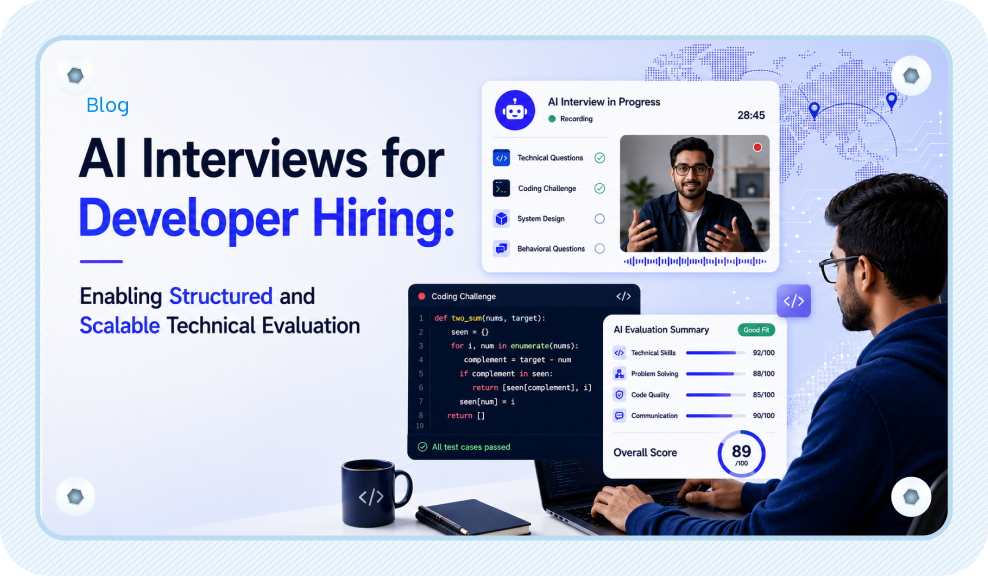
Developer hiring is one of the most difficult hiring categories for enterprises because technical ability is not easy to judge from a resume, portfolio, or coding test alone.
A developer may know the right frameworks, list strong projects, or perform well in a short assessment, but those signals do not always show how they solve problems, debug issues, explain trade-offs, or apply technical knowledge in real engineering environments.
This is where developer hiring becomes difficult: technical evaluation is often inconsistent, time-intensive, and heavily dependent on individual interviewers. One interviewer may focus on coding accuracy, another may prioritize architecture, while another may assess communication or problem-solving depth. As hiring volumes grow, these differences make candidate comparison harder and reduce confidence in technical hiring decisions.
Strong developer hiring requires more than resume screening or coding tests. It requires structured evaluation of technical thinking, coding ability, problem-solving approach, debugging mindset, and role-specific capability.
AI interviews help enterprises create this structured first-round technical evaluation layer. By standardizing how developer candidates are assessed, organizations can improve consistency, reduce unnecessary engineering interview load, and ensure human interviewers spend more time on deeper, higher-value technical conversations.
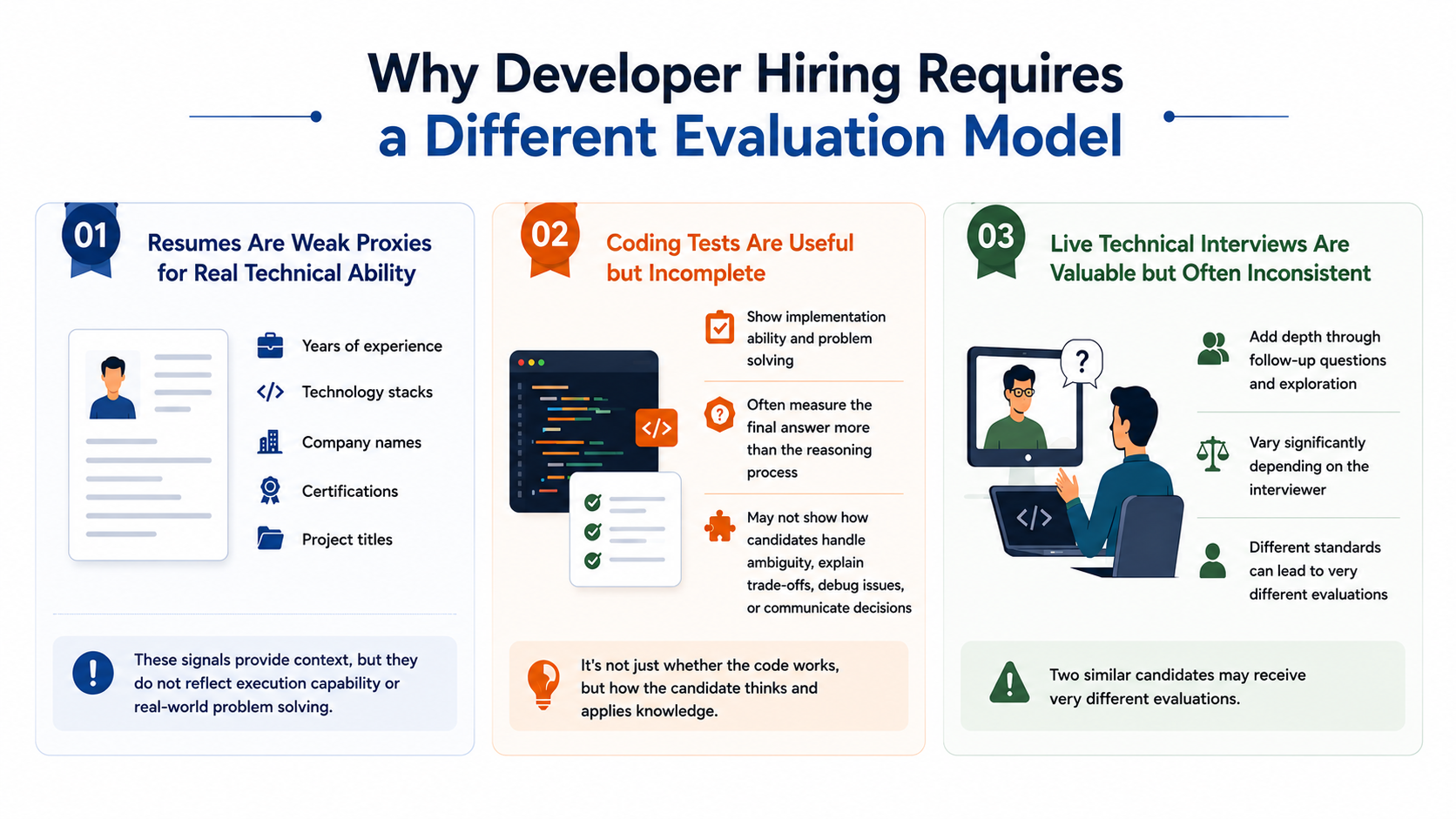
Developer hiring cannot rely on the same evaluation model used for many other roles. Software engineering performance is not visible from one signal alone. A resume, a coding test, or a live interview may each reveal part of a candidate’s ability, but none of them gives a complete view of how a developer will perform in a real engineering environment.
Developer resumes often highlight years of experience, technology stacks, company names, certifications, and project titles. These signals are useful for initial context, but they do not always reflect execution capability.
A candidate may have worked with Java, Python, React, or cloud platforms, but that does not automatically show how well they can solve problems, debug production issues, write maintainable code, or make technical trade-offs. Strong brands and impressive project names can also create false confidence, while capable developers from less familiar backgrounds may be overlooked.
Coding tests are important because they provide evidence of implementation ability. They help hiring teams understand whether a candidate can write code, solve defined problems, and produce working output.
But coding tests alone are not enough. They often measure the final answer more than the candidate’s reasoning process. They may not show how the candidate clarifies requirements, handles ambiguity, explains trade-offs, debugs issues, communicates technical decisions, or approaches real-world constraints.
For developer hiring, the question is not only whether the code works. It is also how the candidate thinks, solves problems, and applies technical knowledge.
Live technical interviews add depth because interviewers can ask follow-up questions and explore reasoning. However, they can also vary significantly depending on the interviewer.
Different interviewers may ask different questions, apply different standards, or score candidates subjectively. As a result, two similar candidates may receive very different evaluations.
Developer hiring is difficult because technical capability must be assessed across multiple dimensions, not just one signal. Enterprises need a more structured evaluation model that makes developer interviews consistent, comparable, and role-specific.
Developer hiring is not just about testing whether a candidate can write code. It is about evaluating how candidates think, solve problems, apply technical knowledge, and work through real engineering situations.
A strong developer hiring process needs a structured technical evaluation model that goes beyond resumes and isolated coding tests. It should help hiring teams understand whether a candidate can take a role-specific problem, reason through it clearly, make sound technical decisions, and explain their approach.
This requires five things.
First, developer interviews need to be structured. Candidates applying for the same role should be evaluated against the same technical competencies, not against whatever questions an individual interviewer chooses to ask.
Second, coding and problem-solving assessment should be standardized. The goal is not only to check whether the final answer works, but also to understand the candidate’s reasoning, debugging approach, edge-case thinking, and code quality.
Third, evaluation criteria must be role-relevant. A backend developer, frontend developer, full-stack developer, and mobile developer may all need different technical signals. The assessment should reflect the actual complexity, stack, and expectations of the role.
Fourth, scoring must be consistent across interviewers and teams. Without a shared rubric, technical interviews can become subjective, making candidate comparison difficult.
Finally, the process should use engineering interviewer time efficiently. Engineers should not spend most of their time filtering candidates who lack baseline technical readiness. Their time is better used in deeper technical conversations with candidates who have already demonstrated relevant capability.
Developer hiring requires structure because strong engineering talent cannot be judged from one signal alone. It requires a comparable, role-specific evaluation process that captures technical thinking, practical problem-solving, and execution ability.
Traditional developer interviewing may work when a company is hiring a small number of engineers. The process depends on a few trusted interviewers, informal calibration, and close communication between hiring managers and engineering teams.
But as developer hiring grows across teams, locations, and roles, this model becomes difficult to scale. More candidates enter the pipeline, more interviewers get involved, and technical evaluation becomes harder to keep consistent.
Developer interviews often require engineering involvement early in the process. Senior engineers and technical leads are asked to screen candidates, conduct coding discussions, review technical answers, and participate in debriefs.
This creates a significant interviewer bandwidth problem. Every hour spent on early-stage interviews is time taken away from product delivery, architecture decisions, code reviews, and mentoring.
The problem becomes worse when too many candidates reach technical rounds without enough evidence of baseline capability. Engineering teams end up spending time on candidates who are not role-ready, while stronger candidates may not always be prioritized quickly enough.
Traditional technical interviews are also difficult to standardize. Different interviewers may ask different questions, focus on different skills, or apply different scoring standards.
One interviewer may emphasize coding correctness, another may focus on debugging depth, and another may judge communication or architectural thinking more heavily. While all of these are important, inconsistency makes candidate comparison unreliable.
At scale, this creates a serious problem. Candidate outcomes may depend too much on who conducts the interview rather than how well the candidate matches the role.
Many hiring teams rely heavily on resumes or basic screening calls before moving candidates into technical interviews. But resumes do not always show real coding ability, problem-solving depth, or role-specific readiness.
As a result, too many candidates may reach engineering-led rounds without enough structured technical evidence. This increases interview load, slows down hiring, and makes the process more expensive to manage.
Without a structured evaluation layer, developer hiring becomes expensive, inconsistent, and difficult to scale.
AI interviews improve developer hiring by creating a structured technical evaluation layer before deeper human interviews. Instead of relying only on resumes, manual screening calls, or interviewer availability, hiring teams can evaluate developer candidates against consistent role-specific criteria from the beginning of the process.
This is especially useful in technical hiring because developer evaluation often varies from one interviewer to another. One interviewer may focus on coding correctness, another may focus on debugging depth, while another may prioritize communication or architectural thinking. AI interviews help reduce this variability by giving every candidate a more standardized first-round evaluation.
For developer roles, this evaluation can include coding ability, problem-solving approach, technical reasoning, debugging mindset, and role-specific knowledge. The goal is not just to identify candidates who look suitable on paper, but to understand whether they can apply technical knowledge in a structured assessment environment.
AI interviews also help engineering teams use their time better. Instead of spending valuable engineering bandwidth on early-stage filtering, technical interviewers can focus on candidates who have already demonstrated relevant capability.
This does not remove the need for human judgment. Final hiring decisions, deeper technical discussions, system design evaluation, and team-fit assessment should remain with human interviewers and hiring teams.
AI interviews support developer hiring by handling structured screening and first-round technical evaluation, while human interviewers focus on deeper judgment and final decision-making.
Coding interviews are an important part of developer hiring, but they should not be treated as the complete evaluation process.
A coding assessment can show whether a candidate can write code, solve a defined problem, and produce working output. These are important signals, but developer hiring also requires a broader view of technical capability.
Hiring teams also need to understand how candidates think through problems, clarify requirements, handle edge cases, debug issues, explain trade-offs, and apply technical knowledge to role-specific scenarios.
This is where AI coding interviews fit in. They help add structure and consistency to coding evaluation by using standardized coding tasks, role-relevant problem statements, defined scoring rubrics, and comparable technical benchmarks.
However, AI coding interviews should sit inside a broader developer hiring process. Coding ability matters, but it is not the only signal that predicts developer success. Communication, collaboration, architecture thinking, practical judgment, and role-fit still need to be evaluated through wider technical interviews and human-led discussions.
AI coding interviews strengthen developer hiring when they are used as part of a structured technical evaluation process, not as the only hiring signal.
For a deeper breakdown of coding interview formats, scoring, proctoring, and reports, read our guide on AI Coding Interviews.
An AI-enabled developer hiring process should not simply automate the existing hiring funnel. It should make technical evaluation more structured from the beginning.
The process starts with role definition and skill mapping. Hiring teams need to define the stack, complexity, and must-have technical signals for the role. A backend developer may need API design, database handling, debugging, and reliability thinking. A frontend developer may need UI logic, component architecture, state management, and browser behavior. A full-stack developer may need both application logic and integration thinking.
The next layer is AI screening. This helps evaluate whether a candidate’s background, experience, and projects are relevant enough for deeper technical assessment. For developer hiring, this should go beyond resume keyword matching and focus on role-relevant readiness.
After screening, candidates can move into an AI technical interview. This may include structured technical questions, coding or problem-solving tasks, debugging scenarios, and reasoning-based follow-ups. The goal is to understand how candidates apply technical knowledge, not just whether they know a concept.
The next step is scoring and benchmarking. Candidates should be assessed against standardized criteria such as coding correctness, problem-solving approach, debugging depth, code quality, technical explanation, and role-specific readiness.
Finally, shortlisted candidates move into human-led technical interviews. These rounds should focus on deeper areas such as system design, architecture thinking, collaboration style, code review judgment, and final role fit.
AI interviews improve developer hiring by ensuring technical evaluation starts with structure, not interviewer availability. Human interviewers then spend their time where it matters most: validating depth, context, and final fit.
For a broader explanation of how AI interviews work across hiring stages, read our guide on AI Interviews. For early-stage filtering, read our guide on AI Screening Interviews.
Enterprises see the strongest impact from AI interviews when they use them to improve the quality and consistency of developer evaluation, not just to move candidates faster through the funnel.
Developer hiring is expensive when engineering teams spend too much time on early-stage interviews, candidate quality varies widely, and technical evaluation depends on individual interviewer judgment. A structured AI interview layer helps reduce these issues by creating a more consistent way to assess technical readiness before deeper human interviews.
The first impact area is shortlist quality. When candidates are evaluated through role-specific technical questions, coding tasks, problem-solving scenarios, and structured scoring, hiring teams can identify stronger candidates earlier. This improves the quality of candidates who move into engineering-led rounds.
The second impact area is engineering interviewer bandwidth. Senior engineers and technical leads should not spend most of their interview time filtering candidates who lack baseline readiness. AI interviews help ensure that engineering teams focus on candidates who have already demonstrated relevant technical capability.
The third impact area is evaluation consistency. Enterprises hiring across multiple teams, locations, or business units often struggle to maintain the same hiring bar. AI interviews provide a standardized evaluation framework, making candidate comparison more reliable across panels.
The fourth impact area is role-fit matching. Developer roles are not identical. Backend, frontend, full-stack, mobile, and DevOps roles require different signals. AI interviews can help align evaluation criteria to the specific skills and complexity of each role.
Finally, AI interviews help candidates move through early rounds more efficiently. Instead of waiting for interviewer availability at every step, candidates can be assessed through a structured first-round layer before human deep dives.
Standardized technical evaluation helps enterprises improve hiring quality while reducing dependence on engineering bandwidth.
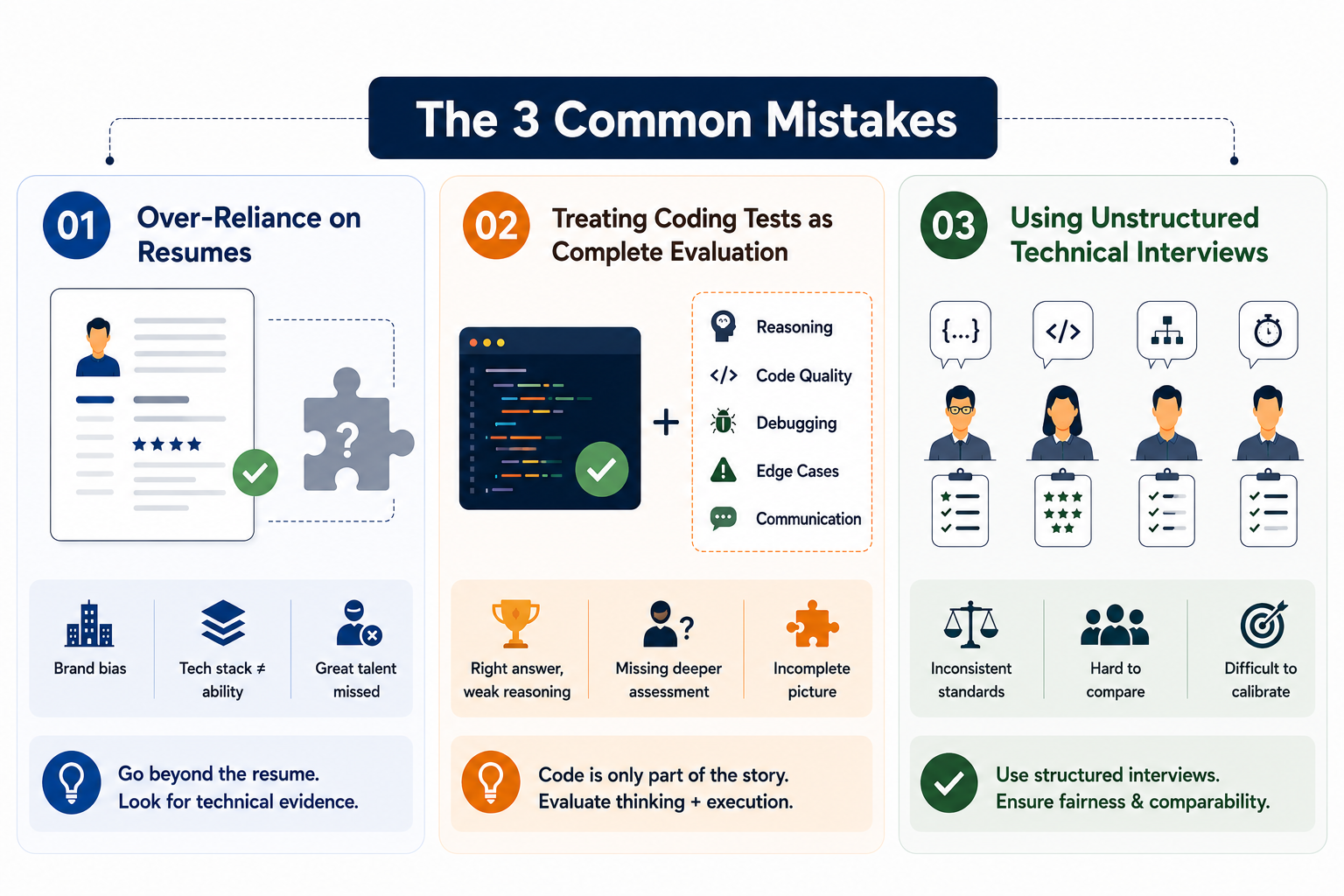
Developer hiring quality often drops when companies rely on signals that are easy to collect but incomplete. A resume, a coding test, or a single technical interview may provide useful information, but none of them is enough to evaluate developer capability on its own.
The strongest hiring processes avoid three common mistakes.
Resumes are useful for understanding a candidate’s background, but they are weak proxies for real technical ability.
A developer may list the right technologies, previous employers, or project names, but that does not always show whether they can solve problems, write maintainable code, debug issues, or make sound technical decisions.
Strong company names and familiar technology stacks can also create false confidence. At the same time, capable developers from lesser-known companies or non-traditional backgrounds may be overlooked.
Developer hiring should not stop at resume validation. It needs structured technical evidence.
Coding tests are valuable because they help assess implementation ability. They show whether a candidate can solve a defined problem and produce working code.
But coding output alone is not the full story.
A candidate may arrive at the right answer without clearly explaining their reasoning. Another candidate may show strong problem-solving ability but need deeper evaluation on code quality, debugging, or edge-case handling.
Developer hiring becomes stronger when coding assessment is combined with evaluation of technical thinking, communication, debugging approach, and practical judgment.
Unstructured interviews create inconsistent hiring outcomes.
When every interviewer asks different questions or applies different standards, candidates are not evaluated fairly or comparably. One interviewer may focus on syntax, another on architecture, another on communication, and another on speed.
This makes hiring decisions difficult to calibrate across candidates, teams, and roles.
Structured technical interviews solve this problem by using role-specific competencies, consistent questions, defined scoring criteria, and comparable evaluation rubrics.
Developer hiring quality improves when technical evaluation is structured, comparable, and role-specific.
AI interviews make the most sense when companies need to evaluate developer candidates regularly, consistently, and without overloading engineering teams.
They are not a replacement for every technical conversation. Instead, they work best as a structured first-round evaluation layer that helps hiring teams identify technically relevant candidates before deeper human interviews.
AI interviews are especially useful when organizations are hiring developers across multiple roles or teams. Backend, frontend, full-stack, mobile, and DevOps roles may require different technical signals, but the evaluation process still needs a common structure. AI interviews help standardize this first layer while adapting questions and scoring criteria to the role.
They also make sense when technical interviewer bandwidth is limited. Senior engineers and technical leads should not spend most of their time conducting early-stage screens. AI interviews help filter candidates through structured technical evaluation so engineering teams can focus on deeper discussions with stronger candidates.
Another strong use case is consistency across interviewers, business units, or locations. When multiple teams are hiring developers at the same time, interview quality can vary. A standardized AI interview layer helps ensure candidates are assessed against comparable criteria before human-led rounds.
AI interviews are also useful for distributed or multi-location hiring, where interviewer availability, scheduling, and time zones can slow down early technical evaluation. In these situations, structured AI-led assessments can reduce dependency on live scheduling while keeping the process role-relevant.
However, AI interviews are not always the best fit. Companies should be careful when hiring for highly niche research roles, very senior engineering leadership roles, or positions where contextual judgment, team influence, or strategic decision-making must be assessed from the first interaction.
The strongest developer hiring processes do not choose between AI and humans. They use AI interviews to standardize screening and first-round technical evaluation, while human interviewers remain responsible for deeper technical judgment and final hiring decisions.
Developer hiring should not be measured only by how quickly roles are filled. Speed matters, but it does not prove that the hiring process is identifying strong engineering talent.
A better measurement model looks at whether the process improves technical evaluation quality, reduces unnecessary engineering effort, and helps hiring teams make more confident decisions.
The first metric is engineering interviewer hours saved. If AI interviews handle structured screening and first-round technical evaluation, engineering teams should spend less time on early-stage filtering and more time on deeper technical discussions with qualified candidates.
The second metric is shortlist quality. Hiring teams should track whether candidates moving into human-led technical rounds are better aligned to the role, stronger on must-have skills, and more prepared for deeper evaluation.
The third metric is interview-to-offer ratio. If technical evaluation becomes more accurate earlier in the funnel, fewer interviews should be needed to identify offer-worthy candidates.
The fourth metric is consistency of technical evaluation. Enterprises should review whether candidates are being assessed against the same role-specific criteria across teams, locations, and interview panels. This is especially important for organizations hiring developers across multiple business units.
The fifth metric is time-to-hire for developer roles. AI interviews can help reduce delays in early technical evaluation, especially when interviewer availability is limited. However, time-to-hire should always be reviewed alongside quality indicators, not in isolation.
The goal is not simply to make developer hiring faster. The goal is to make technical evaluation more structured, comparable, and predictive of role readiness.
Candidate Experience in Developer Hiring
Developer candidates value technical evaluation that feels relevant, structured, and aligned to the role.
A poor developer hiring experience often comes from unclear expectations, long scheduling delays, repetitive interview rounds, or technical questions that do not reflect real engineering work. When candidates feel the process is inconsistent or disconnected from the role, it can reduce trust in the hiring organization.
A structured AI interview layer can improve candidate experience by making the early evaluation process clearer and more consistent. Candidates can be assessed against the same role-specific criteria, which helps the process feel fairer and less dependent on which interviewer happens to be available.
It also helps set clearer expectations. When technical assessments are mapped to the role, candidates understand what they are being evaluated on, whether that is coding ability, debugging approach, problem-solving, technical communication, or role-specific knowledge.
AI interviews can also reduce delays in early technical evaluation. Instead of waiting for multiple interviewer schedules to align, candidates can complete structured first-round assessments earlier in the process. This helps hiring teams move qualified candidates forward faster while still preserving deeper human interviews for later stages.
The experience improves when candidates are not asked to go through unnecessary or repetitive rounds before their technical readiness is understood. For developers, a good hiring process should feel practical, respectful of time, and connected to the work they are expected to perform.
Developer hiring is not only about evaluating candidates accurately. It is also about giving candidates a process that feels fair, relevant, and professionally run.
Developer hiring requires a different evaluation model because technical ability cannot be judged from one signal alone. Resumes, portfolios, coding tests, and live interviews each provide useful information, but they need to be connected through a structured, role-specific evaluation process.
Resumes and coding tests are important, but they are not enough. A resume may show experience, and a coding test may show output, but developer hiring also needs to assess problem-solving, debugging approach, technical reasoning, communication, and practical judgment.
AI interviews help enterprises standardize the early stages of developer evaluation. By using structured screening, role-specific technical questions, coding or problem-solving assessments, and consistent scoring criteria, hiring teams can compare candidates more reliably before deeper human interviews.
Engineering interviewer time should be used where it creates the most value. Instead of spending large amounts of time on early-stage filtering, engineers can focus on shortlisted candidates who have already demonstrated relevant technical capability.
The goal of AI in developer hiring is not to replace human interviewers. It is to create a more structured technical evaluation layer so human interviewers can make better, more informed final decisions.
.avif)
.avif)


.svg)

.svg)


%201.svg)
.svg)

.webp)