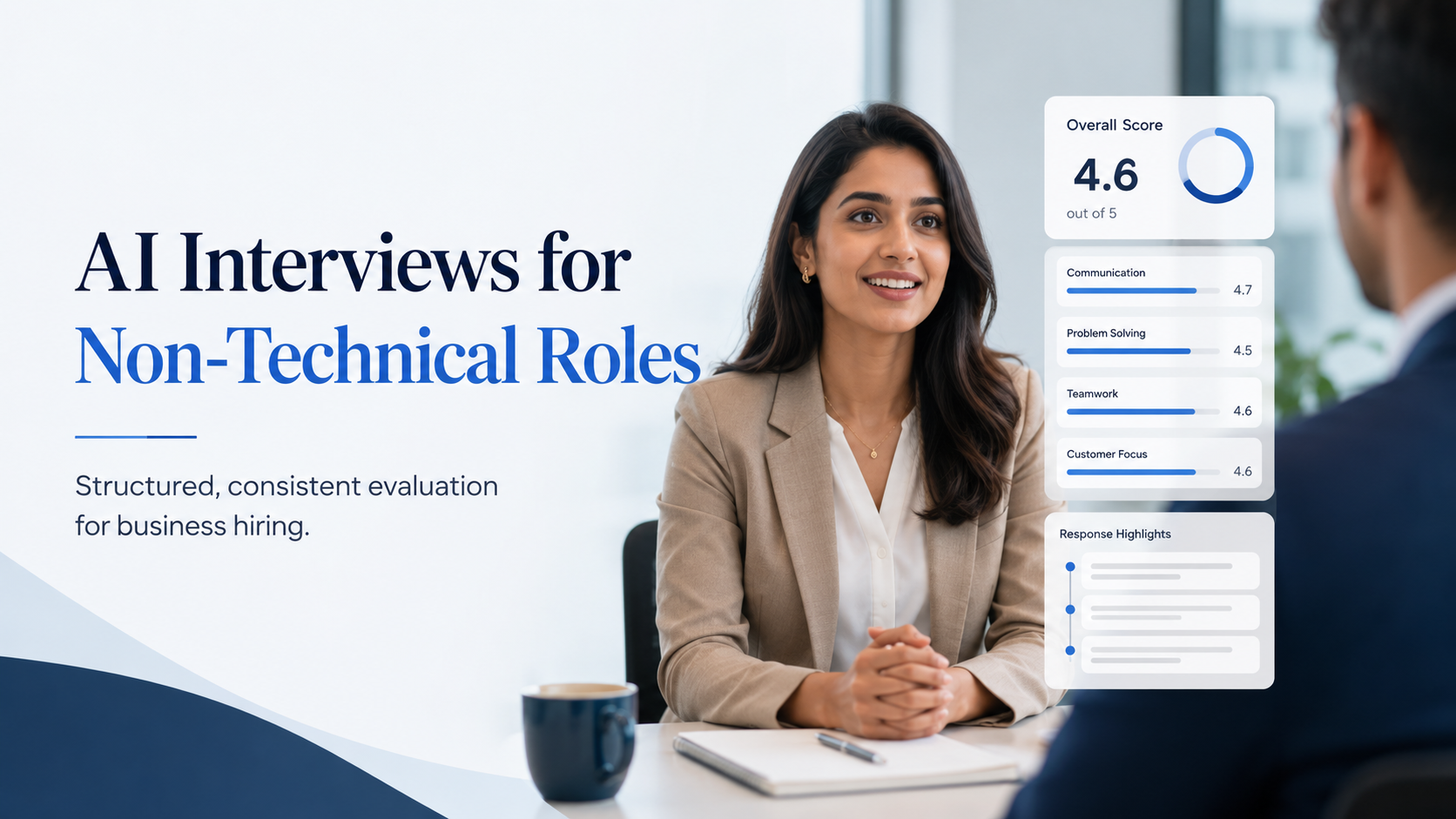
Hiring for non-technical roles is often harder to standardize than it appears.
In business functions such as operations, finance, HR, administration, business support, and corporate services, success is not measured through coding tests or technical assessments. Hiring teams need to understand how candidates communicate, reason, prioritize, respond to workplace situations, and apply judgment in role-relevant contexts.
That is where non-technical hiring becomes difficult.
Resumes may look strong, but they do not always show whether a candidate can handle competing priorities, communicate with stakeholders, follow a process, or make sound decisions under pressure. Interviews may feel conversational, but different interviewers often evaluate different things. One interviewer may focus on confidence, another on communication style, another on past experience, and another on vague “fit.”
Hiring for non-technical roles becomes difficult when evaluation depends too heavily on interviewer judgement, inconsistent questions, and weak comparison standards.
Strong hiring for non-technical roles requires more than resume screening. It requires structured evaluation of communication, judgement, role relevance, and job-specific capability.
This is where AI interviews can help enterprises introduce a more consistent, comparable, and role-relevant evaluation layer for non-technical business hiring.
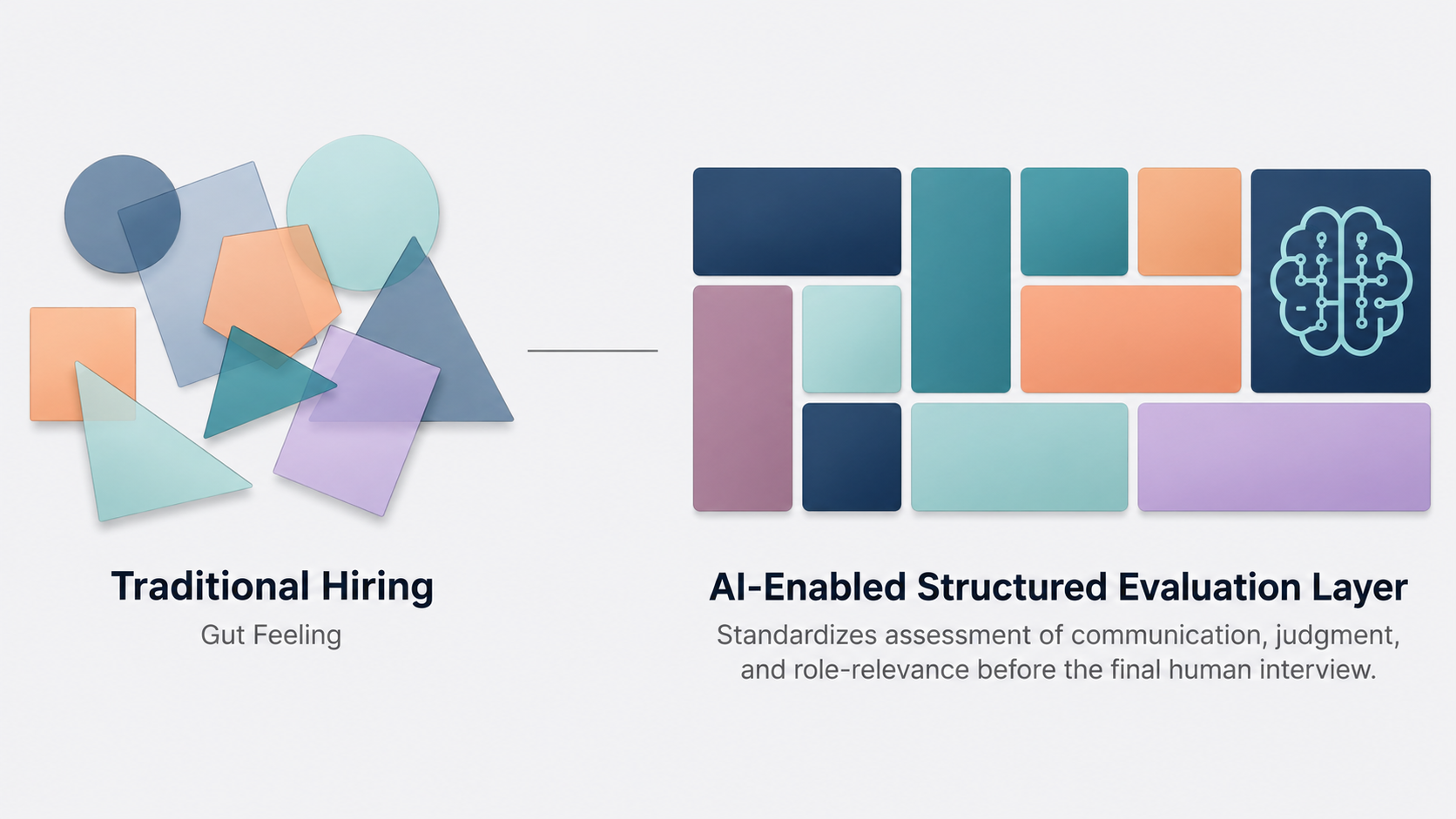
Non-technical roles are sometimes treated as easier to assess because they do not require deep technical testing. In reality, they can be harder to evaluate consistently because the signals are often behavioral, situational, and role-dependent.
A candidate’s success may depend on how they communicate, manage ambiguity, prioritize work, respond to stakeholders, escalate issues, or make practical decisions. These qualities are important, but they are also easy to judge subjectively without a structured process.
A resume can show experience, job titles, industries, and responsibilities. It cannot reliably show how someone performs in real workplace situations.
Two candidates may both have experience in operations, HR, finance, or administration, but their actual capability may differ significantly. One may be strong at process execution. Another may be better at stakeholder communication. A third may have the right experience on paper but struggle when asked to prioritize competing tasks or explain decisions clearly.
For non-technical roles, resume quality should be treated as an input, not the full basis for evaluation. Enterprises need a way to assess how candidates think and respond in job-relevant situations.
Traditional interviews for business roles often rely on open-ended conversations. While these conversations can be useful, they become risky when there is no shared evaluation framework.
Different interviewers may prioritize different signals. A recruiter may focus on communication. A hiring manager may focus on ownership. A business stakeholder may focus on process discipline. Another interviewer may simply respond to how confident or polished the candidate appears.
Without structured questions and common scoring criteria, candidate comparison becomes inconsistent.
Non-technical hiring is often harder to standardize because performance depends on multiple behavioral and role-relevant signals, not just experience on paper.
For example, an operations role may require prioritization and escalation judgment. An HR role may require confidentiality, empathy, and policy awareness. A finance support role may require accuracy, process orientation, and communication with internal teams. A business support role may require coordination, follow-up discipline, and ownership.
The evaluation process must be designed around these role-specific expectations instead of relying on broad impressions.
Hiring for non-technical roles is not just about evaluating experience. It is about assessing how candidates think, communicate, and respond in role-relevant situations.
A stronger non-technical hiring process usually requires five things.
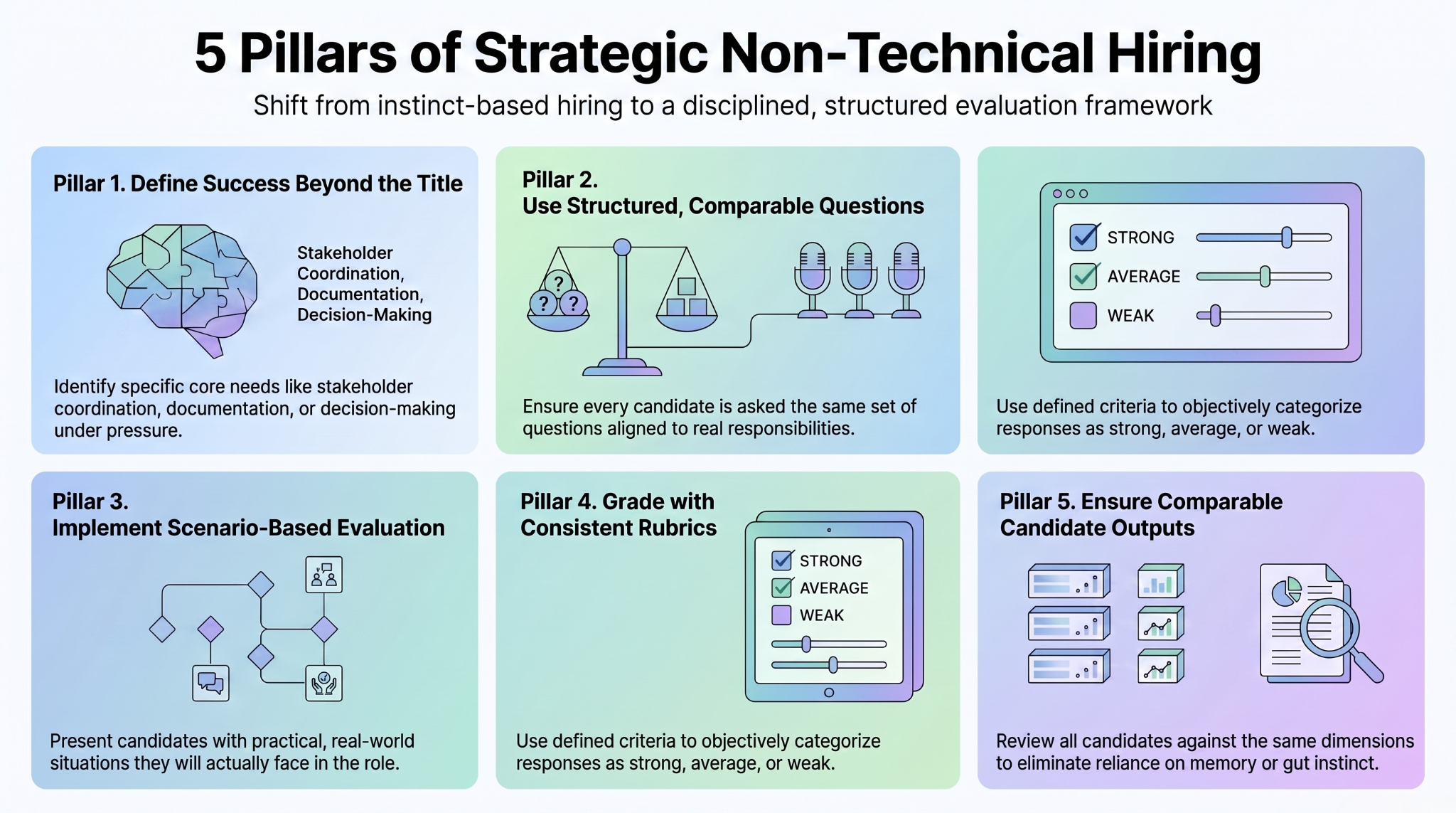
First, the role must be defined clearly. Hiring teams need to identify what success looks like beyond the job title. For example, does the role require stakeholder coordination, process accuracy, escalation handling, documentation, client communication, or decision-making under pressure?
Second, the interview should use structured questions. Candidates should be asked comparable questions that are aligned to the role’s real responsibilities.
Third, the process should include scenario-based evaluation. Instead of asking only general questions, hiring teams should present candidates with practical situations they may face in the role.
Fourth, responses should be evaluated using consistent criteria. A structured rubric helps define what a strong, average, or weak response looks like.
Fifth, candidate outputs should be comparable. Recruiters and hiring managers should be able to review candidates against the same dimensions instead of relying on memory, instinct, or fragmented feedback.
This does not make non-technical hiring mechanical. It makes the process more disciplined, fair, and useful for decision-making.
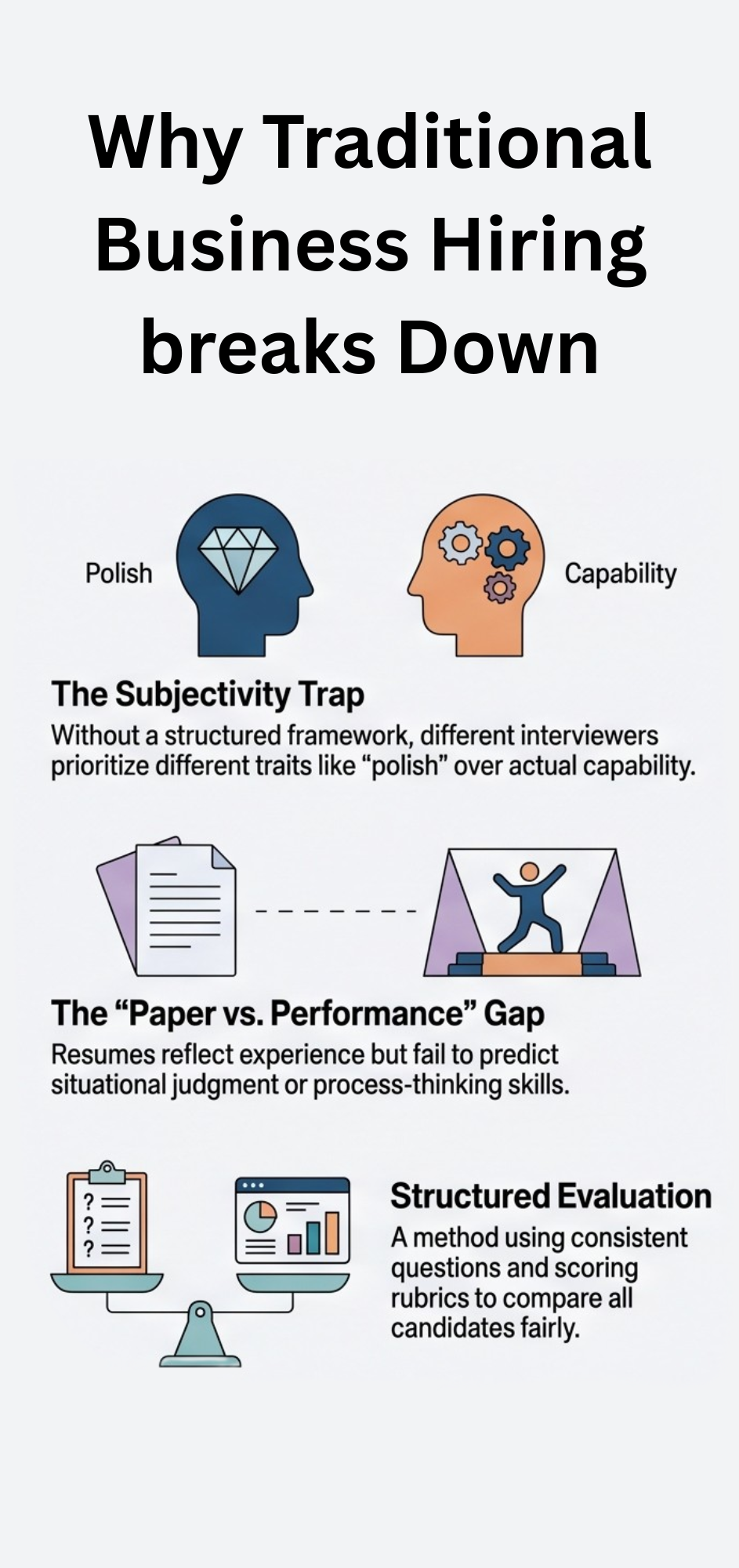
Traditional non-technical interviewing often breaks down because it tries to evaluate complex workplace behavior through informal conversations.
The problem is not that human interviews are unimportant. Human judgment is essential. The problem is that early-stage interviews often lack the structure needed to make that judgment consistent.
In many organizations, the quality of a non-technical interview depends heavily on who conducts it.
One manager may ask detailed situational questions. Another may focus on personality. Another may spend most of the interview reviewing the resume. Another may evaluate whether the candidate “feels right” for the team.
This creates uneven evaluation. Candidates are not always assessed against the same expectations, and hiring teams may struggle to explain why one candidate progressed while another did not.
Early-stage interviews often become screening conversations rather than structured evaluations.
Questions may vary from candidate to candidate. Scoring may be unclear. Interview notes may be inconsistent. Feedback may be based on phrases like “good communication” or “not confident enough” without explaining what that means in relation to the role.
For business roles, this is especially risky because many important signals are behavioral. If the process does not define those signals clearly, interviewers may interpret them differently.
Without structured evaluation, non-technical hiring becomes inconsistent, difficult to compare, and harder to scale across teams.
When candidates are asked different questions and evaluated by different standards, hiring teams do not get a reliable basis for comparison. Decisions become harder to defend, especially when multiple stakeholders are involved.
A structured evaluation process solves this by ensuring that every candidate is assessed against the same role-relevant dimensions.
AI interviews help enterprises create a structured evaluation layer for non-technical hiring.
They do not remove the need for recruiters or hiring managers. Instead, they help standardize early-stage evaluation so that human teams receive stronger, more comparable candidate signals before investing time in deeper interviews.
AI interviews can ask every candidate the same role-relevant questions in a consistent format. This reduces variation in the early interview process and gives hiring teams a clearer basis for comparison.
For example, candidates for an operations role can be evaluated on prioritization and escalation judgment. Candidates for an HR role can be evaluated on confidentiality, empathy, and policy reasoning. Candidates for an administrative role can be evaluated on coordination, follow-up discipline, and accuracy.
The value lies in giving each candidate the same opportunity to demonstrate job-relevant capability.
In non-technical roles, communication is not just about speaking fluently. It is about explaining decisions clearly, structuring thoughts, adapting to the audience, and responding professionally in realistic situations.
AI interviews can evaluate how candidates respond to role-based prompts. The assessment can consider whether the candidate understood the situation, structured the response, identified the right priorities, and communicated next steps clearly.
This makes communication assessment more evidence-based and less dependent on general impressions.
AI interviews reduce variation by applying the same evaluation framework to every candidate.
This is especially useful when multiple recruiters, departments, business units, or locations are involved. Instead of each interviewer applying a different standard, the organization can use common competencies, common questions, and common scoring criteria.
That does not mean every role is evaluated the same way. It means every role has a defined evaluation framework.
AI interviews can also help qualified candidates move through early rounds faster.
When early-stage evaluation is structured, hiring managers do not need to spend as much time on candidates who are clearly misaligned. They can focus their time on candidates who have already demonstrated relevant communication, reasoning, and role-fit signals.
AI interviews create a structured evaluation layer for non-technical roles, making early-stage hiring more consistent, comparable, and role-relevant.
AI interviews support hiring for non-technical roles by handling structured screening and first-round evaluation, while final hiring decisions remain with human interviewers and hiring teams.
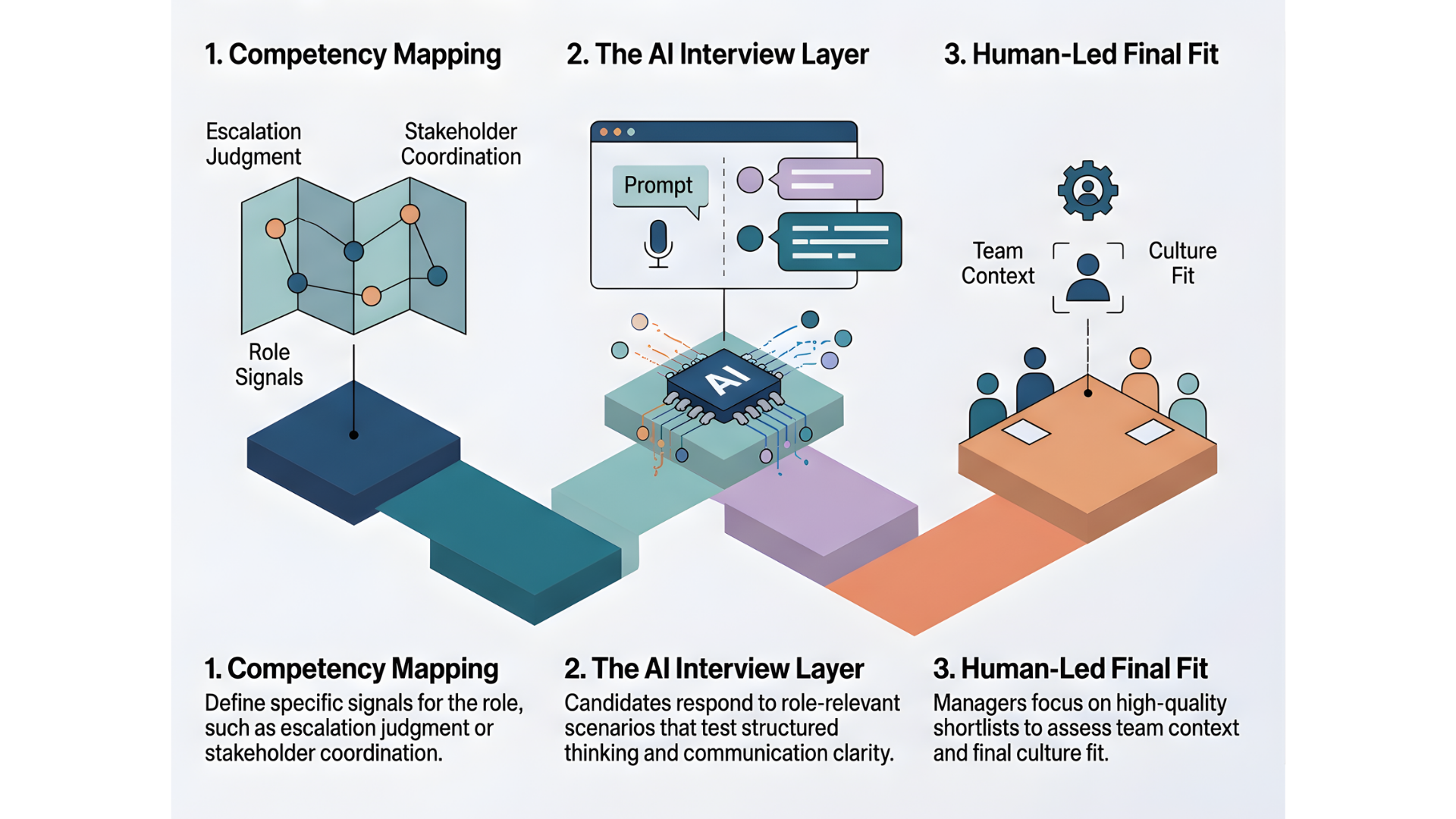
An AI-enabled non-technical hiring process should not begin with automation. It should begin with role clarity.
The purpose is not to replace hiring managers. The purpose is to introduce structure and comparability before managers invest time in deeper interviews.
A strong process usually follows five steps.
The hiring team first defines what the role actually requires.
For a finance support role, this may include accuracy, process discipline, documentation, and stakeholder communication. For an HR operations role, it may include confidentiality, policy understanding, empathy, and escalation judgment. For an operations role, it may include prioritization, follow-through, and process thinking.
This step ensures that the interview evaluates the actual work, not just generic personality traits.
The AI screening layer helps identify candidates who meet baseline requirements before deeper evaluation begins.
This may include checking basic eligibility, role alignment, communication readiness, or initial fit against defined criteria. The screening layer should not be treated as the final hiring decision. It is a way to create a cleaner and more relevant candidate pool for structured evaluation.
The AI interview layer asks structured, role-relevant questions.
Instead of relying only on general interview questions, the AI interview can present candidates with workplace scenarios. For example:
An operations candidate may be asked how they would prioritize three urgent requests with limited resources.
An HR candidate may be asked how they would respond to a sensitive employee concern.
A finance support candidate may be asked how they would handle a discrepancy in a recurring report.
An administrative candidate may be asked how they would coordinate multiple stakeholder requests with overlapping deadlines.
These prompts help assess how candidates think, communicate, and respond in realistic situations.
After the interview, responses are evaluated against common dimensions such as communication clarity, structured thinking, judgment, role relevance, and process orientation.
This gives hiring teams a more consistent way to compare candidates. Instead of only seeing a resume and interview notes, recruiters and managers can review competency-based outputs and identify where each candidate is strong or weak.
The goal is not to reduce people to scores. The goal is to make early-stage evaluation more transparent and comparable.
Human interviews remain essential.
Once candidates are shortlisted through structured evaluation, hiring managers can focus on deeper conversations. These later rounds can explore team fit, stakeholder expectations, work context, motivation, and role-specific nuance.
AI interviews improve non-technical hiring by introducing structure and comparability before managers invest time in deeper interviews.
For non-technical roles, the value of AI interviews lies in structured, role-relevant evaluation, not generic automation.
AI interviews are most useful when the competency can be observed through a candidate’s response to a structured question or realistic scenario.
They can evaluate communication clarity by reviewing whether the candidate explains ideas in a clear, organized, and professional way.
They can evaluate structured thinking by looking at how the candidate breaks down a problem, identifies priorities, and explains the reasoning behind a decision.
They can evaluate situational judgment by presenting workplace scenarios where there may not be one perfect answer, but where the quality of reasoning matters.
They can evaluate process orientation by assessing whether the candidate follows logical steps, considers dependencies, and understands when to escalate.
They can evaluate role relevance by checking whether the response reflects the actual expectations of the job.
However, AI should not be the only evaluator. Final contextual judgment still matters. Human interviewers are needed to interpret nuance, assess team context, and make the final hiring decision.
Enterprises see the greatest impact when AI interviews are used to improve consistency, comparability, and shortlist quality.
The first area of impact is more consistent candidate comparison. When every candidate is assessed against the same competencies, hiring teams can compare responses more confidently.
The second area is reduced interviewer subjectivity. Structured questions and scoring criteria reduce the risk of decisions being driven only by confidence, polish, or personal preference.
The third area is better early-stage filtering. Candidates who are clearly misaligned can be filtered earlier, while stronger candidates can move forward faster.
The fourth area is reduced hiring manager time spent on weak candidates. Managers can focus on candidates who have already demonstrated relevant communication, reasoning, and role-fit signals.
The fifth area is more defensible hiring decisions. When evaluations are structured and documented, hiring teams can explain why candidates were shortlisted or rejected based on role-relevant criteria.
Structured evaluation improves non-technical hiring by helping teams compare candidates more consistently and progress stronger candidates faster.
Many non-technical hiring challenges come from a lack of structure.
A strong resume does not always mean strong job performance. Candidates may present experience well but still struggle with judgment, communication, process discipline, or ownership.
Resumes should help identify potential fit, but they should not replace structured evaluation.
Unstructured interviews create inconsistent candidate experiences and unreliable comparisons.
When different candidates are asked different questions and evaluated by different standards, hiring teams lose the ability to compare them fairly.
Confidence can influence interviewer perception, but it should not be mistaken for job readiness.
A candidate who sounds polished may not always demonstrate strong reasoning or role-specific judgment. Similarly, a less polished candidate may still show strong capability through a clear, practical, and well-structured response.
Non-technical hiring improves when evaluation is structured around role relevance, not just interviewer impressions.
AI interviews make sense when organizations hire regularly for non-technical business roles and need a more consistent way to evaluate candidates.
They are useful when early-stage interviews feel too subjective, when different interviewers apply different standards, or when hiring managers want stronger shortlists before spending time on deeper conversations.
They are also useful when organizations need to compare candidates across teams, departments, locations, or similar role families.
AI interviews may be less suitable when hiring for highly senior, relationship-driven, or highly strategic roles where the evaluation depends heavily on context, negotiation, leadership presence, and long-term influence.
In those cases, AI may still support documentation or first-level screening, but human-led evaluation should remain central.
The best use of AI interviews in non-technical hiring is not full automation. It is structured support for better human decision-making.
To measure whether AI interviews are improving non-technical hiring, enterprises should track both process and quality metrics.
Shortlist quality is one of the most important indicators. Hiring managers should see more candidates who are relevant, prepared, and aligned with the role.
Interviewer hours saved can show whether structured early evaluation is reducing time spent on weak or poorly matched candidates.
Time-to-hire can help measure whether candidates are moving through early rounds more efficiently.
Candidate progression rate can show whether the process is identifying stronger candidates earlier.
Consistency of first-round evaluation is also important. Hiring teams should review whether candidates are being evaluated against the same competencies and whether scoring remains aligned across similar roles.
The goal is not simply to hire faster. The goal is to make early-stage evaluation more consistent, useful, and predictive of role readiness.
Candidates for non-technical roles value hiring processes that feel structured, relevant, and consistent.
A strong AI interview experience should make it clear what the role involves, what skills are being assessed, how long the interview will take, and what the next steps are.
Scenario-based questions can improve candidate experience because they feel closer to the actual job. Instead of answering only generic questions, candidates get a chance to demonstrate how they would think and respond in real workplace situations.
Consistency also matters. When every candidate receives the same core questions and is evaluated against the same criteria, the process feels less random.
AI can support candidate experience by making early-stage interviews more accessible and structured. But human communication remains important. Candidates should still receive clear updates, transparent instructions, and a process that respects their time.
Unstructured interviews depend heavily on interviewer style. One interviewer may ask detailed role-based questions, while another may rely on general conversation. This creates inconsistency and makes candidate comparison difficult.
Structured AI interviews improve comparability by asking candidates the same role-relevant questions and assessing responses against predefined criteria.
This is especially useful in business-role hiring because many important signals are not visible on the resume. Communication, judgment, prioritization, stakeholder handling, and process thinking need to be evaluated through structured responses.
Human interviews still matter. They are especially important later in the funnel, when hiring managers need to assess team context, motivation, working style, and final role fit.
The strongest model is not AI versus human interviewing. It is AI-supported structure followed by human-led decision-making.
Unstructured interviews often create inconsistency in business-role hiring, while structured AI interviews improve comparability in early-stage evaluation.
Non-technical roles still require structured evaluation.
Resumes and conversational interviews alone are not enough to assess communication, judgment, reasoning, and role-specific capability.
AI interviews can help enterprises standardize early-stage evaluation for business roles by using structured questions, realistic scenarios, and consistent scoring criteria.
The biggest value is not automation alone. The value is consistency, comparability, and stronger candidate signals before hiring managers invest time in deeper interviews.
AI interviews should support human decision-making, not replace it. Final hiring decisions should remain with recruiters, hiring managers, and business leaders who understand the role context.
For enterprises hiring across operations, HR, finance, administration, and business support roles, AI interviews can provide a more structured and reliable way to evaluate non-technical talent.
For enterprises hiring across operations, HR, finance, administration, and business support roles, FloCareer provides a structured AI interview layer that helps improve consistency, comparability, and shortlist quality beyond technical hiring.
.avif)
.avif)


.svg)

.svg)


%201.svg)
.svg)

.webp)