Remote hiring has made it easier for companies to connect with candidates beyond office-based hiring models. But many hiring processes still depend on real-time coordination between candidates, recruiters, interviewers, and hiring managers.
That dependency creates friction. A candidate may be ready to move forward, but the first evaluation still waits for interviewer availability. Recruiters spend time coordinating calendars, interviewers manage repeated screening calls, and hiring managers receive candidate information later than they should.
This is where remote hiring needs a different operating model. Remote hiring is not just location-independent hiring. It requires a shift from fully synchronous interviews to structured, asynchronous evaluation.
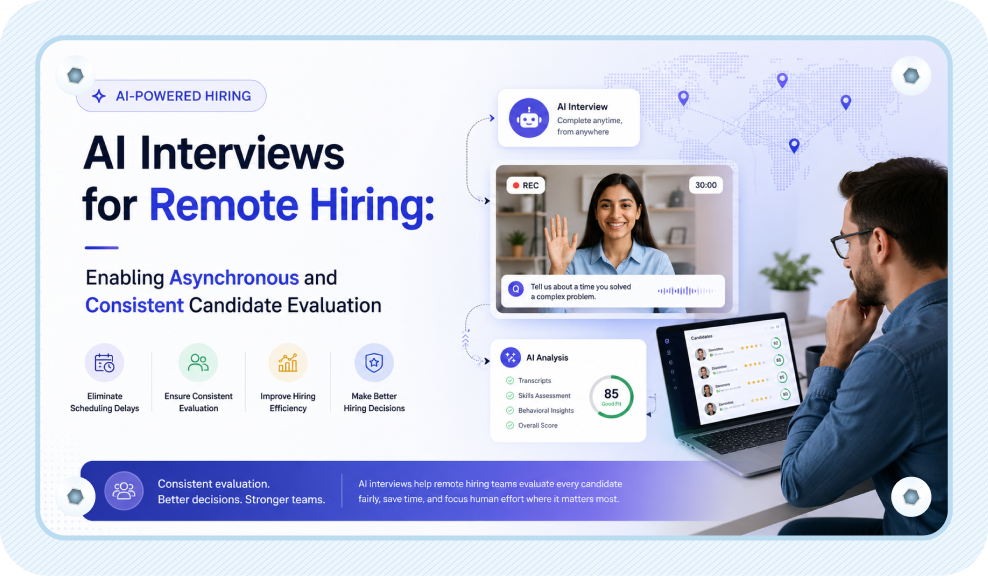
AI interviews support this shift by allowing candidates to complete structured first-round evaluations within a defined time window. Hiring teams can then review transcripts, summaries, scores, and role-relevant insights later.
Used correctly, AI interviews do not replace human hiring decisions. They create a consistent evaluation layer that helps remote teams reduce scheduling dependency, improve candidate assessment, and use human interviewer time where it matters most.
Remote hiring is no longer just about allowing candidates to interview from home. For many companies, it has become a regular part of how they attract, evaluate, and hire talent for remote-capable roles. But while work has become more flexible, hiring processes have not always changed enough.
A large part of recruitment still depends on live conversations between candidates, recruiters, interviewers, and hiring managers. That creates delays when people are working across different schedules, locations, and availability windows.
The biggest challenge in remote hiring is not always finding candidates. It is evaluating them consistently without making every step dependent on real-time coordination. When every screening call or first-round interview needs a shared calendar slot, candidates wait, recruiters spend more time scheduling, and hiring managers receive decision-ready information later than expected.
Remote hiring also changes what companies need to evaluate. In distributed teams, success often depends on clear communication, independent problem-solving, documentation, ownership, and the ability to collaborate without constant meetings. Traditional live interviews can still be useful, but they are not always the best way to assess these skills at the first stage.
This is why remote hiring requires more than video interview links. It requires a structured evaluation process that can operate even when candidates and interviewers are not available at the same time. Clear role requirements, standardized questions, consistent scoring, and asynchronous evaluation options help hiring teams reduce scheduling dependency while maintaining evaluation quality.
Ultimately, remote hiring works best when the hiring process is designed for flexibility. Without a scalable and consistent evaluation model, remote hiring can quickly become slow, fragmented, and overly dependent on interviewer availability.
Most hiring processes still rely heavily on synchronous interviews: live conversations where candidates, recruiters, interviewers, and hiring managers need to be available at the same time.
This model can work well for later-stage conversations. But in remote hiring, it creates friction when every screening or first-round evaluation depends on a shared calendar slot.
The biggest challenge is scheduling. Candidates may be ready to move forward, but the process slows down when recruiter or interviewer availability becomes the deciding factor. A first-round conversation that should happen quickly can get delayed simply because calendars do not align. These delays create gaps in the hiring process, reduce candidate momentum, and slow down decision-making.
Synchronous interviews can also make hiring teams over-dependent on availability. Strong candidates may have limited windows because of current work commitments, personal schedules, or different working hours. When the process is too rigid, teams may unintentionally prioritize candidates who are easiest to schedule rather than candidates who are best suited for the role.
There is also an evaluation-quality challenge. Live remote interviews can be influenced by factors that have little to do with job performance, such as internet stability, audio quality, camera setup, or comfort with real-time video conversations. While live communication is useful, it should not become the only signal used to judge a candidate’s ability.
The core issue is not live interviewing itself. The issue is relying too heavily on live, calendar-bound interviews in a hiring environment that increasingly requires flexibility. Remote hiring works better when early-stage evaluation can happen asynchronously, consistently, and without depending on every stakeholder being available at the same time.
Remote hiring teams need more than online interview tools. They need a hiring process that can work even when candidates, recruiters, interviewers, and hiring managers are not available at the same time.
The first requirement is asynchronous evaluation. Candidates should be able to complete structured interviews, screening questions, role-based assessments, or work-sample tasks within a defined time window. Hiring teams can then review responses later and move qualified applicants forward without waiting for interviewer schedules to align.
The second requirement is standardized interview structure. Remote hiring becomes difficult when every interviewer follows a different process. One interviewer may ask detailed competency-based questions, another may rely on a casual conversation, and another may focus mainly on resume history. This makes candidate comparisons inconsistent.
Remote hiring teams also need lower coordination overhead. When hiring depends heavily on live interviews, recruiters spend significant time scheduling, rescheduling, following up, and waiting for interviewer availability. By introducing asynchronous evaluation earlier in the funnel, hiring teams can reduce calendar dependency and focus interviewer time on candidates who are already better qualified.
Finally, remote hiring decisions need reviewable data. Hiring managers should be able to access interview transcripts, answer summaries, scoring details, communication signals, work samples, and areas that need clarification. This gives distributed stakeholders a shared source of truth instead of relying only on memory, scattered notes, or individual interviewer impressions.
Effective remote hiring requires clarity. The goal is not simply to make interviews remote. The goal is to make candidate evaluation work in a remote-first environment.
AI interviews enable remote hiring by solving one of the biggest operational challenges in the hiring process: the need for candidates, recruiters, interviewers, and hiring managers to be available at the same time.
In a traditional remote hiring process, even the first screening conversation often depends on calendar coordination. A candidate may be ready to move forward, but evaluation still waits for recruiter or interviewer availability. This creates unnecessary delays before hiring teams have enough information to make the next decision.
AI interviews change this model by allowing candidates to complete structured interviews within a defined time window, while hiring teams review the results later. This helps remote teams move from synchronous interviews to asynchronous evaluation without losing structure or consistency.
In remote hiring, candidate availability and interviewer availability do not always match. Candidates may be applying outside standard working hours, balancing current work commitments, or responding from different availability windows.
AI interviews make early-stage evaluation more flexible because the interview does not need to happen only when a human interviewer is free. Once the interview is assigned, candidates can complete it within the given time frame, and hiring teams can review the output later.
Scheduling is one of the most common bottlenecks in remote hiring. When every first-round conversation requires a shared time slot, recruiters spend more time coordinating interviews than evaluating candidates.
AI interviews reduce this dependency by separating candidate participation from interviewer availability. The candidate completes the interview asynchronously, and the hiring team reviews transcripts, summaries, responses, and evaluation outputs when they are available.
This does not remove human involvement. It simply ensures that early-stage evaluation does not stop every time calendars fail to align.
Remote hiring can become inconsistent when different interviewers ask different questions, use different evaluation styles, or capture feedback differently.
AI interviews help create a more standardized first-round evaluation process. Candidates applying for the same role can receive the same core questions, follow the same interview structure, and be assessed against the same role-relevant criteria.
This makes candidate comparison easier for recruiters and hiring managers. Instead of relying only on memory or scattered interview notes, teams can review structured responses, summaries, transcripts, and scores in a consistent format.
AI interviews should support hiring decisions, not replace them.
In a strong remote hiring process, AI helps collect candidate responses, generate transcripts, summarize key points, organize evaluation data, and highlight areas that may need human review. Recruiters and hiring managers remain responsible for advancement decisions, deeper evaluation, and final hiring outcomes.
This distinction matters. AI interviews act as a structured evaluation layer within the hiring process, supporting but not replacing final hiring decisions.
An AI-enabled remote hiring system is not just a video interview tool with AI features added to it. It is a structured hiring workflow designed to help teams evaluate candidates without depending on live interviewer availability at every stage.
A practical AI-enabled remote hiring system usually follows five steps.
The process begins with clear role definition.
Before candidates enter the interview flow, hiring teams define the skills, responsibilities, competencies, communication expectations, and evaluation criteria required for the role. This step matters because AI interviews are most useful when they are mapped to specific job-related expectations.
For remote hiring, role definition should also clarify how the person is expected to work. For example, hiring teams may define expectations around written communication, independent problem-solving, documentation, collaboration style, and availability overlap.
Once the role requirements are clear, AI screening can help organize early candidate information.
At this stage, the system may review candidate inputs such as resumes, application responses, previous experience, skill information, or basic qualification details. The purpose is not to make final hiring decisions automatically. The purpose is to help hiring teams identify which candidates should move into a structured evaluation process.
For remote teams, this is useful because early screening does not have to wait for a recruiter-led call. Candidates can be moved into the next step based on predefined criteria, while recruiters retain oversight of the process.
The AI interview is where asynchronous evaluation becomes most visible.
Instead of scheduling a live first-round interview, candidates complete a structured AI interview within a defined time window. Depending on the role, this may include voice-based responses, video responses, chat-based questions, technical questions, scenario-based prompts, or role-specific screening questions.
Every candidate applying for the same role can receive the same core question structure. This helps reduce inconsistency caused by different interviewer styles and makes candidate comparison easier.
After the AI interview is completed, the system organizes the candidate’s responses into reviewable outputs.
This may include transcripts, answer summaries, competency-level insights, communication indicators, scoring details, strengths, concerns, and areas that need human follow-up. These outputs help recruiters and hiring managers review candidates more consistently.
Scoring and shortlisting should not be treated as a final hiring decision. Instead, it should help hiring teams prioritize candidates for deeper review.
The final decision should remain human-led.
Once candidates have completed the AI interview and hiring teams have reviewed the structured outputs, the strongest candidates can move into human-led evaluation. This may include a live interview, technical discussion, hiring manager conversation, team-fit conversation, or final clarification round.
At this stage, live interviews are more focused and valuable. Instead of using human time for repetitive first-round screening, hiring teams can use it to clarify open questions, assess deeper role fit, discuss expectations, and make the final decision.
In practice, the process looks like this:
Role Definition → AI Screening → AI Interview → Scoring and Shortlisting → Human-Led Final Decision
This model allows remote hiring teams to run evaluation independently of interviewer schedules.
AI interviews create the most value in remote hiring when they reduce the parts of the process that depend too heavily on live coordination.
The first area of impact is reduced scheduling delay. In traditional remote hiring, even an early screening conversation can take time to schedule. AI interviews reduce this dependency by allowing candidates to complete structured interviews within a defined time window while hiring teams review responses later.
The second area is faster early-stage evaluation. Remote hiring teams often lose momentum when candidates wait too long for the first evaluation step. AI interviews help move the first round earlier in the process, allowing recruiters and hiring managers to identify qualified candidates sooner.
The third area is consistent evaluation quality. Candidates applying for the same role can answer the same core questions, follow the same structure, and be reviewed against the same criteria. This gives hiring teams a clearer basis for comparison.
The fourth area is better use of human interviewer time. Human time should be used for deeper evaluation, clarification, technical validation, team alignment, and final decision-making. It should not be consumed mainly by repetitive early-stage screening calls.
The strongest impact comes when asynchronous evaluation makes the process more structured, responsive, and easier to review.
Remote hiring gives companies more flexibility, but it also exposes weaknesses in hiring processes that were originally designed around live conversations and local availability.
The first challenge is over-reliance on scheduling. When every screening call, first-round interview, and evaluation step requires candidates and interviewers to be available at the same time, delays begin to build. In remote hiring, scheduling should not control the entire evaluation process.
The second challenge is lack of structured evaluation. Remote hiring becomes difficult when every interviewer evaluates candidates differently. Without a common structure, hiring teams struggle to compare candidates fairly or make decisions confidently.
The third challenge is inconsistent candidate experience. Remote candidates experience the employer mostly through digital touchpoints. If the process feels slow, repetitive, or unclear, candidates may disengage.
The fourth challenge is misalignment between evaluation and remote work skills. Many hiring teams still rely heavily on live interview performance, even for roles where day-to-day success depends on asynchronous work. Remote roles often require clear written communication, independent problem-solving, documentation, ownership, and the ability to collaborate without constant meetings.
Remote hiring works best when the evaluation process reflects how the work actually happens.
AI interviews are not the right solution for every hiring situation. They work best when they solve a specific remote hiring problem: helping teams evaluate candidates consistently without making every early-stage conversation dependent on live interviewer availability.
AI interviews make sense when scheduling is a bottleneck. If candidates, recruiters, and interviewers cannot easily find shared time slots, asynchronous AI interviews can help the process move forward.
They also make sense for structured first-round evaluation. AI interviews can help hiring teams assess whether a candidate meets basic role expectations, communicates clearly, understands job-related scenarios, and has enough relevant experience to move forward.
AI interviews are also useful when teams need consistent candidate data. Remote hiring often involves multiple stakeholders reviewing candidates at different times. AI interviews create reviewable outputs such as transcripts, summaries, scores, strengths, concerns, and areas for follow-up.
However, AI interviews become less useful when the role requires deep judgment, strategic discussion, relationship-building, or highly contextual evaluation. Senior leadership roles, executive roles, and specialized roles may require direct human interaction earlier in the process.
The model is simple:
AI helps hiring teams identify who deserves further consideration. Humans decide who gets hired.
Remote hiring success should not be measured only by how quickly a role is closed. For remote hiring teams, the more important question is whether the process reduces scheduling dependency, improves evaluation consistency, and helps qualified candidates move forward without unnecessary delays.
Useful metrics include time to first evaluation, candidate completion rate, scheduling dependency reduction, evaluation consistency, and human interviewer time saved.
Time to first evaluation shows how quickly a candidate moves from application or shortlist to the first meaningful assessment step. Candidate completion rate shows how many candidates complete the assigned interview or assessment. Scheduling dependency reduction shows whether fewer early-stage steps depend on live calendar coordination.
Evaluation consistency shows whether candidates for the same role receive the same core questions, are assessed against the same criteria, and receive comparable evaluation outputs. Human interviewer time saved shows whether interviewers are spending less time on repetitive screening and more time on deeper evaluation.
The strongest remote hiring teams do not optimize for speed alone. They measure whether the process helps candidates complete evaluations easily, gives hiring teams consistent data, and reduces unnecessary dependency on live interviewer availability.
Remote hiring is not just about conducting interviews online. It requires a hiring process that works when candidates, recruiters, interviewers, and hiring managers are not always available at the same time.
The biggest challenge in remote hiring is scheduling dependency. When every early-stage evaluation depends on live coordination, hiring teams face delays, inconsistent feedback, and slower decision-making.
AI interviews help remote hiring teams reduce this dependency by enabling structured, asynchronous evaluation. Candidates can complete interviews within a defined time window, while hiring teams review responses, transcripts, summaries, and scores later.
AI interviews should support, not replace, human decision-making. The strongest remote hiring systems use AI to standardize early-stage evaluation while keeping recruiters and hiring managers responsible for deeper assessment and final decisions.
For remote hiring teams, the goal is not simply to hire faster. The goal is to build a process that reduces coordination overhead, improves evaluation consistency, and helps teams make better hiring decisions without depending on interviewer availability at every stage.
.avif)
.avif)


.svg)

.svg)


%201.svg)
.svg)

.webp)