Walk-in hiring drives are high energy — and high chaos.
In just a few hours, hundreds of candidates arrive at the venue. Applications pile up, interview panels get overwhelmed, queues grow longer, and evaluation quality drops rapidly.
Most mass hiring drives don’t fail because of lack of candidates.
They fail because there is no structured evaluation system that can operate under extreme time pressure.
In walk-in hiring, speed often replaces structure — and that’s where quality breaks.
This is where AI interviews are changing how enterprises run walk-ins and bulk hiring events, turning crowd management problems into structured evaluation systems.
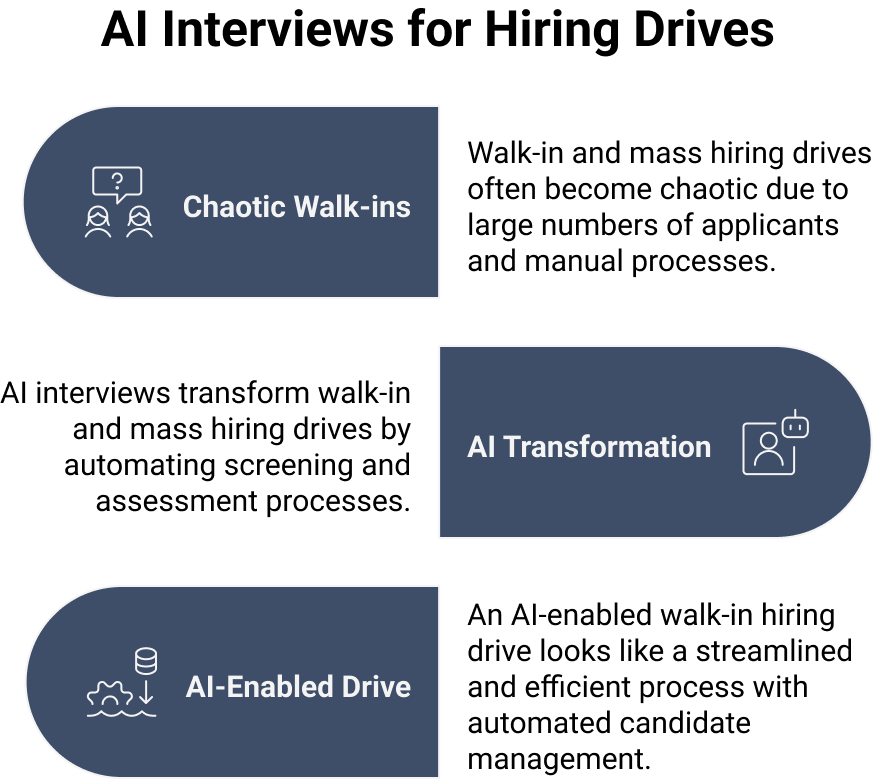
Walk-in hiring events and mass recruitment drives often promise speed and efficiency, but without careful planning, they quickly descend into disorder. Several factors explain why these events often feel chaotic.
Walk-ins attract a high volume of applicants in a short window. Generic postings and last-minute surges overwhelm available interviewers, creating long queues and long waiting times. Recruiters simply don’t have the bandwidth to process hundreds of candidates efficiently, which slows down the entire event.
With time pressure, interviews are often rushed. Quick judgments replace thoughtful evaluation, and inconsistent questioning makes it hard to fairly compare candidates. High-volume hiring can turn into a tick-box exercise rather than a meaningful assessment, frustrating both recruiters and applicants.
Different interviewers assess candidates in different ways, leading to inconsistent outcomes and difficulty comparing applicants. Without predefined scorecards or structured evaluation criteria, decisions are subjective and error-prone.
In walk-in hiring, speed often replaces structure — and that’s where quality breaks.
Most teams treat walk-in drives as simple events — post a job, show up, and start interviewing. In reality, they are high-volume operations that demand precision, structure, and control.
Mass hiring drives are not just about managing queues — they are about managing evaluation quality under time constraints.
Mass hiring drives are not simple hiring events — they are time-bound operations that require flow design, evaluation structure, and parallel processing.
Standardized Interview Format
What’s required is a predefined evaluation framework — standardized questions, role-specific criteria, and clear qualification filters. Even lightweight pre-screening (via forms, QR codes, or bots) ensures only relevant candidates enter the pipeline.
Parallel Candidate Processing
Walk-ins fail when everything depends on interviewer availability. A single-threaded process creates bottlenecks and long wait times.
High-performing hiring drives are designed for parallelism — multiple interview lanes, batch-based assessments, and simultaneous evaluations.
AI interviews allow enterprises to evaluate large candidate volumes in parallel while maintaining consistent assessment standards.
Real-Time Shortlisting
When decisions are postponed or undocumented, recruiters lose momentum and candidates drop off. Instant evaluation and immediate shortlisting keep the process moving without compromising quality.
Controlled Candidate Flow
A large venue alone doesn’t create order — flow design does. Station-based movement (entry → screening → interview → exit), supported by signage and crowd managers, keeps candidates informed and queues under control.
AI interviews replace chaotic, manual processes with structured, scalable evaluation systems built for high-volume, time-bound events.
Every candidate is asked the same set of role-specific questions aligned to predefined evaluation criteria. Every response is assessed against the same framework, ensuring consistency regardless of when or where the candidate completes the interview.
Multiple candidates can complete interviews simultaneously without dependency on interviewer schedules or panel availability.
As soon as a candidate completes the interview, responses are scored against job criteria and ranked automatically. Recruiters can identify top candidates immediately instead of reviewing hundreds manually.
Recruiters no longer spend hours on first-round screening. They receive a pre-qualified shortlist and focus only on high-potential candidates.
AI interviews turn walk-ins from crowd management problems into structured evaluation systems.
Mass hiring drives are not just about managing queues — they are about managing evaluation quality under time constraints.
Enterprises running walk-in and mass hiring drives see immediate operational impact in five areas:
Technology doesn’t fix chaotic hiring — structured process design does.
AI should not be layered on top of an unstructured process. It must be part of a redesigned hiring flow where screening, evaluation, and shortlisting are integrated.
Without staggered scheduling, digital check-ins, and clear stage movement, crowding and confusion continue even with AI.
Candidates must clearly understand the steps, tools, and expectations. Simple instructions and clear updates are critical for smooth execution.
Use AI When:
Be Careful When:
Track success using operational and outcome metrics:
In traditional walk-ins, candidates spend hours waiting with little clarity on what happens next.
AI changes this completely.
In mass hiring events, candidates value clarity and speed more than human interaction alone. Structured AI-driven flow creates a professional, fair, and predictable experience even when hundreds of candidates are present.
.avif)
.avif)


.svg)

.svg)


%201.svg)
.svg)

.webp)
.webp)