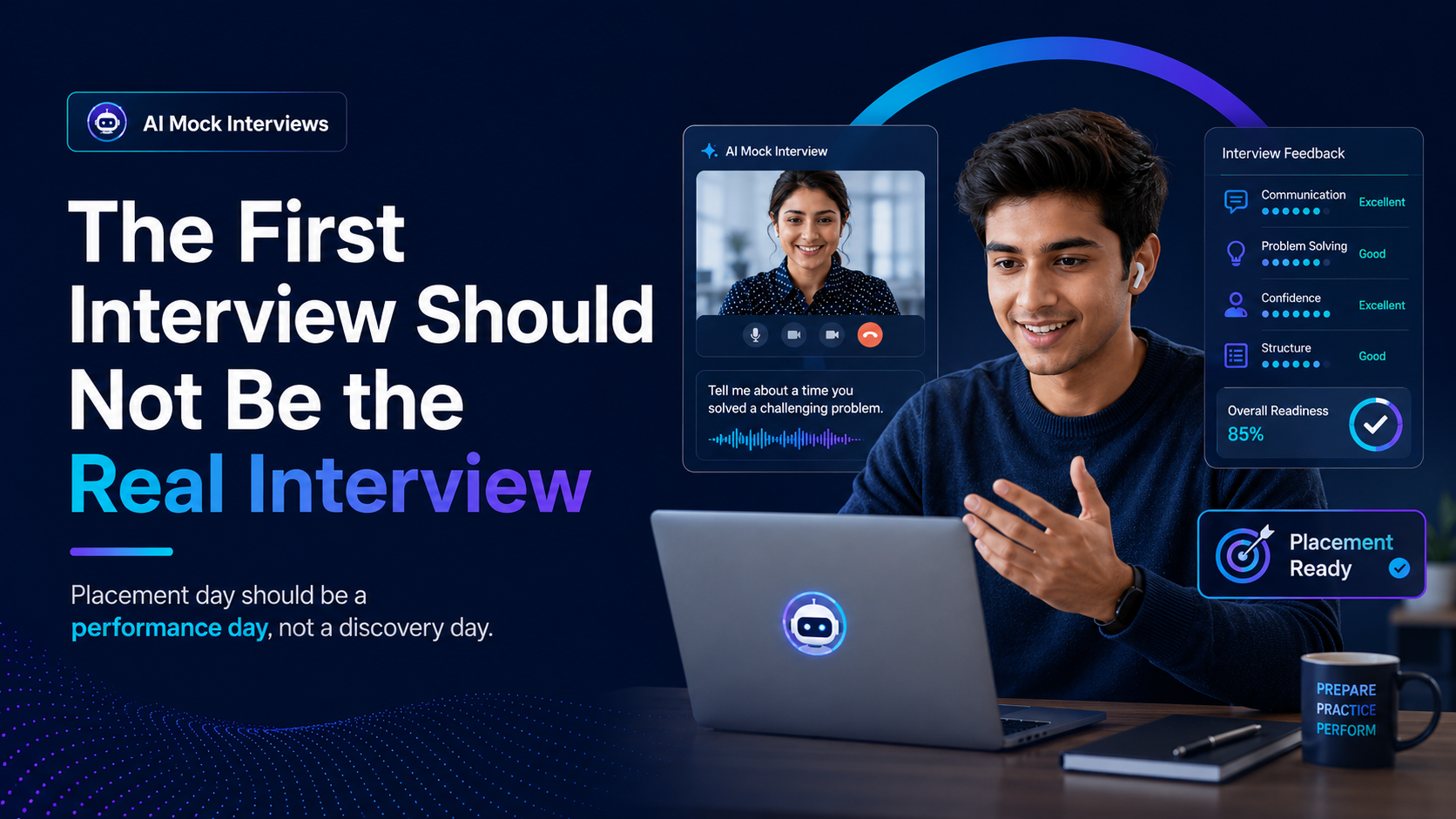
For many students, the first serious professional interview happens directly in front of a recruiter.
That is too late.
By then, every hesitation matters. Every unclear answer matters. Every weak project explanation matters. Every nervous pause, unstructured response, or incomplete technical explanation can affect the outcome.
The recruiter is not there to diagnose the student.
The recruiter is there to evaluate.
That is why the first interview should not be the real interview.
Placement day should be a performance day, not a discovery day.
Students should not discover their interview gaps for the first time when an employer is already making a hiring decision. They should discover those gaps earlier, in a safer environment, when there is still time to improve.
This is where mock interviews move from being a nice-to-have activity to becoming core placement-readiness infrastructure.
Most students prepare for interviews in familiar ways.
They revise technical concepts. They read common HR questions. They polish resumes. They watch videos. They attend training sessions. Some memorize answers to questions like “Tell me about yourself” or “Explain your project.”
All of this helps.
But it does not fully prepare them for the pressure of a real interview.
A real interview is not only a knowledge test.
It is a communication test.
It is a confidence test.
It is a structure test.
It is a pressure test.
It tests whether the student can think, explain, adapt, and respond when the conversation does not go exactly as expected.
That is where many students struggle.
They may know the topic but fail to explain it clearly.
They may have built a project but fail to communicate their role in it.
They may solve a coding problem but fail to explain their approach.
They may know the answer but lose confidence when the interviewer asks a follow-up question.
The weakness was always there.
The real interview simply exposed it too late.
When students experience their first serious interview directly with a recruiter, many discover basic readiness gaps only after the outcome is already at risk.
These gaps are common across student batches.
Many students underestimate the first two minutes of the interview.
They either speak too little, speak too much, or give a generic introduction that does not connect their skills, projects, and career direction.
A weak introduction does not always mean a weak candidate.
But it can create a weak first impression.
Project work is often one of the most important parts of a fresher interview.
But many students describe only the title, tools used, or broad objective.
They struggle to explain:
A project that looks good on a resume can sound weak in an interview if the student cannot explain it well.
Some students know the concept when they are revising alone.
But when a recruiter asks the same concept in a live setting, they freeze.
The issue is not always a lack of knowledge.
Often, it is a lack of practice under interview-like pressure.
Many students answer in a scattered way.
They start with one point, jump to another, miss the main question, and end without a clear conclusion.
This makes it harder for the interviewer to understand the candidate’s thinking.
In interviews, structure matters because it helps the recruiter follow the candidate’s logic.
Communication is not only about English fluency.
It is about clarity.
Can the student explain a concept simply?
Can they slow down when nervous?
Can they avoid filler words?
Can they stay relevant?
Can they answer with confidence without sounding rehearsed?
These signals are visible only when the student is placed in a realistic interview environment.
Recruiters often ask follow-up questions to test depth.
Students who prepare only memorized answers struggle here.
They may answer the first question but fail when the interviewer asks:
Follow-up questions reveal whether the student has real understanding or surface-level preparation.
When a student discovers these gaps during a practice session, the gap becomes a learning opportunity.
When the same gap appears during a real recruiter interview, it becomes a selection risk.
That is the difference.
A missed project explanation in practice can be fixed.
A nervous self-introduction in practice can be improved.
A poor technical explanation in practice can be corrected.
An unstructured answer in practice can be rebuilt.
But when these issues appear during a real employer interview, there may not be a second chance.
This is why colleges need to create enough practice exposure before placement season.
Students should enter recruiter conversations with awareness, structure, and confidence.
Not with guesswork.
Campus placement is a high-pressure environment.
Students are often evaluated quickly. Recruiters may have limited time. Competition can be intense. The student has to create trust in a short conversation.
That trust is built through more than correct answers.
It is built through:
These are not built only by reading interview questions.
They are built through rehearsal.
A student who has practiced answering under pressure is more likely to recognize the interview format, control nervousness, and respond with structure.
A student who has never experienced that pressure may discover their gaps only when the recruiter is already evaluating them.
That is why mock interviews for campus placement are not only preparation tools.
They are rehearsal environments.
Most colleges understand the value of mock interviews.
Many already conduct them through faculty members, alumni, trainers, placement teams, or external interviewers.
These efforts are valuable.
But they often face practical limitations when the batch size is large.
A college may need to prepare hundreds or thousands of students. Running high-quality mock interviews for every student is difficult.
The common challenges are:
As a result, mock interviews may become a one-time activity instead of a repeatable readiness system.
Some students get useful feedback.
Some get generic feedback.
Some get no meaningful practice at all.
For a placement team managing an entire batch, this is not enough.
A TPO does not only need to know that mock interviews happened.
A TPO needs to know whether students have practiced enough to face real interviews with confidence.
The role of mock interviews needs to change.
They should not be treated as a last-minute placement activity.
They should become part of the college’s readiness infrastructure.
That means every student should get a chance to experience:
This is especially important before high-stakes placement drives.
A student should not be practicing structure, confidence, and explanation for the first time in front of a recruiter.
They should have already experienced that pressure before.
They should already know where they struggle.
They should already have received feedback.
They should already have improved.
That is what interview practice should achieve.
For a deeper view of why this matters, read our earlier article on the placement readiness gap and why academic eligibility is not enough.
A mock interview should not only ask questions.
It should reveal how a student performs in an interview situation.
That requires evaluating more than correct answers.
This is the difference between a mock interview as a practice round and a mock interview as a rehearsal system.
Practice gives exposure.
Rehearsal builds familiarity.
Feedback creates improvement.
Colleges need all three.
AI-led mock interviews should not be seen as replacing human mentors, trainers, or placement teams.
They are better understood as a scalable practice layer.
They can help colleges ensure that every student gets structured interview exposure before facing real recruiters.
For large batches, AI mock interviews can help in five practical ways.
In a manual setup, only some students may receive enough mock interview exposure. AI-led mock interviews can help provide structured practice across the batch.
A shared rubric allows students to be evaluated across similar parameters such as communication, confidence, technical response, answer structure, and project explanation.
Interview confidence improves with repetition. A one-time workshop may create awareness, but repeated practice builds comfort.
TPOs can see whether students have practiced, where common gaps are emerging, and which students may need additional support before placement day.
Once practice data reveals common gaps, human trainers and faculty members can spend time where they are most needed.
This is the practical value of AI in mock interviews.
It is not about replacing human judgment.
It is about making interview preparation more scalable, measurable, and timely.
A student wants to know:
“How do I improve before my interview?”
A placement team needs to know:
This visibility is difficult to get from resumes, attendance, or training completion reports.
It comes from interview-like practice.
A college should not discover these gaps after recruiters have already rejected students.
The goal of mock interviews is not to make students memorize perfect answers.
That can backfire.
The goal is to help students become more aware, structured, and confident.
A good mock interview should help a student say:
That awareness changes the student’s mindset.
The real interview no longer feels like the first time.
It becomes a familiar format.
That familiarity matters.
Confidence does not come only from knowing the answer.
Confidence comes from having practiced the situation.
FloCareer NIVO gives students a safe environment to experience realistic AI-led mock interviews before real employer evaluation.
This is important because students need a place where mistakes become learning signals, not rejection signals.
NIVO helps students practice interview conversations and receive structured feedback on areas such as communication, confidence, technical responses, answer quality, and project explanation.
For students, this creates rehearsal before the real interview.
For colleges, it creates visibility into who has practiced, where students are struggling, and which gaps should be addressed before placement day.
The goal is not to promise guaranteed placements.
The goal is to help students practice earlier, improve with clearer feedback, and enter interviews with more structure and confidence.
Colleges can make mock interviews more effective by treating them as a practice loop, not a one-time event.
Give students a realistic interview experience before placement season.
Identify where students struggle: self-introduction, project explanation, technical reasoning, coding explanation, communication, or confidence.
Use the feedback to guide student practice, mentoring, faculty support, or targeted training.
Allow students to practice again so they can improve before the real recruiter conversation.
Send students into placement conversations after they have experienced interview pressure, understood their gaps, and improved their responses.
This approach turns mock interviews from an activity into a placement rehearsal system.
It also gives the placement team a stronger way to support students before outcomes are at stake.
The real interview should not be the first time a student explains their project under pressure.
It should not be the first time they answer technical follow-up questions.
It should not be the first time they hear themselves giving an unstructured answer.
It should not be the first time they realize they are nervous.
It should not be the first time the college discovers a batch-level communication gap.
Those discoveries should happen earlier.
In practice.
In rehearsal.
In a safe environment.
Before placement outcomes are at stake.
That is why the first interview should not be the real interview.
Placement day should be a performance day, not a discovery day.
___________________________________________________________________________
Are your students experiencing interview pressure for the first time in front of recruiters?
FloCareer NIVO can help your placement team run AI-led mock interviews and identify practice gaps before placement day.
Help your students practice before placement day with FloCareer NIVO.
The first interview should not be the real interview because students often discover communication, confidence, project explanation, technical reasoning, and pressure-handling gaps only during live recruiter conversations. Mock interviews help surface these gaps earlier, when students still have time to improve.
Mock interviews help students experience interview pressure before placement day. They allow students to practice self-introduction, project explanation, technical responses, communication, and follow-up questions in a safer environment.
Colleges should ideally start mock interview practice before major placement drives, not in the final few days. Starting earlier gives students time to understand their gaps, improve their responses, and practice again before recruiter evaluation.
A campus mock interview should evaluate self-introduction, project explanation, communication, confidence, answer structure, technical understanding, coding explanation, behavioral responses, and the ability to handle follow-up questions.
There is no single fixed number, but one mock interview is rarely enough for students who need improvement. A better approach is to run at least one baseline mock interview, provide feedback, allow targeted practice, and then reassess before important placement drives.
Yes. AI mock interviews can help colleges provide structured interview practice across large batches, generate consistent feedback, identify common practice gaps, and help placement teams understand where students need more support.
No. AI mock interviews should work as a scalable practice and feedback layer. Human mentors, trainers, and faculty members remain important for deeper coaching, motivation, and targeted support.
.avif)
.avif)

.svg)

.svg)


%201.svg)
.svg)

.webp)