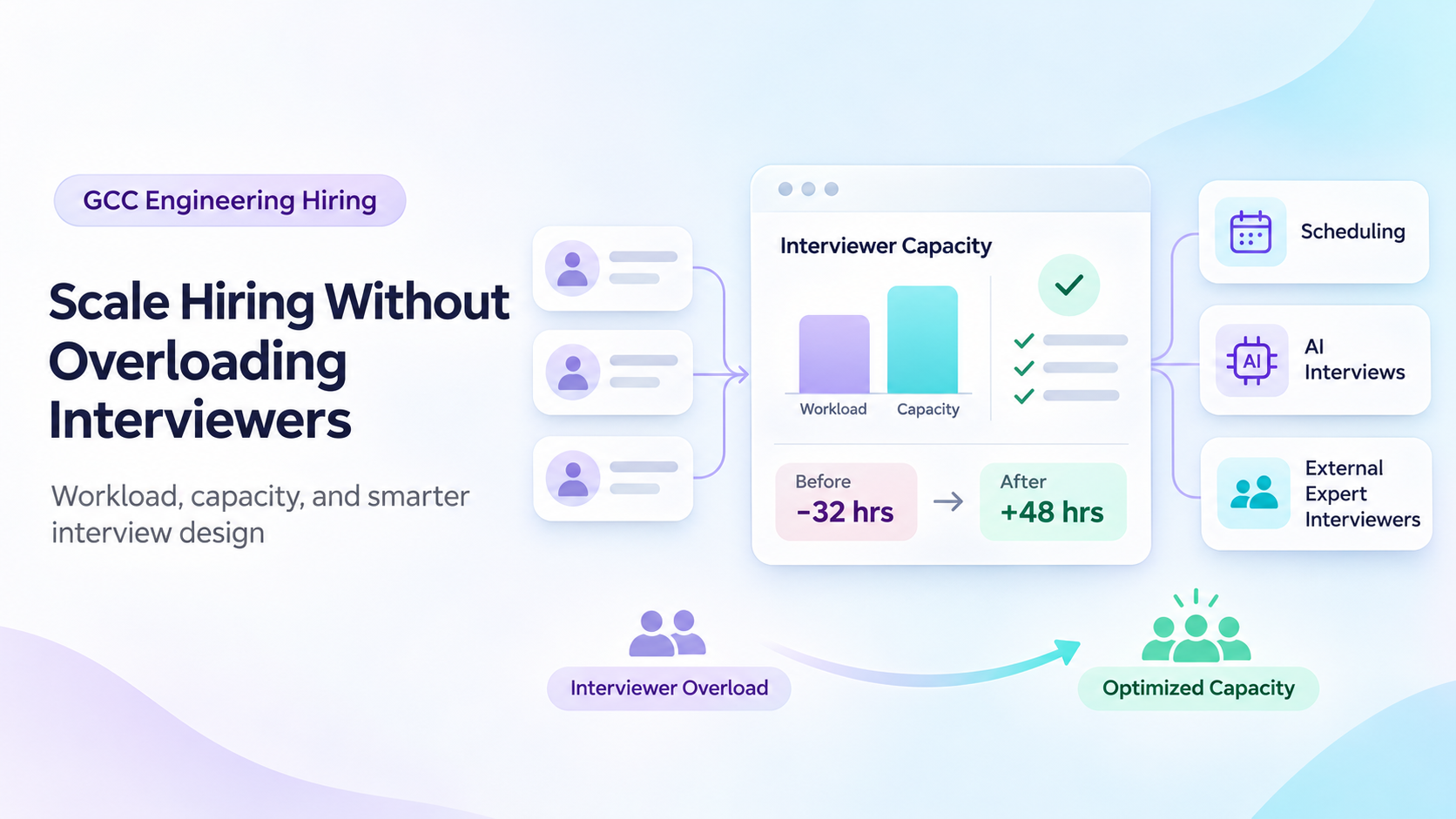
For a Global Capability Center (GCC) expanding its engineering capabilities, hiring demand may increase before the internal team has enough qualified interviewers to support it. The constraint becomes particularly important when the same senior engineers are responsible for technical delivery, capability development, and candidate assessment.
So how can GCCs meet growing interview demand without proportionately increasing the workload of their internal engineering teams?
This article explains how to calculate internal interview workload, identify capacity gaps, and evaluate where process improvements, AI interviews, and external expert support can help.
But before looking at ways to reduce this workload, it's worth understanding why interviewer capacity becomes constrained in the first place.
Hiring 30 engineers does not mean conducting just 30 interviews. The workload depends on how many candidates reach each assessment stage, how many interviewers participate, and the preparation, feedback, and review required. GCCs building multiple engineering functions simultaneously may face competing demands on the same technical leaders.
Interviewers are not interchangeable across technical specializations. An experienced data engineer may be qualified to assess Spark and data architecture but not necessarily cybersecurity or cloud infrastructure. EY's 2025 GCC research found that 66% of surveyed GCCs reported difficulty attracting niche technology talent, illustrating the importance of specialist capabilities in GCC hiring.
For a GCC establishing a new function, the people qualified to assess candidates may also be the people responsible for building that capability.
Where assessments involve both India-based teams and global engineering stakeholders, limited overlapping availability can restrict interview scheduling. Even after an interview takes place, incomplete feedback or additional review requirements may delay decisions.
The distinction matters: a shortage of qualified interview hours requires a different response from delays caused by coordination or decision-making.
But when hiring slows down, how do you know whether interviewer availability is actually the problem?
When GCC engineering hiring slows down, it's easy to assume the team needs more interviewers. But what if interviews are happening on time and candidates are getting stuck somewhere else?
Before increasing interview capacity, GCC leaders should identify where candidates are waiting and what's causing the delay.
These distinctions matter because each problem requires a different response.
For example, additional expert interviewers may help when qualified candidates are waiting for technical assessment slots. But they won't necessarily resolve delays caused by incomplete feedback or pending approvals.
Ashby's 2026 Recruiting Operations Benchmarks also distinguishes the time taken to schedule an interview from the waiting period before it actually happens. Limited interviewer availability can extend that waiting period even when scheduling is handled promptly.
Once you've identified where interviews are slowing down, the next question is how much internal engineering time the process actually requires.
Once you've identified interviewer capacity as a potential constraint, the next question is: how much internal engineering time does your hiring plan actually require?
The answer isn't simply the number of interviews multiplied by their duration. A useful workload estimate must account for every internal engineer involved, including time spent preparing, interviewing, documenting feedback, reviewing assessments, and handling shared activities.
Begin with the expected number of candidates reaching each technical assessment stage. Use historical hiring data or forecast stage-conversion rates where available.
For each stage, record:
Remember that not every candidate progresses through every round. Count the expected workload at each stage rather than applying the entire interview process to every applicant.
A one-hour interview involving two engineers consumes two internal person-hours before preparation or feedback.
For example, if each engineer spends 15 minutes preparing, 60 minutes interviewing, and 15 minutes documenting feedback, assessing one candidate requires three internal person-hours.
Required internal hours = Σ (Candidates at each stage × total internal minutes per candidate ÷ 60) + shared overhead
Total internal minutes should include the relevant work of every internal participant. Add shared calibration meetings and exception reviews separately, without counting activities already included in individual assessments.
Track recruiter coordination time separately from engineering assessment workload.
Next, calculate how many hours qualified engineers can realistically allocate to interviews alongside their existing responsibilities.
Available internal hours = Sum of committed interview-work hours from qualified engineers.
Suppose a GCC has 20 qualified interviewers, each contributing six hours weekly. That provides 120 internal person-hours of capacity.
If forecast demand exceeds those hours, the hiring plan has a capacity shortfall. But aggregate capacity alone doesn't tell the whole story.
A GCC expanding its cloud, data, and platform engineering teams may have sufficient interviewers overall but limited experts qualified to assess particular technologies or seniority levels.
Compare demand and available capacity by skill, role family, interview stage, and scheduling window. Account for leave and other commitments, and keep forecast work separate from interviews already completed.
This gives GCC leaders a clearer picture of where additional assessment capacity may actually be needed.
Once you know where internal interview capacity is constrained, the next step is deciding what can change.
Not every improvement requires hiring more interviewers or shortening assessments. Some changes eliminate unnecessary work, while others redistribute responsibilities so the right expertise is available when needed.
Consider a backend engineering candidate assessed on SQL fundamentals during an initial screening, a coding interview, and a senior engineer's round.
Repeating a competency isn't always unnecessary. But when each round collects essentially the same evidence without adding depth, it consumes engineering time without necessarily improving the hiring decision.
Map the competencies assessed at each stage, assign clear assessment ownership, and use structured scorecards to share findings. Repeat an assessment only when earlier evidence is incomplete, conflicting, or requires deeper validation.
Even when engineers have available hours, those hours may be fragmented across sprint commitments, project meetings, and other responsibilities.
GCCs coordinating interviews between India-based teams and global stakeholders may face additional scheduling constraints.
Reserve dedicated interview windows, maintain skill-specific interviewer pools, arrange backup coverage, and establish clear expectations for feedback submission.
Better scheduling can reduce waiting and coordination work, although it doesn't automatically reduce the engineering hours required to conduct an assessment.
Do all early-stage technical assessments require an internal engineer to conduct them live?
For suitable roles, AI Screening and AI Coding interviews can support structured technical questions, coding exercises, and initial evidence collection without requiring an internal interviewer to attend every session.
However, internal teams still need to configure assessment criteria, review outputs, handle exceptions, and monitor whether the assessments produce useful evidence.
The goal is to reduce routine assessment delivery work, not remove human oversight or assume every technical competency can be evaluated through AI.
When GCCs lack sufficient internal assessment capacity for particular technologies or hiring volumes, external expert interviewers can conduct clearly defined technical rounds.
For example, external experts could assess programming proficiency, database fundamentals, and practical problem-solving, while internal engineering leaders focus on organization-specific architecture, technical ownership, and final hiring decisions.
Through Interview-as-a-Service, GCCs can access expert-led technical assessments without requiring internal engineers to conduct every agreed round.
The employer still needs to define expectations, calibrate evaluation criteria, review relevant evidence, and retain hiring accountability.
Sometimes the constraint isn't total engineering capacity but its concentration among a few senior specialists.
For recurring hiring requirements, GCCs can train additional engineers to assess competencies within their expertise.
A qualified backend engineer, for instance, may be able to evaluate programming fundamentals without requiring a principal engineer to participate in every initial interview.
However, expanding the interviewer pool requires training, shadowing, calibration, and ongoing participation. It can distribute workload more sustainably without necessarily reducing total internal assessment hours.
Ultimately, the right approach depends on where the constraint lies. A GCC may need better scheduling, redesigned assessment stages, AI-supported screening, expert interview capacity, or a combination of these changes.
Reducing internal interviewer workload sounds beneficial, but what if the alternative costs more than the engineering time it releases?
For GCCs, the comparison shouldn't stop at the price of an interview. An assessment conducted internally consumes engineering time, while AI interviews or external expert support introduce additional fees and still require some internal oversight.
The starting point is to compare the full cost of the existing process with the revised approach.
Existing process: Internal assessment work, preparation, feedback, coordination, calibration, and rework.
Revised process: Platform or external service charges, remaining internal assessment and review work, setup, calibration, coordination, and rework.
Here's how the five approaches differ:
But there are three outcomes GCC leaders should evaluate separately:
For example, reducing 80 internal engineering hours doesn't automatically produce 80 hours' worth of payroll savings. Those employees remain on the payroll; the benefit is the capacity made available for other work.
The right choice is therefore not necessarily the cheapest interview option, but the one that provides sufficient assessment capacity at an acceptable cost while maintaining evaluation quality.
Let's put the workload calculation into practice.
Consider a GCC expanding its engineering team while trying to maintain its existing internal interviewer capacity. The goal is to determine whether redistributing certain technical assessment responsibilities could help the GCC handle more candidates without increasing the hours committed by its engineers.
Illustrative workload forecast: The following assumptions and calculations are hypothetical. They are not FloCareer customer results or industry benchmarks.
The scenario: Engineering interview demand versus available capacity
The GCC has 20 qualified internal interviewers, each allocating six hours per week to interview-related work.
That gives the team:
20 interviewers × 6 hours = 120 internal person-hours per week.
The initial hiring plan requires:
Under the revised model, external experts conduct the first-stage assessments, while internal engineers spend an assumed 15 minutes reviewing each report. The GCC retains responsibility for later-stage interviews and hiring decisions.
Comparing the original and revised interview workloads
All figures represent illustrative weekly engineering person-hours. External interview delivery hours and service fees are excluded and must be considered separately.
In the original process, 80 first-stage assessments require:
80 × 75 ÷ 60 = 100 internal hours.
After moving first-stage delivery to external experts, internal engineers instead review the assessment reports:
80 × 15 ÷ 60 = 20 internal hours.
If the GCC increases first-stage assessments to 120, report review requires:
120 × 15 ÷ 60 = 30 internal hours.
For this higher-volume scenario, the GCC also assumes 30 later-stage interviews, each involving two engineers for 60 minutes:
30 × 2 × 60 ÷ 60 = 60 internal hours.
Adding calibration and follow-up gives the three total workload estimates:
The higher-volume scenario assumes 30 candidates reach the later stage. This is a planning assumption, not a recommended pass rate. Weekly stage volumes also do not imply every candidate completes the entire process within one week.
The revised model assumes engineers need only 15 minutes to review each external assessment report. But what if the reports require more detailed review?
If review time increases to 30 minutes, reviewing 120 reports would require 60 hours instead of 30.
The higher-volume workload would then become:
60 + 60 + 10 + 6 = 136 internal hours per week.
That's a 16-hour shortfall against the GCC's available 120 hours.
This sensitivity check demonstrates why the revised model must be tested rather than assumed to work. The GCC needs to verify actual report-review time, follow-up requirements, assessment quality, and later-stage demand.
Under the stated assumptions, redistributing first-stage assessment delivery reduces forecast internal workload enough to accommodate higher interview demand within the same aggregate capacity budget.
However, the result depends on qualified interviewers being available for the remaining stages and appropriate scheduling windows. The GCC must also account for external delivery costs and confirm that the assessment reports provide sufficient evidence for internal decisions.
The takeaway: A revised interview model is useful only when the internal work that remains fits the team's available capacity without compromising assessment quality.
Reducing internal interviewer hours is one thing. But how do you know the revised process still gives hiring managers enough evidence to make informed decisions?
For GCCs introducing AI assessments, external interviewers, or redesigned interview rounds, the goal is to reduce unnecessary internal work without weakening technical evaluation or simply shifting the workload elsewhere.
Before changing the process, document how much internal engineering time assessments currently require and what evidence they produce.
Track interview hours by activity, candidate volumes at each stage, waiting times, feedback corrections, repeated assessments, and candidate completion or withdrawal reasons.
Compare results across similar engineering roles and seniority levels so differences in hiring requirements don't distort the findings.
A shorter assessment isn't necessarily a better one if it produces insufficient evidence.
Review a sample of assessments completed under the revised process, including candidates who advanced and those who were screened out.
Check whether:
This is especially important when earlier technical rounds are handled by AI systems or external experts rather than internal engineering teams.
Even when first-stage interviews consume fewer internal hours, additional work may appear later in the hiring process.
Are engineering managers repeating earlier assessments? Are reports taking longer to review than expected? Are more candidates reaching later rounds without sufficient supporting evidence?
Also monitor calibration, exception handling, coordination effort, and candidate experience.
A revised process should only be considered effective when actual internal workload remains manageable, assessment evidence supports hiring decisions, and candidate experience stays acceptable.
The objective isn't simply fewer engineering interview hours. It's a more sustainable assessment process that preserves the quality of hiring decisions.
For GCCs facing limited internal interviewer capacity, FloCareer provides two ways to support technical assessments without requiring internal engineers to conduct every interview.
FloCareer's AI Interview Platform supports AI Screening and AI Coding interviews, allowing candidates to complete suitable technical assessments without a live internal interviewer. Hiring teams can configure role-specific evaluation criteria and review structured reports before deciding the next steps.
For assessments that require experienced technical interviewers, FloCareer's Interview-as-a-Service provides experts matched to relevant skills, seniority, and role requirements. This includes interview coordination, structured evaluations, and feedback reporting.
GCC hiring example: ParentPay Group
FloCareer's ParentPay Group case study reports 657 structured expert-led interviews supporting its India GCC. The engagement covered software engineering, product, data, QA, cloud, and DevOps requirements, helping a lean internal team access assessment capacity across multiple technical functions.
The example demonstrates FloCareer's experience supporting GCC interview operations, although the published results do not quantify internal engineering hours saved.
Whether a GCC uses AI interviews, external experts, or both, its internal leaders retain responsibility for assessment expectations, reviewing relevant evidence, and making hiring decisions.
The appropriate combination depends on the roles, assessment requirements, and capacity constraints involved.
Start by identifying how many hours qualified internal interviewers can realistically dedicate to assessments each week, after accounting for engineering delivery commitments, leave, and other responsibilities. Multiply each interviewer's committed hours by their availability, then add the hours across the team. Compare this capacity with the forecast workload, including preparation, interviews, feedback, and review. For GCCs hiring across multiple technical functions, calculate capacity separately by skill, seniority, and interview stage.
No. Outsourcing technical interviews can reduce the time internal engineers spend conducting assessments, but some responsibilities remain. GCC teams still need to define evaluation criteria, calibrate external interviewers, review assessment reports, handle exceptions, and make hiring decisions. The actual workload reduction depends on how much internal effort these activities require.
Yes, for suitable assessment tasks. AI Screening and AI Coding interviews can conduct structured early-stage evaluations without requiring an internal engineer to attend every session. However, hiring teams still need to configure assessments, review results, handle exceptions, and monitor evaluation quality. The benefit should be measured against the internal work that remains.
Training additional interviewers makes sense when hiring demand is recurring and qualified internal expertise can be developed. GCCs should consider the time required for training, shadowing, and calibration. Expanding the pool can reduce dependence on a few specialists, although it may not reduce total engineering interview hours.
Measure internal assessment hours, interviewer availability by skill, scheduling delays, report-review time, repeated assessments, and candidate experience. Also check whether external evaluations provide sufficient evidence for internal hiring decisions. These measures help determine whether expanding external support would address the actual capacity constraint.