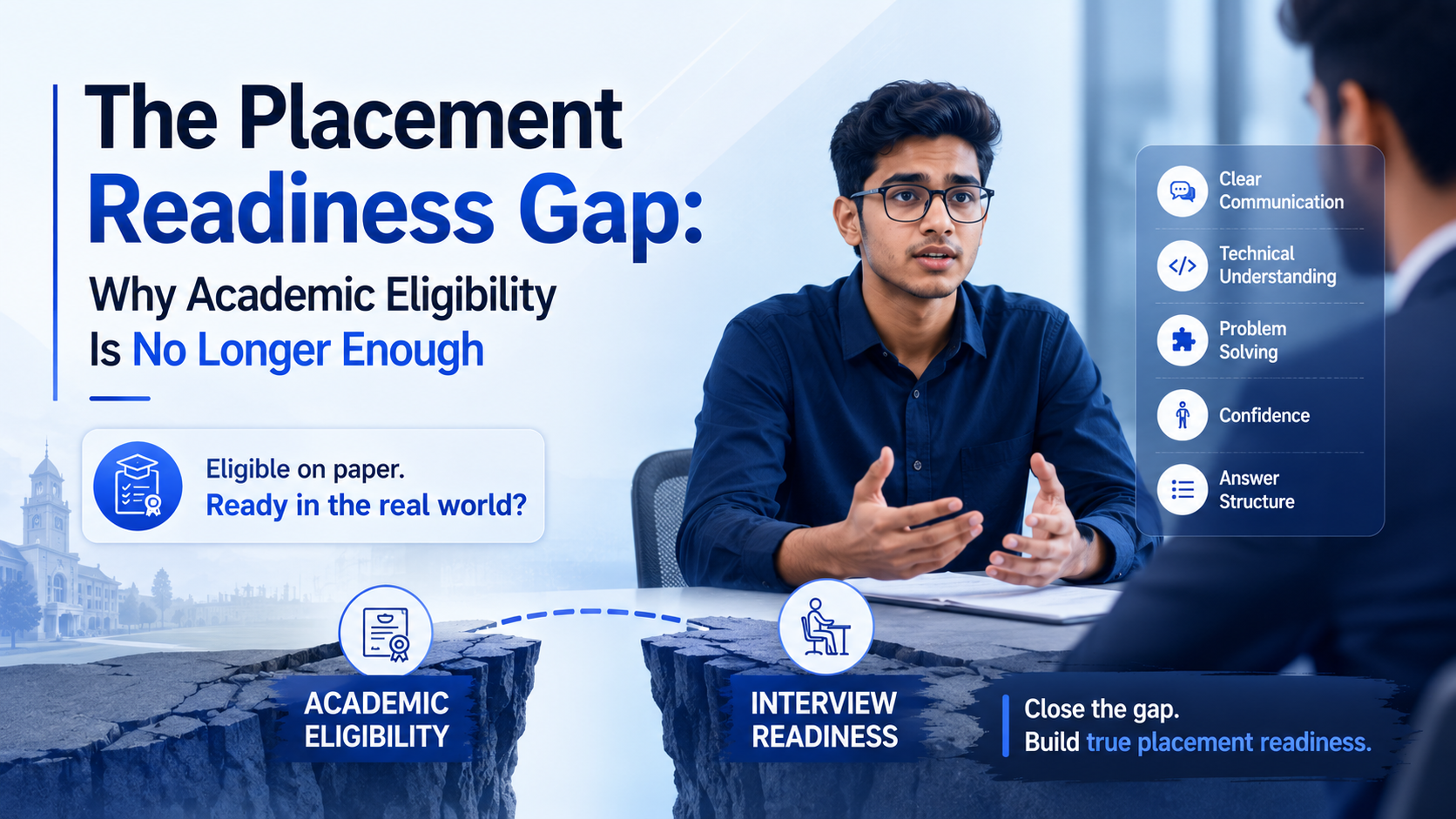
Every placement season, colleges prepare lists of eligible students.
These students have the required CGPA. They have completed the required coursework. They may have submitted resumes, attended training sessions, cleared internal checks, and registered for campus placement drives.
On paper, they are ready.
But when the interview begins, a different reality often appears.
Some students cannot explain their projects clearly. Some know the technical answer but struggle to communicate their thinking. Some become nervous when asked follow-up questions. Some can write code but cannot explain their logic. Some give long, unstructured answers that lose the interviewer’s attention within the first few minutes.
The result is a frustrating gap.
The student was eligible.
But the student was not interview-ready.
This is the placement readiness gap.
For colleges, especially institutions preparing large student batches for campus hiring, this gap is becoming one of the most important employability challenges. Academic eligibility may decide who can sit for placement. Interview readiness decides who can actually perform when the recruiter is evaluating them.
A student may be eligible for placement on paper, but still not be ready for the interview room.
The placement readiness gap is the difference between a student being academically eligible for placement and being able to perform effectively in a real hiring process.
It is not only a knowledge gap.
It is a performance gap.
It includes whether a student can:
This is why two students with similar marks, similar projects, and similar resumes can have very different placement outcomes.
One student may be able to explain, apply, and communicate what they know.
Another student may know the same concepts but fail to present them clearly during the interview.
Colleges often track academic readiness.
Recruiters evaluate interview readiness.
That difference is where many placement outcomes are lost.
In campus placement conversations, the words eligibility, employability, and readiness are often used together. But they do not mean the same thing.
A student can be eligible and still not be employable.
A student can be employable in potential and still not be interview-ready.
A student can know the subject and still fail to communicate it under pressure.
That is why colleges need to look beyond eligibility lists.
A student may be academically ready but not technically ready.
A student may be technically ready but not communication-ready.
A student may be communication-ready but not interview-ready.
This is why placement preparation cannot depend only on marksheets, resumes, training attendance, or one-time mock interviews.
Colleges need a clearer view of who is actually ready for recruiter evaluation.
Academic systems are designed to assess learning.
Interviews are designed to assess application, judgment, communication, and performance under pressure.
A semester exam may test whether a student remembers a concept. A recruiter may test whether the student can apply that concept, explain it, defend it, and adapt when the question changes.
That is a very different environment.
Recruiters often evaluate signals such as:
These signals are difficult to capture through marksheets, resumes, attendance records, or training completion reports.
They become visible only when the student is placed in an interview-like environment.
That is the challenge for placement teams.
By the time these gaps become visible during an actual campus drive, the recruiter has already made a decision.
India’s technology talent market is large, competitive, and changing quickly.
Nasscom’s Strategic Review 2025 reports that India’s technology industry employee base is expected to reach 5.80 million in FY2025E. At the same time, the India Skills Report 2026 reports India’s employability at 56.35%, showing that job readiness remains a major national priority.
For students, this means the opportunity is real.
But the competition is also intense.
For colleges, especially Tier-2 and Tier-3 institutions, the pressure is sharper. Many students are competing in centralized drives, online assessments, virtual interviews, AI-assisted screening workflows, structured scorecards, and standardized hiring processes.
In this environment, small readiness gaps can become major rejection points.
A student who cannot explain a project clearly may lose the interviewer early.
A student who writes code but cannot explain edge cases may appear weaker than they actually are.
A student who answers with memorized lines may not build confidence with the recruiter.
A student who lacks structure may fail even when the underlying knowledge is present.
The problem is not always a lack of talent.
Often, it is a lack of readiness for the format in which talent is evaluated.
Most colleges already invest time and effort in placement preparation.
They conduct aptitude sessions, resume workshops, soft-skill training, coding classes, alumni interactions, and mock interview rounds.
These efforts are useful.
But they often face a scale problem.
A placement team may need to prepare hundreds or thousands of students. Manual mock interviews require interviewer availability, scheduling, coordination, feedback collection, and follow-up. Even when mock interviews happen, the quality of feedback can vary widely.
One interviewer may focus on confidence.
Another may focus on technical depth.
Another may give only generic feedback such as “improve communication” or “prepare better.”
That does not give the student a clear improvement path.
It also does not give the TPO a reliable batch-level view.
The placement team may still not know:
Without this visibility, placement preparation becomes activity-led rather than diagnosis-led.
The college may be doing many things, but still not know what needs to be fixed first.
The next step in placement preparation is not simply more training.
It is a better diagnosis.
Before a college runs another workshop, it should know what its students actually need.
Some students may need help with coding logic.
Some may need help with explaining projects.
Some may need practice with HR and behavioral questions.
Some may need confidence-building.
Some may need role-specific technical preparation.
Some may already be placement-ready and should not spend time in generic remedial sessions.
This is where pre-placement diagnostics become important.
A good placement-readiness diagnostic should answer three questions:
The future of placement preparation should be simple:
Diagnose first.
Train where needed.
Measure improvement.
Then send students into real recruiter conversations with more confidence.
A strong diagnostic should not only ask whether the student knows the answer.
It should evaluate how the student performs in an interview-like situation.
This kind of diagnostic helps both students and placement teams.
Students get specific feedback.
Placement teams get visibility.
The college moves from assumption to evidence.
AI-led mock interviews should not be seen as a replacement for every human interaction.
They are best understood as a scalable readiness layer before human interviews, recruiter interviews, or final placement rounds.
For large student batches, AI-led mock interviews can help in five practical ways.
In a manual model, mock interviews may reach only a limited number of students. AI-led interviews can give every student an opportunity to practice in a structured environment.
A common rubric helps evaluate students across similar parameters. This creates more consistency than scattered, one-time feedback.
Instead of vague comments like “improve communication,” students can receive structured inputs on communication, confidence, technical response, project explanation, and answer quality.
The placement team can see patterns across the batch. For example, many students may be technically sound but weak in explaining projects. Or many may struggle with structured communication.
Once the gaps are visible, colleges can run more focused interventions instead of giving the same training to everyone.
This is the real value of AI-led mock interviews in campus placement.
Not just practice.
Readiness intelligence.
A TPO does not manage one candidate.
A TPO manages a batch.
That changes the problem.
A student wants to know: “How can I improve before my interview?”
A TPO wants to know:
This is why batch-level reporting is so important.
A student-level report helps the learner.
A batch-level report helps the institution.
For colleges, placement readiness has to become measurable before placement outcomes are finalized.
The phrase “mock interview” can sound like a simple practice activity.
But for colleges, the opportunity is much bigger.
A mock interview can become a diagnostic event.
A diagnostic event can become a batch-readiness report.
A batch-readiness report can become a training plan.
A training plan can improve placement preparation.
This is the shift colleges need to make.
From:
“We conducted mock interviews.”
To:
“We know where our students stand before recruiters arrive.”
That is the difference between activity and intelligence.
FloCareer NIVO is designed to help students experience realistic AI-led mock interviews and receive structured feedback on communication, confidence, technical responses, and answer quality.
For students, this means practice before the real interview.
For colleges, it means visibility before placement season.
Through AI-led mock interviews and diagnostic reporting, placement teams can identify readiness gaps across a batch and take action before employer evaluation begins.
The goal is not to promise guaranteed placements.
The goal is to improve preparedness, identify gaps earlier, and help students enter interviews with more structure and confidence.
A college can approach placement readiness in four steps.
Run AI-led mock interviews across a selected batch or student group.
Review student-level feedback and batch-level patterns across communication, confidence, technical depth, coding ability, and project explanation.
Group students by need. Some may need coding support. Some may need communication coaching. Some may need project explanation practice.
Run another diagnostic closer to placement season to track improvement and identify remaining risk areas.
This creates a more measurable placement-readiness process.
It also gives the placement team a stronger story to tell students, parents, management, and recruiters.
For years, placement preparation has often been workshop-led.
But the future will be diagnostic-led.
Colleges that diagnose early will know which students need help before placement outcomes are at stake.
Colleges that rely only on eligibility lists may discover gaps too late.
Academic eligibility will continue to matter.
But it is no longer enough.
The modern hiring process demands more.
Students need to explain, apply, communicate, reason, and perform under pressure.
Colleges need to measure these signals before recruiters do.
That is the placement readiness gap.
And it is time to close it.
___________________________________________________
Is your batch eligible, or truly interview-ready?
FloCareer NIVO can help your placement team run a Free Batch Diagnostic Drive and identify student readiness gaps before recruiters arrive.
Placement readiness is the ability of a student to perform effectively in a real hiring process. It includes technical knowledge, communication, confidence, problem-solving, project explanation, coding ability, and interview behavior.
Academic eligibility usually refers to requirements such as CGPA, attendance, branch, and placement registration. Placement readiness refers to whether the student can actually perform well during recruiter evaluation.
Eligible students may fail interviews because they struggle to communicate clearly, explain projects, handle technical follow-up questions, structure answers, or perform under pressure. The issue is not always knowledge; it is often presentation, confidence, and interview behavior.
Colleges can measure interview readiness through structured mock interviews, AI-led assessments, coding evaluations, communication scoring, student-level feedback, and batch-level diagnostic reports.
AI mock interviews help TPOs scale interview practice across large batches, generate consistent feedback, identify at-risk students, and understand common readiness gaps before placement season.
AI mock interviews should not be seen as a complete replacement for human interviewers. They are best used as a scalable practice and diagnostic layer before human-led interviews, recruiter rounds, or final placement evaluations.
.avif)
.avif)

.svg)

.svg)


%201.svg)
.svg)

.webp)