Every placement team has seen this happen.
A student looks ready on paper.
The CGPA is good. The resume is complete. The project list looks decent. The student attended training sessions, cleared internal checks, and registered for placement.
From the college’s view, the student appears prepared.
But the recruiter rejects the student within a short interview.
Not because the student had no potential.
Not always because the student lacked knowledge.
Often, the rejection happens because the recruiter saw signals that were not visible earlier.
The student could not explain their thinking clearly.
The project explanation lacked depth.
The technical answer sounded memorized.
The student struggled when asked a follow-up question.
The answer was correct in parts, but the communication was unstructured.
The candidate knew something, but could not apply and explain it under pressure.
This is the gap between what colleges can usually see and what recruiters actually evaluate.
Academic performance tells us what students have learned. Interviews reveal whether they can apply and explain it.
Most colleges have access to academic and participation signals.
They can see marks, attendance, branch eligibility, resume completion, project submissions, training attendance, and sometimes assessment scores.
These are important signals.
But they do not show the full picture.
A recruiter evaluates a student in a very different environment. The student is not only expected to know the answer. They are expected to listen, think, explain, adapt, and respond with clarity.
That is why interviews reveal a different layer of readiness.
A student may have a good resume but fail to explain their project.
A student may have completed a coding course but struggle to explain the logic behind a solution.
A student may have attended communication training but still become nervous in a live conversation.
A student may know a concept but fail when the interviewer asks, “Why did you choose this approach?”
These signals do not always appear in classrooms, assignments, or training attendance.
They appear when the student is evaluated like a candidate.
That is the recruiter’s lens.
And that is the lens colleges need before placement day.
Academic systems are designed to assess learning.
Recruiter conversations are designed to assess readiness.
A student’s academic record may answer questions like:
Has the student completed the course?
Has the student passed the exam?
Has the student submitted the project?
Has the student met eligibility criteria?
Has the student attended placement training?
But a recruiter is asking a different set of questions:
Can this student explain their work clearly?
Can they think through a problem in real time?
Can they communicate trade-offs?
Can they handle ambiguity?
Can they respond when challenged?
Can they connect their skills to the role?
Can they learn and work in a professional environment?
This is why academic visibility and recruiter visibility are not the same.
One shows preparation inputs.
The other shows performance signals.
Colleges need both.
Interview rejection is often explained too simply.
Students may think, “I was rejected because I did not know the answer.”
Sometimes that is true.
But very often, the reason is more layered.
Recruiters may reject candidates because the answer lacked clarity, the explanation lacked structure, the candidate could not go deeper, or the communication did not build confidence.
These are the hidden signals that shape interview outcomes.
Recruiters listen for how a candidate thinks.
A student may arrive at an answer, but the interviewer wants to understand the reasoning behind it.
If the student jumps between points, speaks in fragments, or gives an answer without explaining the path, the interviewer may struggle to trust the response.
Clarity of thought is not about speaking perfect English.
It is about making the thinking visible.
For freshers, projects are often the strongest proof of applied learning.
But many students explain projects like resume bullet points.
They mention the technology stack. They mention the project title. They mention the broad objective.
But they do not explain their personal contribution, decisions, challenges, trade-offs, failures, or learning.
Recruiters are not only checking whether the project exists.
They are checking whether the student understood the work.
A prepared answer can help with the first question.
Follow-up questions reveal depth.
When a recruiter asks, “Why did you choose this design?” or “What happens if the data size increases?” or “How would you improve this?” the candidate has to move beyond memorization.
This is where many students struggle.
They can answer what they prepared.
But they cannot handle the conversation when it goes deeper.
Interviews create pressure.
Some students speak too fast. Some become too quiet. Some lose structure. Some repeat the same point. Some fill silence with unnecessary words. Some give long answers that do not answer the question.
Recruiters notice these patterns.
Communication under pressure is a major part of interview readiness.
It is also one of the hardest things to detect without putting the student in an interview-like situation.
In technical interviews, the answer matters.
But the explanation matters too.
A student may solve a coding problem but fail to explain the logic, edge cases, complexity, or debugging approach.
A recruiter wants to understand how the student thinks when building a solution.
That is why coding ability alone may not be enough.
Technical interviews evaluate the thinking behind the answer.
Even at fresher level, recruiters often look for signs of judgment.
Why did the student choose one tool over another?
Why did they design the project in a certain way?
What would they change if given more time?
What did they learn from the problem?
These questions reveal whether the student is only repeating what was done or actually understands the decisions behind the work.
Recruiters also notice confidence.
But confidence does not mean loudness.
It means the student can explain calmly, admit what they do not know, ask clarifying questions, and stay composed when the interview becomes difficult.
A student who panics may appear unprepared even when they have potential.
A student who overstates knowledge may lose credibility.
The best candidates communicate with clarity and humility.
The biggest challenge for colleges is that many of these signals remain hidden until the student sits in an actual interview.
Marksheets do not show whether a student can handle follow-up questions.
Resumes do not show whether a student can explain a project clearly.
Training attendance does not show whether the student can communicate under pressure.
Coding test scores do not always show whether the student can explain the logic.
Aptitude results do not show whether the student can build trust in a conversation.
This is why placement teams often discover the real readiness picture too late.
The student looked ready based on available indicators.
The recruiter saw something else.
That “something else” is the missing visibility layer.
Colleges need a way to see those signals before employers do.
If every interviewer evaluates differently, feedback becomes difficult to use.
One person may focus on communication.
Another may focus on technical depth.
Another may focus on confidence.
Another may only say, “needs improvement.”
This does not help the student enough.
It also does not help the placement team understand the batch.
Structured interview scorecards solve this problem by creating a common evaluation lens.
A strong scorecard should look beyond whether the answer was right or wrong.
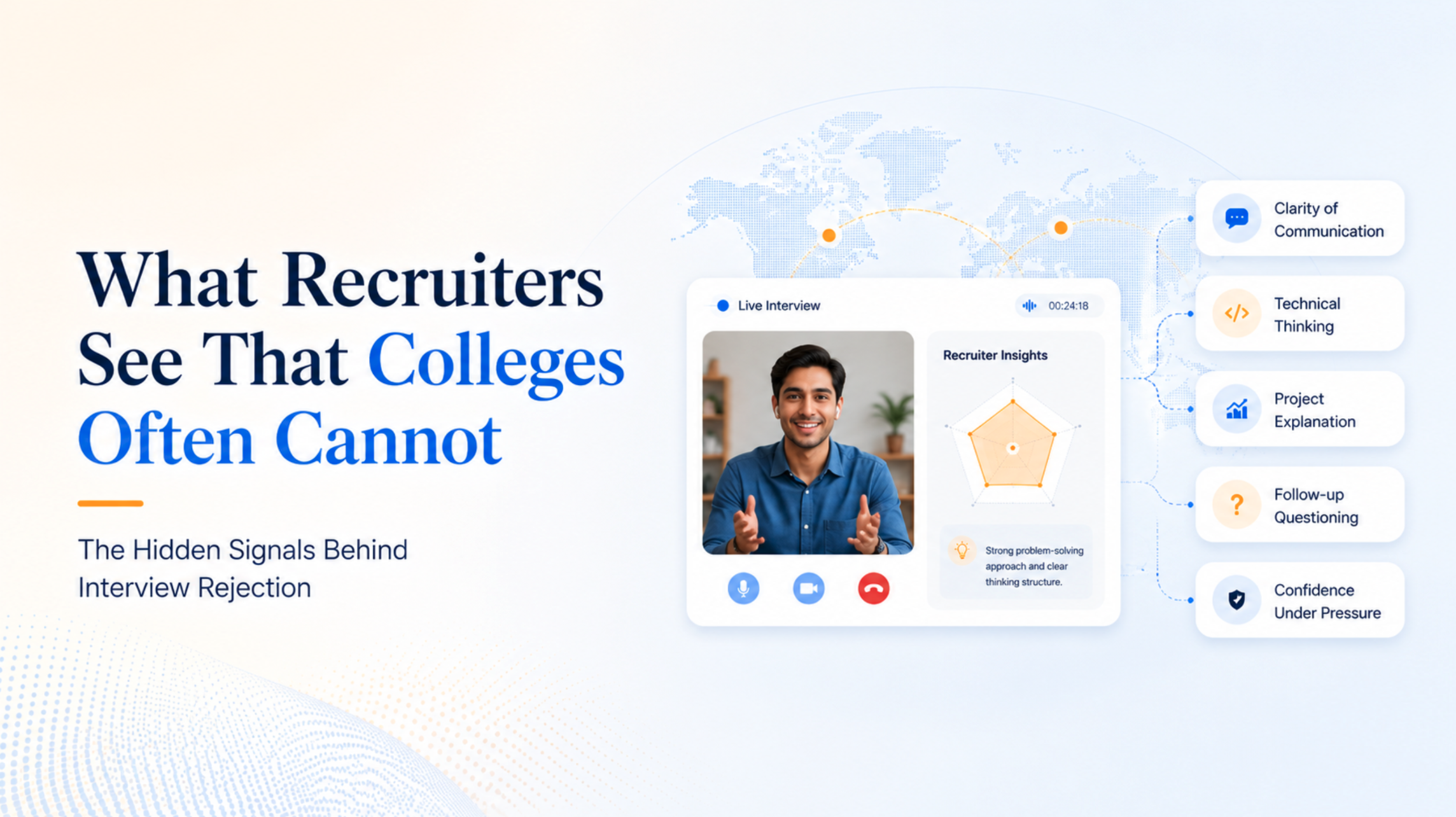
It should evaluate whether the student communicated clearly, structured the answer, showed technical understanding, handled follow-up questions, explained projects, and demonstrated confidence.
This is important for students because they need specific feedback.
It is important for TPOs because they need patterns.
A single student report helps the learner improve.
A batch-level view helps the institution act.
Colleges should not wait for recruiters to reveal interview gaps.
The recruiter lens should enter earlier in the placement preparation process.
This does not mean colleges need to replace their existing training programs.
It means colleges need to add a structured readiness layer before the actual hiring process begins.
Students should experience recruiter-style questions before meeting recruiters.
They should explain projects before the real interview.
They should handle follow-up questions before placement day.
They should receive feedback on communication, confidence, and answer structure before selection outcomes are at stake.
This is where mock interviews become more than practice.
They become early visibility.
And early visibility gives colleges time to act.
A single mock interview helps one student.
But when mock interview data is viewed across a batch, it becomes far more powerful.
Placement teams can start seeing patterns.
Maybe a large number of students can introduce themselves but cannot explain projects clearly.
Maybe students from a certain branch perform well technically but struggle with communication.
Maybe many students know definitions but fail when asked application-based questions.
Maybe coding performance is acceptable, but explanation quality is weak.
Maybe confidence drops when students face follow-up questions.
These insights are difficult to get from normal placement data.
They require interview-like evaluation.
When mock interview analytics are structured well, colleges can move from assumptions to evidence.
Instead of saying, “Our students need more training,” the placement team can say:
“Our students need project explanation practice.”
“Our students need support with technical follow-up questions.”
“Our students need coding explanation practice.”
“Our students need confidence-building before recruiter rounds.”
That is a much more useful starting point.
A TPO is not only responsible for scheduling drives.
A TPO is responsible for improving placement readiness across a batch.
That requires visibility into the signals recruiters care about.
Before a major placement drive, the placement team should ideally know:
Which students can explain their projects clearly?
Which students struggle with follow-up questions?
Which students need communication support?
Which students are technically sound but poor at explaining?
Which students are confident but shallow in technical depth?
Which students are at risk in the first five minutes of an interview?
Which students are ready for specific recruiter conversations?
These questions cannot be answered fully through attendance sheets or resumes.
They require structured interview evaluation.
That is why recruiter-style visibility should become part of campus placement preparation.
FloCareer NIVO helps students experience AI-led mock interviews in a structured, interview-like environment.
For students, this creates a safe space to practice before real employer evaluation.
For colleges, it creates visibility into the same signals recruiters often notice during interviews: communication, confidence, technical response, project explanation, answer structure, and follow-up handling.
This is important because the goal is not only to help students practice.
The goal is to help placement teams understand readiness before placement outcomes are affected.
FloCareer NIVO brings an enterprise-style interview lens into campus preparation by helping colleges identify student-level and batch-level interview gaps earlier.
The objective is not to guarantee selection.
The objective is to make interview readiness visible, measurable, and improvable before recruiter conversations begin.
Colleges already have academic visibility.
They know which students are eligible.
They know which students attended training.
They know which students submitted resumes.
They know which students registered for placement.
The next step is recruiter-style visibility.
That means knowing how students perform when they are asked to explain, apply, reason, communicate, and respond under pressure.
This is the missing layer in many placement readiness programs.
Once this layer becomes visible, colleges can make better decisions.
They can support students earlier.
They can prioritize training better.
They can identify common gaps.
They can prepare students more realistically.
They can approach placement season with more confidence.
Interview rejection often contains useful information.
But by the time rejection happens, the opportunity may already be lost.
That is why colleges need to capture the signal earlier.
If students are struggling with project explanation, discover it before the recruiter asks.
If students cannot handle follow-up questions, discover it in practice.
If students lose structure under pressure, discover it in a mock interview.
If students are technically strong but cannot explain code, discover it before the technical round.
If the batch has a communication gap, discover it before placement season.
Recruiters should not be the first people to reveal these gaps.
The next stage of campus placement preparation will not be based only on more training hours.
It will be based on better visibility.
Colleges will need to know not only who attended training, but who is ready to perform.
Not only who submitted a resume, but who can defend what is written on it.
Not only who knows a concept, but who can explain it clearly.
Not only who wrote code, but who can describe the thinking behind the code.
Not only who is eligible, but who is ready for the conversation that decides the outcome.
This is where recruiter-informed readiness becomes important.
A college that understands recruiter signals early can prepare students better.
A student who receives specific feedback early can improve before the real interview.
A placement team that sees batch-level patterns can act before the placement drive.
That is the shift campus hiring now needs.
Recruiters evaluate more than academic performance. They look at communication, confidence, technical understanding, problem-solving structure, project explanation, follow-up handling, and whether the student can apply what they know in a real conversation.
Students with good marks may still fail interviews if they cannot explain their thinking clearly, communicate under pressure, handle follow-up questions, explain projects, or connect their skills to the role. Academic performance and interview performance are related, but they are not the same.
Recruiter-style visibility means understanding how students perform on the signals recruiters actually evaluate during interviews, such as clarity, confidence, structure, technical explanation, and decision-making under pressure.
Colleges can identify hidden interview gaps through structured mock interviews, AI-led interview practice, common scorecards, student-level feedback, and batch-level readiness analytics.
Mock interviews help placement teams see how students perform in interview-like situations. They can reveal common gaps in communication, project explanation, technical reasoning, confidence, and follow-up handling before the real placement drive.
AI mock interviews can help by providing structured practice, consistent feedback, and visibility into student-level and batch-level readiness signals. They are best used as a scalable preparation layer before human-led interviews or recruiter evaluation.
No. Academic scores are important, but they do not fully show whether a student can perform in a real interview. Colleges also need to assess communication, confidence, problem-solving, project explanation, and technical reasoning under pressure.
Do you know what recruiters will see when your students enter the interview room?
FloCareer NIVO can help your placement team identify hidden interview-readiness gaps before placement day.
Get a batch-level interview readiness report with FloCareer NIVO.
.avif)
.avif)

.svg)

.svg)


%201.svg)
.svg)

.webp)