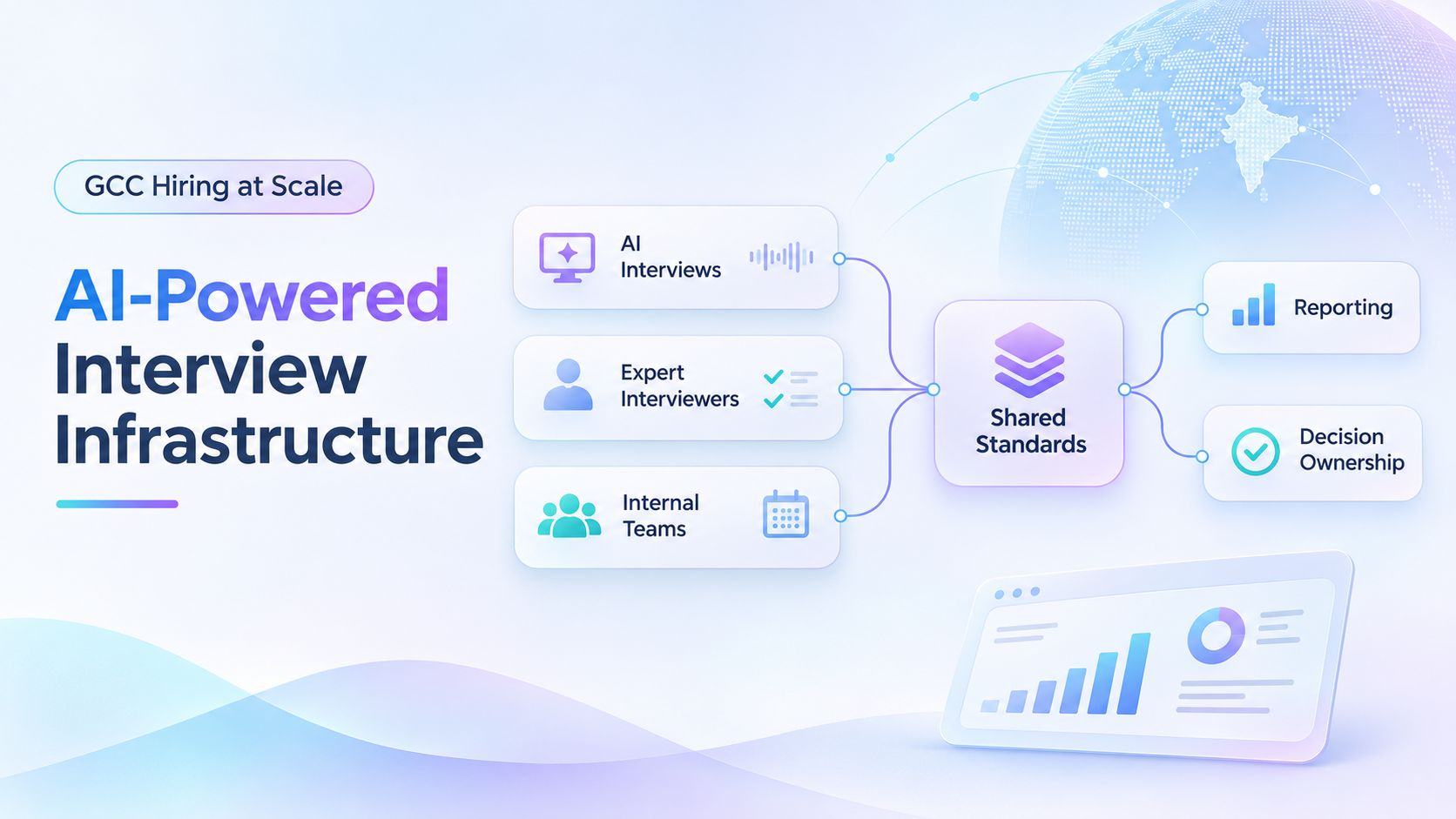
Scaling hiring in a Global Capability Center (GCC) requires more than adding interview slots. As responsibilities expand across engineering and specialized functions, GCCs need qualified interviewers, consistent assessment standards, and clear coordination between local and global teams.
This guide explains how GCCs can organize AI interviews, external expert interviewers, and internal teams into a scalable process while maintaining assessment quality and hiring accountability.
As GCCs take on more specialized responsibilities, interview operations must accommodate different technical requirements, seniority levels, and stakeholders across locations. Three challenges become particularly important.
GCC engineering leaders and headquarters stakeholders may interpret the same role differently. For example, a local interviewer may prioritize coding proficiency for a senior engineering position, while a global hiring manager expects experience in production architecture and independent technical decision-making.
Without agreed expectations, these differences can result in conflicting recommendations, repeated assessments, and delayed decisions.
As GCCs expand into AI, cybersecurity, cloud engineering, and data platforms, they need interviewers capable of evaluating specialized technical skills.
EY's GCC Pulse Survey 2025 reported that 66% of surveyed GCCs faced difficulty attracting niche technology talent.
Assessing these candidates requires experienced specialists who often balance interviewing with delivery responsibilities. Coordinating their availability becomes more difficult when several teams are hiring simultaneously, particularly across time zones.
Candidates may move between local recruiters, technical interviewers, external partners, and global hiring managers. With each handoff, important assessment findings must reach the next reviewer.
For example, a hiring manager may receive a recommendation without knowing which mandatory skills were assessed or which competencies require further evaluation.
Incomplete handoffs can lead to repeated questions, additional reviews, and delays.
These challenges show why GCC hiring requires more than additional interview capacity. The process must also maintain consistent assessments and reliable coordination across stakeholders.
GCC interview infrastructure is the combination of people, assessment criteria, technology, coordination processes, and governance practices used to evaluate candidates across roles, teams, and locations.
It extends beyond interview scheduling or assessment software and includes six components:
Together, these components form an operating model that GCCs can adapt to different hiring requirements rather than a single platform or fixed interview process.
A scalable process starts with clear assessment requirements and defines how interviews will be conducted, reviewed, and coordinated. The following six steps provide a practical framework.
A headcount target alone cannot determine interview needs. Different role families and seniority levels require different competencies and assessment methods.
For each role, identify mandatory and desirable skills, expected proficiency, and the evidence candidates must demonstrate.
For example, backend engineers may require coding and debugging assessments, data engineers may need SQL and pipeline-design evaluations, and engineering leads may need to demonstrate architectural judgment and technical leadership.
Output: A role assessment plan defining competencies, proficiency expectations, and required evidence, agreed upon by talent acquisition and hiring managers.
Headquarters and GCC stakeholders should agree on proficiency expectations, rating criteria, and which competencies each interview round will assess.
Calibration can involve independently reviewing the same sample interview responses, comparing ratings, and resolving differences.
For example, if reviewers disagree on whether a system-design response meets the required standard, they should identify the specific evidence needed to justify the rating.
The U.S. Office of Personnel Management's structured interview guidance supports using job-related competencies and standardized evaluation criteria to improve consistency.
Output: An agreed evaluation rubric and assessment scope for each round.
Different roles require different assessment approaches.
AI interviews may support suitable structured screening and coding evaluations. External expert interviewers can assess specialist technical skills, while internal teams evaluate company-specific requirements and organizational context.
Each stage should contribute evidence relevant to the hiring decision without unnecessarily repeating earlier assessments.
Output: An interview stage plan identifying the competencies, delivery method, and responsible owner for each round.
Estimate interview demand by role and stage, accounting for interviewer expertise, seniority, availability, delivery responsibilities, and time-zone coverage.
For example, a GCC may have enough interviewers overall but insufficient specialists to assess cloud architecture or cybersecurity requirements.
Internal interviewers, external experts, and suitable AI assessments can provide different forms of capacity.
The delivery plan should also cover candidate instructions, scheduling, technical support, rescheduling, and backup arrangements. AI assessments still require candidate support and timely review of results.
Output: An interview delivery plan covering expected demand, qualified capacity, and exception handling.
Assessment reports should help the next reviewer understand what was demonstrated and what remains uncertain.
A useful report should include:
For example, if a data engineering interview covers SQL and pipeline design but not cloud infrastructure, the report should identify cloud infrastructure as not assessed, rather than as a demonstrated weakness.
Numerical ratings from AI and expert-led assessments should not be assumed equivalent without reviewing their criteria and supporting evidence.
Output: A standardized assessment report and handoff process.
GCCs should establish who reviews incomplete assessments, resolves disputed recommendations, and approves changes to evaluation criteria.
Quality reviews should check whether required competencies were assessed and whether ratings and recommendations are supported by evidence.
Responsibilities should also cover candidate accommodations, technical problems, information access, and applicable data retention requirements. Interview-integrity concerns require appropriate review rather than automatic conclusions.
AI platforms and external interviewers may provide recommendations, but the employer retains responsibility for final hiring decisions.
Output: A responsibility and escalation guide covering quality review, exceptions, and decision authority.
These six steps allow GCCs to adapt interview delivery across roles while maintaining a common assessment framework.
A GCC does not need every candidate to complete AI, expert-led, and internal interviews. The appropriate method depends on the competencies being evaluated, the evidence required, and the expertise available.
A hybrid model does not require a fixed interview sequence. AI assessments, expert interviewers, and internal teams should contribute different evidence according to the role.
The employer should review the findings from each stage and retain control over progression and final selection decisions.
Consider a hypothetical India GCC planning to hire 100 technical professionals across three role groups: 60 backend engineers, 25 data engineers, and 15 engineering leads.
Rather than applying the same interview process to every candidate, the GCC could design assessments around the competencies and level of technical judgment each role requires.
Across all three groups, the GCC could apply shared reporting conventions while maintaining role-specific competency criteria. AI assessments, external experts, and internal interviewers would be assigned according to the evidence required, rather than following one mandatory interview sequence.
For example, if a data engineering assessment covers SQL and pipeline design but does not evaluate cloud infrastructure, the report should identify cloud expertise as an outstanding assessment requirement. The next interviewer can then address that gap without repeating the completed evaluation.
The goal is to standardize how interview evidence is documented and reviewed, while allowing assessment methods to differ according to role complexity and hiring requirements.
Interview volume and turnaround speed alone cannot establish whether a GCC's interview process is effective. The model must also produce useful assessments without creating excessive internal workload.
These indicators should be considered together.
For example, faster interviews provide limited value if reports increasingly require corrections. Similarly, external interviewers may reduce engineering interview hours but create additional work if internal managers must extensively revise assessment feedback.
L1-to-L2 conversion and hiring-manager agreement can provide further context, but lower conversion or disagreement does not automatically mean an earlier assessment was incorrect.
Compare similar roles and seniority levels over consistent periods. Review completion rates alongside withdrawals, candidate feedback, and technical problems. Over time, GCCs can also compare assessment findings with relevant post-hire performance evidence.
The objective is to improve speed and capacity while preserving assessment quality and manageable internal effort.
At FloCareer, we support GCC interview operations through two complementary offerings: our AI Interview Platform and Interview-as-a-Service.
Our AI Interview Platform includes NIVO, our conversational AI interviewer, which conducts role-specific screening and coding interviews and generates structured evaluation reports.
Through Interview-as-a-Service we provide expert interviewers matched to technical skills, seniority, and domain requirements, supported by interview scheduling, candidate coordination, and structured feedback.
Cigna Group: We supported Cigna's India GCC hiring requirements through 5,229 expert-led interviews across specialized technology roles.
ParentPay Group: We supported ParentPay's growing India GCC through 657 structured expert-led interviews, involving 168 associated expert interviewers and providing additional assessment capacity for its lean internal team.
These examples reflect our Interview-as-a-Service engagements, not AI interview outcomes.
Our role is to support interview execution and assessment reporting. GCC and headquarters teams continue to define hiring standards, review recommendations, and retain responsibility for final hiring decisions.
Explore our GCC hiring solutions to see how AI-led and expert-led assessments can support different hiring requirements.
Start with a defined interview requirement rather than changing the entire hiring process at once. The goal is to test whether a different delivery approach improves a specific constraint without weakening assessment quality.
Choose a defined requirement and establish the baseline
Select one role family and a specific problem, such as limited technical interviewer availability or inconsistent feedback.
Document current turnaround times, internal workload, assessment criteria, and reporting expectations. Agree on success measures and decision ownership.
Test the selected AI, expert-led, or hybrid approach against the agreed requirements.
For example, a GCC experiencing cloud engineering interview delays could pilot expert-led assessments and compare turnaround, report quality, internal hours, and hiring-manager feedback against its baseline.
Review candidate experience, technical issues, and assessment disagreements during the pilot.
Decide what to adjust before expanding
Determine whether the pilot improved the original constraint while maintaining useful assessment evidence and manageable review effort.
If reports lack sufficient architectural evidence, revise the evaluation criteria before extending the process to additional roles.
Expand, adjust, or discontinue the approach based on the findings.
GCCs can scale interviews by standardizing role-specific competencies, calibrating interviewers against consistent scoring rubrics, and building flexible capacity through trained internal and vetted external interviewers. Regular quality reviews and post-hire performance tracking help ensure that interview volume increases without compromising hiring standards.
GCCs should use AI interviews for high-volume, standardized early-stage screening and expert interviewers for complex technical assessments, senior roles, and nuanced decision-making. A hybrid model combines AI's scalability and consistency with human expertise, while keeping final hiring decisions accountable to people. Both methods should be validated for job relevance, reliability, and fairness.
Yes. A newly established GCC can adopt a hybrid AI-and-expert interview model by starting with a small pilot across a few priority role families. AI screening and vetted external interviewers can provide early capacity while internal teams establish competency frameworks, calibrate assessments, and retain ownership of hiring decisions. The GCC should expand only after validating hiring quality, candidate experience, and early performance outcomes.
Headquarters and the GCC can maintain consistent interview expectations by aligning on role levels, competency frameworks, and shared scoring rubrics. Joint calibration sessions, regular reviews of interview reports, and a documented process for resolving disagreements help ensure candidates are assessed against the same hiring standards across locations. Final decisions should be based on evidence, not differences in interviewer preferences or geography.
The employer retains responsibility for all final hiring decisions. The designated hiring manager or authorized hiring team evaluates interview findings, assessment evidence, and role requirements before deciding whom to hire. AI platforms and external expert interviewers can provide assessments and recommendations, but they do not replace the employer’s decision-making authority.