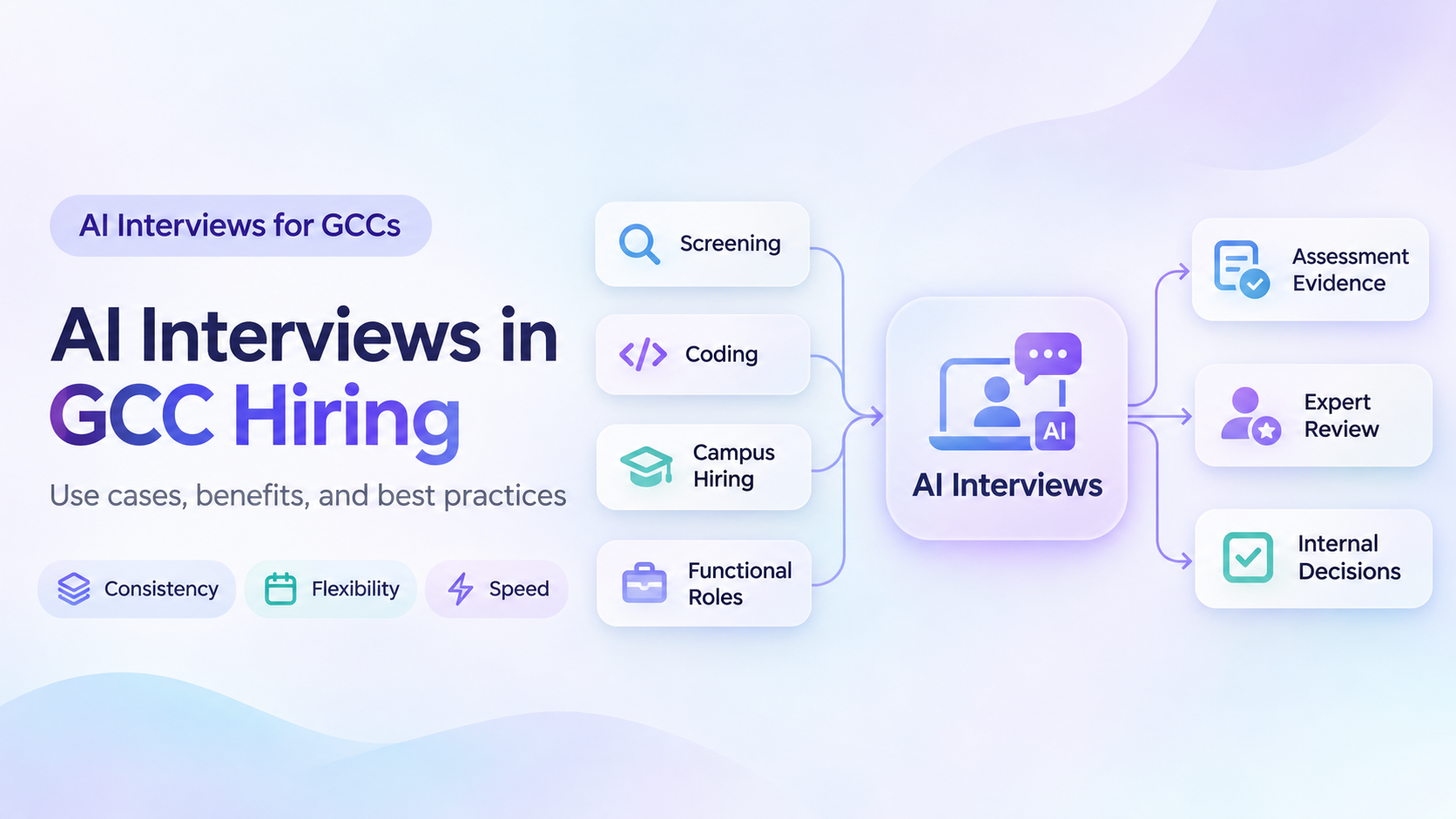
For Global Capability Centers (GCCs), adopting AI interviews starts with identifying which job-related capabilities need to be assessed, what evidence hiring teams should review, and who is responsible for the next decision. A first-stage screening conversation, a coding exercise, and a senior architecture discussion serve different purposes.
This guide explores where AI interviews for GCCs can fit, how to implement and evaluate them, and when expert or internal assessment remains necessary.
In GCC hiring, AI interviewing involves software conducting job-related interviews, collecting candidate responses, and producing assessment outputs for review.
AI interviews can support different stages of GCC hiring, particularly when teams need to assess similar competencies across multiple candidates, locations, or hiring cycles. However, the appropriate use depends on the role, assessment requirements, and evidence needed to make the next hiring decision.
For engineering, data, cloud, QA, cybersecurity, and selected functional roles, AI interviews can help evaluate essential competencies before candidates move to more detailed assessments.
Rather than relying on generic questions or familiarity with technical terminology, these interviews should explore how candidates apply their knowledge through role-specific questions and relevant follow-ups. The responses should provide sufficient evidence of the selected must-have skills, while identifying areas that require further evaluation.
For software engineering and related technical roles, AI coding interviews can assess programming fundamentals, problem-solving, debugging, and code correctness through practical exercises.
Depending on the assessment format, candidates may be asked to write or review code, explain their approach, identify errors, and discuss testing strategies. The resulting code and explanations should allow reviewers to examine what the candidate demonstrated.
The difficulty and tasks should reflect the responsibilities and experience level of the position. Employers should also define whether candidates may use coding assistants or other external resources.
GCCs conducting campus recruitment or hiring large groups of entry-level candidates can use AI interviews to assess technical fundamentals, analytical reasoning, and practical problem-solving.
For candidates with limited professional experience, assessments should focus on foundational knowledge and appropriately scoped tasks rather than expecting familiarity with complex production systems.
This approach may also support repeated hiring programs where candidates are assessed against similar entry-level requirements.
AI interviews may also support initial assessments for functional roles in finance, operations, customer support, and shared services, where particular capabilities can be demonstrated through structured questions or workplace scenarios.
For example, a customer support candidate might be asked to explain how they would resolve a service issue, while a finance candidate might discuss how they would investigate a reporting discrepancy.
The assessment should focus on job-relevant reasoning, decisions, and communication requirements rather than using general confidence, accent, or presentation style as substitutes for competence.
For specialist positions, AI interviews may provide useful initial evidence on a defined subset of technical requirements before candidates proceed to expert-led or internal interviews.
For example, an AI interview might explore programming fundamentals or selected cloud concepts, while a qualified expert evaluates complex system architecture, production trade-offs, or specialist domain knowledge.
The important distinction is whether the interview can meaningfully assess the required capability. Any important requirement that remains untested should be identified for further assessment rather than interpreted as a candidate weakness.
These use cases can also be relevant when GCCs are expanding teams, hiring across multiple cities, recruiting from emerging talent hubs, or coordinating interviews across time zones. Candidate-selected completion windows may reduce some scheduling constraints, but these operational benefits do not make an assessment suitable for every role.
AI interviews do not need to appear at every hiring stage. They are most useful where the required competencies can be assessed through appropriate questions or tasks, the resulting evidence can be reviewed, and responsibility for the next decision is clear.
AI interviews can offer GCC hiring teams greater flexibility, more consistent assessment processes, and reduced dependence on live interview slots. However, these benefits depend on whether the interview is suitable for the role, produces reliable evidence, and fits into the existing hiring process.
Rather than assuming improvements, GCCs should evaluate the following outcomes:
The value of AI interviews should be assessed across the hiring process, not simply through the number of interviews completed or the time saved during screening. For example, a faster assessment offers limited operational value if hiring managers must spend substantial time correcting reports or reassessing competencies that were not adequately covered.
For a deeper discussion of interviewer capacity and workload, see our guide to measuring internal interview effort in GCC hiring.
AI interviews can assess selected job-related competencies, but not every capability can be meaningfully evaluated through the same interview format. GCCs should involve expert or internal interviewers when an assessment requires deeper technical investigation, organization-specific judgment, or clarification of incomplete or conflicting evidence.
Expert-led interviews can help validate capabilities that require specialized knowledge or deeper technical discussion. For example, a qualified expert may be better suited to assess complex system architecture, production troubleshooting, cybersecurity scenarios, or specialist enterprise technologies.
Expert assessment may also be appropriate when an AI interview identifies a potential skill gap but the available responses do not provide enough evidence to reach a reliable conclusion.
The decision should depend on the competency being assessed, not simply the candidate's seniority. A mid-level specialist role may require expert evaluation, while selected competencies for a senior role may still be suitable for AI assessment.
Internal GCC interviewers are particularly valuable when assessing how candidates would operate within the organization's systems, engineering standards, business priorities, and stakeholder environment.
For example, an AI interview might establish a candidate's understanding of cloud architecture, while an internal engineering leader evaluates how that knowledge applies to the company's existing infrastructure and technical constraints.
Internal hiring teams should also review unresolved assessment concerns and retain responsibility for final hiring decisions.
Avoiding unnecessary reassessment
Not every candidate needs AI, expert-led, and internal interviews. The next assessment should address what remains uncertain rather than repeat competencies already supported by credible evidence.
Importantly, an unassessed competency should be recorded as missing evidence, not treated as poor candidate performance. Technical failures or accessibility barriers may also require review, an alternative format, or reassessment before a decision is made.
Implementing AI interviews in a Global Capability Center starts with defining what the assessment needs to accomplish, rather than introducing AI across every hiring stage. This approach should also align with the GCC's broader interview operating model.
Start with one role, experience level, and interview stage where AI assessment could provide meaningful evidence.
For example, a GCC hiring mid-level Java backend engineers might use AI interviews to assess Java fundamentals, API development, and problem-solving before candidates proceed to deeper technical discussions.
Before configuring the interview, the hiring team should establish:
Starting with a defined scope makes it easier to determine whether the assessment is suitable before extending it to other roles.
AI interview questions should reflect the actual responsibilities of the role, rather than relying on generic technical or behavioral questions.
For technical positions, this may involve coding exercises, debugging tasks, or questions requiring candidates to explain implementation decisions. Functional roles may benefit from practical workplace scenarios.
Hiring teams should define the expected difficulty, acceptable alternative solutions, scoring criteria, and permitted resources, including whether candidates may use AI coding assistants.
Adaptive follow-up questions should clarify reasoning or explore relevant competencies without unintentionally changing the assessment standard between candidates.
The assessment should also distinguish between incorrect responses, answers given after guidance, and competencies for which insufficient evidence was collected.
Before using AI interviews at scale, relevant technical or functional experts should review sample questions, candidate responses, and assessment outputs.
Calibration should establish whether:
Where qualified reviewers disagree with an AI-generated assessment, teams should examine the underlying evidence and scoring rubric rather than automatically accepting either judgment.
Calibration helps identify assessment problems, although agreement between reviewers alone does not establish that the assessment predicts job performance.
Candidates should understand the interview format and expectations before beginning.
Instructions should explain that an AI interviewer will conduct the assessment, the expected duration, completion window, technical requirements, and whether external resources or assistance are permitted.
Candidates should also know what information will be recorded, where to find the relevant data-use notice, how to request technical support or an appropriate accommodation, and what happens after completing the interview.
If an interview is interrupted by technical problems, the hiring process should provide a clear recovery or reassessment procedure rather than treating the interruption as poor candidate performance.
An AI interview report should help hiring teams understand what the candidate demonstrated, not simply provide an overall score.
Depending on the assessment, useful reporting information may include:
Hiring teams should also establish who reviews reports, how material inaccuracies can be corrected, and when findings require escalation.
These are recommended evaluation requirements; the availability of specific reporting features should be confirmed with the provider.
The final step is defining how AI interview results fit into the GCC's existing recruitment workflow.
Teams should determine where reports will be accessible, who reviews them, how candidate status is updated, and how relevant findings are shared with subsequent interviewers.
For example, a candidate who demonstrates sufficient evidence of the required programming skills may proceed directly to an internal engineering discussion. Another candidate may need a targeted expert interview if a critical technical requirement remains unassessed.
This approach avoids unnecessary interview rounds while ensuring unresolved competencies receive appropriate attention.
Before rollout, GCCs should also verify any required applicant tracking system integrations, access permissions, and workflow capabilities rather than assuming they are available by default.
The objective is not to automate every hiring decision, but to establish a process in which AI-generated evidence supports appropriate assessment, review, and candidate progression.
Illustrative example only. This is not an actual customer assessment or FloCareer product report.
Consider a GCC hiring a mid-level backend engineer. The team wants to assess debugging, SQL reasoning, and testing before candidates move to a deeper technical interview.
An AI interview is configured with a small API debugging exercise and a SQL query discussion. Follow-up questions explore the candidate's reasoning, approach to identifying problems, and understanding of test cases.
The assessment produces the following illustrative evidence:
Rather than relying on a single overall rating, the reviewer should consider which competencies were demonstrated independently, which required clarification, and which remain unassessed.
For example, the candidate's debugging and SQL responses may provide sufficient evidence for those requirements. However, testing proficiency may need closer review, while production troubleshooting should be addressed in a subsequent technical discussion if it is essential to the role.
The next interviewer can then focus on these remaining questions instead of repeating the entire assessment.
This is where AI interview reports become useful: they connect observed candidate performance with a specific, evidence-based next step, while leaving the hiring decision with the employer.
GCCs should evaluate an AI interview pilot by determining whether it produces reliable, job-relevant assessment evidence while improving hiring efficiency and maintaining a fair, accessible candidate experience.
Start with a defined role, experience level, and interview stage. Before launching the pilot, establish a baseline for the existing process and agree on what successful results would look like. This allows hiring teams to evaluate actual improvements rather than relying on the number of interviews completed.
What should GCCs measure?
Qualified reviewers should examine a sample of interview responses and reports, including candidates who progressed and those who did not. They should investigate significant scoring disagreements, missing technical evidence, and cases where subsequent interviews reveal gaps in the initial assessment.
Human agreement alone does not establish that an assessment is valid. Similarly, higher candidate progression rates or faster screening do not necessarily indicate better hiring decisions.
The pilot should also test the interview under conditions relevant to its intended use, including supported languages, accessibility requirements, technical reliability, and human review procedures.
Based on the findings, GCCs can decide whether to:
Evaluation should continue after rollout, particularly when job requirements, scoring rubrics, or interview configurations change.
FloCareer supports GCC hiring through an AI-First, Expert-Backed interview model, allowing organizations to choose an assessment approach based on the role, competencies, and level of technical evaluation required.
Through FloCareer's AI Interview Platform, NIVO, its conversational AI interviewer, conducts role-specific screening and coding interviews and generates structured assessment reports for hiring teams to review.
NIVO's assessment reports can include interview transcripts, recordings, skill-level ratings, and evaluation summaries, providing evidence for further review.
GCCs can use these approaches independently or in combination, depending on their hiring requirements. Internal hiring teams retain responsibility for interpreting assessment evidence and making final hiring decisions.
The appropriate starting point is a defined role and assessment need—not a fixed sequence of AI and human interviews.
AI interviews work best when GCCs start with a clearly defined role, interview stage, and set of job-related competencies. The objective is not to automate every assessment, but to collect reliable evidence, improve hiring workflows, and involve qualified interviewers where deeper evaluation is needed.
Exploring AI interviews for your GCC? Discuss your target roles, assessment requirements, and review process with FloCareer to identify a suitable AI Screening or AI Coding use case.
Yes. GCCs can use AI interviews for role-specific technical screening, coding exercises, debugging, and problem-solving assessments. Suitability depends on the role, experience level, assessment format, and whether the interview produces sufficient evidence of the required technical competencies.
No. Automated resume screening evaluates information candidates have already submitted, such as qualifications, experience, and skills. AI interviews collect additional evidence through candidate responses, technical questions, or practical tasks, helping hiring teams assess capabilities beyond what appears on a resume.
Yes. Asynchronous refers to when candidates complete the interview, not necessarily how the interaction works. Some AI interview platforms support live, conversational exchanges with adaptive follow-up questions, even when candidates complete interviews independently without a human interviewer attending.
Hiring teams should examine the scoring rubric alongside candidate responses, coding submissions, and supporting assessment evidence. Reviewing sample reports with qualified evaluators can help identify scoring inconsistencies, unsupported conclusions, or missing competencies. Significant disagreements should be investigated rather than accepting either assessment automatically.
Expert interviewers may be needed when AI interviews leave important competencies unassessed, produce inconclusive findings, or cannot adequately evaluate specialist technical knowledge. Deeper architecture discussions, complex troubleshooting, and contextual decision-making may also require qualified expert or internal interviewers.
AI interviews may include integrity controls such as identity verification, activity monitoring, or assessment proctoring, depending on the platform. However, these controls cannot guarantee that cheating will be prevented or detected. Suspicious indicators require appropriate review and should not automatically establish misconduct. Learn more about interview proctoring and integrity review.