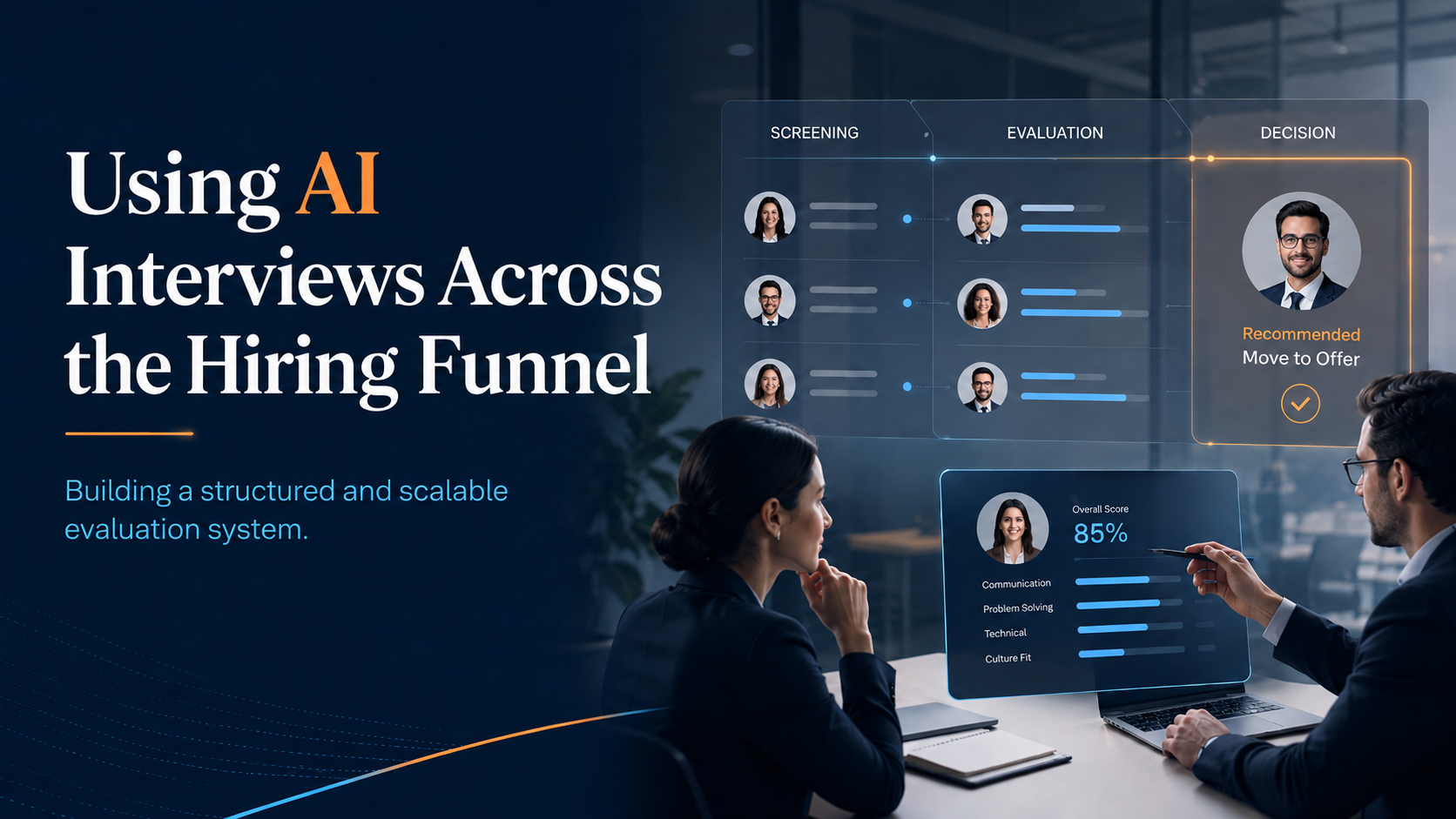
Hiring funnels often look structured on paper. Candidates move from screening to first-round interviews, technical or functional evaluations, hiring manager discussions, and final decision-making. But in practice, many hiring funnels still break down because every stage is not always evaluating candidates with the same level of consistency.
Different recruiters, hiring managers, and interview panels may use different criteria. One stage may focus on communication, another on experience, another on technical skills, and another on overall fit. When these signals are not connected, candidate progression depends more on fragmented opinions than structured evidence.
This is why AI interviews are often misunderstood when they are viewed only as a screening tool. Their real value increases when they are used across the hiring funnel as a connected evaluation system, not just as a point solution at one stage.
A hiring funnel becomes inefficient when evaluation standards change from stage to stage and candidate progression depends on disconnected decisions. AI interviews help enterprises bring more structure, consistency, and evidence into each stage of evaluation while keeping human teams responsible for judgment, alignment, and final hiring decisions.
For enterprise hiring teams, the question is not only “Should we use AI interviews?” The better question is: “Where should AI interviews fit across the hiring funnel so every stage improves decision quality?”
Many organizations assume that more interview rounds will automatically lead to better hiring decisions. More conversations should mean more information, and more information should reduce hiring risk.
But longer hiring funnels do not always create better hiring outcomes.
The problem is not usually the number of interviews. The problem is how candidates move from one stage to the next. When each interview stage operates independently, hiring teams collect separate opinions instead of building one connected view of the candidate.
Screening may confirm basic fit. A technical round may test functional skills. A hiring manager round may focus on experience. A final round may evaluate confidence or alignment. But if these stages are not connected by shared criteria, the funnel becomes longer without becoming stronger.
A hiring funnel is only as strong as the consistency of evaluation across its stages.
This breakdown usually happens in three ways.
First, more stages do not automatically create better hiring. If each stage is not designed to assess a different decision signal, interviews start to overlap. Candidates answer similar questions repeatedly, while important competencies may still remain unevaluated.
Second, candidate progression often depends on fragmented signals. Recruiters, interviewers, and managers may all evaluate candidates differently. Without common rubrics or structured feedback, movement through the funnel becomes subjective.
Third, funnel design matters more than funnel length. A strong hiring process is not defined by how many rounds it has. It is defined by whether every stage adds useful evidence toward the final hiring decision.
A strong hiring funnel does not simply reduce candidates. It increases confidence at every decision point.
To do that, every stage must have a clear purpose. Screening should not try to do the job of technical evaluation. Technical evaluation should not repeat basic qualification checks. Final rounds should not restart the assessment from the beginning.
A well-designed hiring funnel needs:
This is especially important for enterprise hiring, where multiple recruiters, interviewers, locations, and business units may be involved. Without a consistent evaluation framework, hiring quality can vary from team to team.
AI interviews help by making each stage more structured. They can standardize first-round evaluation, capture role-specific signals, create comparable scorecards, and give later-stage interviewers better context.
The goal is not to make every interview identical. The goal is to ensure every candidate is evaluated against the same expectations for the same role.
That is what turns the hiring funnel from a sequence of disconnected interviews into a connected evaluation system.
AI interviews are most valuable when each stage is designed to assess a specific decision signal within the hiring funnel.
They should not be inserted randomly into the process. They should be mapped to the purpose of each stage.
At the screening stage, AI interviews help evaluate baseline qualification, communication, role understanding, and minimum fit. This gives recruiters a structured first layer of evidence before candidates move deeper into the funnel.
At the early evaluation stage, AI interviews can assess reasoning, problem-solving, communication quality, motivation, and role awareness. This helps hiring teams understand whether the candidate should move into deeper evaluation.
At the technical or functional evaluation stage, AI interviews can support role-specific assessment. For technical roles, this may include coding, debugging, architecture, or problem-solving. For business roles, it may include scenario-based evaluation for sales, customer support, operations, finance, or HR.
At the final-round stage, AI interviews help consolidate evidence. Instead of relying only on scattered notes, hiring teams can review structured feedback, scorecards, transcripts, strengths, and gaps.
Across all stages, AI interviews should support better decisions, not replace decision-makers. Recruiters, hiring managers, and interview panels still own context, nuance, stakeholder alignment, and final hiring decisions.
At the top of the funnel, AI interviews improve progression quality by turning screening into structured evaluation.
Traditional screening often depends on resumes, recruiter availability, and individual judgment. As a result, two candidates applying for the same role may be evaluated differently before they even enter the formal interview process.
AI screening interviews create a more consistent first interaction. Every candidate can be evaluated against the same role-relevant questions, competencies, and scoring expectations. This gives recruiters a clearer view of communication skills, motivation, role understanding, and baseline qualification.
The value is not only in filtering candidates faster. The bigger value is improving who moves forward.
When early-stage evaluation is structured, weak candidate progression reduces, shortlist quality improves, and later interviewers spend more time with candidates who have already demonstrated basic fit.
This section should not become a full screening explainer. The deeper explanation should sit in the dedicated AI Screening Interview blog. Here, the main point is that screening should create the first structured evidence layer for the rest of the funnel.
In the middle of the hiring funnel, the focus shifts from eligibility to capability.
By this stage, hiring teams are no longer asking only whether the candidate should move forward. They are asking whether the candidate can perform the work.
This is where AI interviews help teams assess role-specific capability with more structure and consistency.
For developer hiring, AI interviews may support coding questions, debugging exercises, system design prompts, or technical problem-solving. For non-technical roles, they may support scenario-based evaluation for communication, customer handling, business judgment, operational decision-making, or role-specific reasoning.
The advantage is consistency. Every candidate can be assessed against the same role requirements, while still allowing the assessment to reflect the actual responsibilities of the role.
This also improves handoffs. If screening has already validated baseline fit, the technical or functional round does not need to repeat basic questions. It can focus on deeper capability. The structured outputs from this stage can then guide hiring managers and final-round interviewers.
At the bottom of the funnel, AI interviews help improve comparability and confidence between strong finalists.
Final-round hiring decisions are often difficult because most remaining candidates are already qualified. At this stage, hiring teams are not just looking for basic capability. They are comparing strengths, gaps, consistency, role alignment, and long-term fit.
Without structured evidence, final discussions can become subjective. One interviewer may remember a strong answer. Another may focus on a concern. A hiring manager may rely on overall impression. The final decision can become a debate between individual opinions rather than a review of accumulated evidence.
AI interviews support this stage by organizing structured feedback from earlier rounds. Interview summaries, competency scores, transcripts, strengths, improvement areas, and recommended follow-up questions can give hiring teams a clearer view of each finalist.
This does not mean AI should make the final decision. Final decisions require human judgment, business context, team fit, stakeholder alignment, and organizational priorities.
An AI-enabled hiring funnel is not a process where AI replaces recruiters, interviewers, or hiring managers. It is a connected evaluation workflow where AI supports structure at the right stages and humans focus on judgment where it matters most.
Here is what that can look like in practice.
Before using AI interviews, hiring teams need to define what each stage is supposed to assess.
Screening may evaluate baseline qualification and role fit. Early evaluation may assess communication, reasoning, and motivation. Technical or functional assessment may validate job-specific capability. Final rounds may focus on alignment, judgment, collaboration, and decision confidence.
Without this clarity, AI interviews may simply automate an already unclear process.
At the top of the funnel, AI interviews can help create consistent first-round evaluation. Candidates answer role-relevant questions, and recruiters receive structured insights instead of relying only on resumes or informal calls.
This improves early progression because candidates move forward based on demonstrated signals, not only profile strength.
Once candidates pass initial screening, AI interviews can support deeper role-based evaluation.
For technical roles, this may include coding or problem-solving. For business roles, this may include practical scenarios that test decision-making, communication, or functional judgment.
The goal is to evaluate whether the candidate can perform the work, not just whether they look suitable on paper.
As candidates move closer to final stages, AI-generated summaries, scorecards, and structured feedback help hiring teams compare candidates more consistently.
Instead of reviewing scattered notes, stakeholders can discuss the same evidence base.
The final decision should remain human-led.
AI interviews improve the quality of evidence available to recruiters, hiring managers, and interview panels. Human teams then apply business context, role nuance, team fit, compensation considerations, and long-term judgment.
AI interviews improve hiring funnels by creating structure at each stage while allowing human teams to focus on deeper judgment and final decisions.
Enterprises see maximum impact when AI interviews are used to improve the quality of progression across the full hiring funnel.
The value is not limited to one stage. A connected evaluation system improves how candidates move from screening to assessment to final decision.
The most important impact areas are:
For enterprise teams hiring across locations, roles, or business units, this consistency becomes especially valuable. It helps create common evaluation standards without forcing every role into the same interview format.
This section should stay focused on funnel-level impact. Topics such as high-volume hiring, global hiring, campus hiring, or remote hiring should be handled through dedicated internal links where needed.
A connected evaluation system improves not just one stage of hiring, but the quality of progression across the entire funnel.
AI interviews create the most value when they are mapped to stage-specific decisions, not inserted randomly into the process.
Three mistakes are especially common.
Many teams use AI only for screening and then continue with disconnected evaluation for the rest of the funnel. This limits the value of AI interviews because the later stages still rely on fragmented feedback.
AI becomes more valuable when structured evidence continues across the funnel.
Every hiring stage should assess something different.
If screening, technical evaluation, and final rounds all evaluate the same signals, the process becomes repetitive. Candidates repeat answers, interviewers duplicate effort, and decision quality does not improve.
AI interviews should be designed around the purpose of each stage.
AI works best when hiring teams know what each stage should prove.
Without clear progression criteria, AI may generate more data but not better decisions. Enterprises should define role competencies, scoring expectations, and stage-specific decision rules before scaling AI interviews.
The biggest mistake is expecting AI to fix a hiring funnel that has not been properly designed. AI strengthens structure; it does not replace the need for structured hiring design.
AI interviews make the most sense when hiring involves multiple stages, multiple stakeholders, or high candidate volume.
They are especially useful when screening, technical evaluation, and final decision-making feel disconnected. They also help when recruiters and interviewers spend too much time repeating evaluations that could be structured earlier in the process.
AI interviews are useful when:
However, teams should be careful when the hiring process is very small, informal, or poorly defined. AI interviews are also not the right answer when organizations expect AI to replace human decision-making entirely.
The best use case is a hybrid hiring funnel: AI supports structured evaluation, and human teams handle nuance, relationships, alignment, and final decisions.
The success of AI interviews should not be measured only by how many interviews are automated.
The better question is whether the hiring funnel becomes more consistent, efficient, and reliable.
Enterprise teams should measure:
These metrics help teams understand whether AI interviews are improving the funnel as a system, not just speeding up one step.
A faster process is only valuable if candidate quality and decision confidence also improve.
Also read:
Candidate experience in AI Interviews.
Fragmented hiring processes weaken decision quality because every stage operates independently.
Recruiters conduct one evaluation. Technical interviewers conduct another. Hiring managers form their own view. Final decision-makers may rely on scattered notes and subjective impressions.
By the time the candidate reaches the final round, the hiring team may have more interviews but not necessarily a clearer decision.
AI interviews help connect evaluation across the funnel.
Structured screening results can inform technical evaluation. Technical assessment outputs can guide hiring manager conversations. Final interviewers can review accumulated evidence instead of starting from zero.
This creates a more continuous hiring process where each stage builds on the previous one.
The difference is important.
A fragmented hiring process collects separate opinions.
A structured AI-enabled hiring funnel builds a connected evidence base.
This does not remove the role of interviewers. It helps interviewers use their time better. Instead of repeating basic questions, they can validate deeper concerns, explore role-specific scenarios, and apply human judgment where it matters most.
AI interviews support system design, not just stage automation. Their strongest value is helping enterprises move from disconnected hiring activity to connected hiring evaluation.
Hiring funnels need consistency across stages, not just more rounds.
AI interviews are most effective when they are mapped to stage-specific decisions across screening, early evaluation, technical or functional assessment, and final-round comparison.
A connected evaluation system improves progression quality, shortlist quality, interviewer efficiency, and final decision confidence.
AI should not replace recruiters, hiring managers, or interview panels. It should give them better structure, clearer evidence, and more consistent evaluation data.
For enterprises, the real opportunity is not simply to automate interviews. It is to build a hiring funnel where every stage has a purpose, every candidate is evaluated more consistently, and every final decision is supported by structured evidence.
That is where AI interviews create the greatest value across the hiring funnel.
.avif)
.avif)


.svg)

.svg)


%201.svg)
.svg)

.webp)